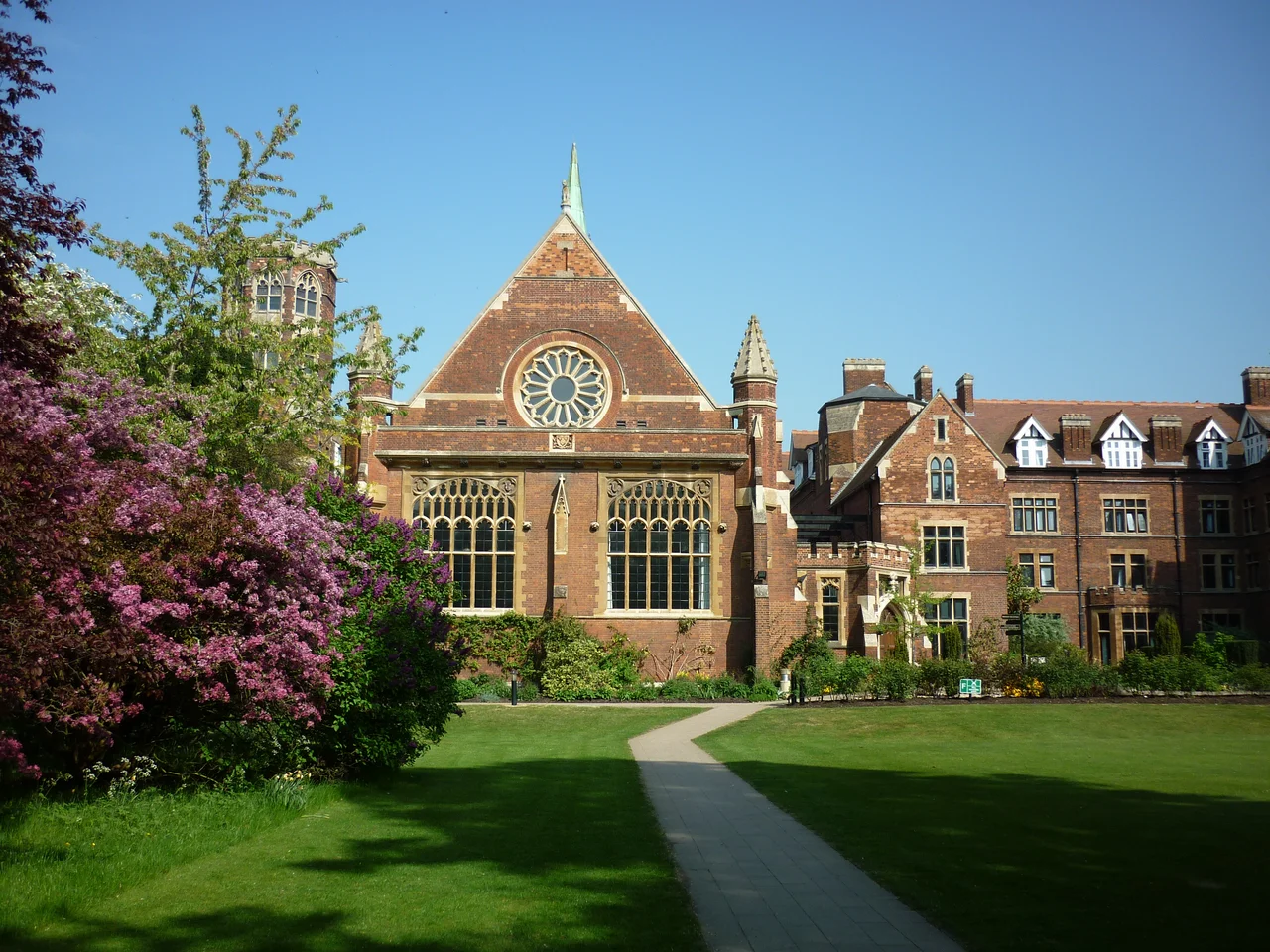

Homerton College, Cambridge
In 1695, Calvinist ministers in London pooled their money to educate young men who were legally barred from attending Oxford and Cambridge. Non-conformists couldn't study at the ancient universities — the law said so plainly — so they built their own alternative, meeting first in a pub at the Royal Exchange and eventually purchasing premises in Homerton, a neighbourhood of London's East End. Three centuries later, that same institution sits in Cambridge as its largest college, with more students than any other. The journey from dissent to establishment is one of the stranger stories in English education.
Dissenters and Abolitionists
The King's Head Society, named for the pub where it held its meetings, formally organised in 1730 to fund young men at dissenting academies — institutions that taught philosophy, science, and modern history at a time when Oxford and Cambridge taught little else but theology and classical languages. By the early 19th century, Homerton College had become closely associated with the movements opposed to the slave trade and the Corn Laws. Its students and alumni were among the most prominent dissenting figures of their era. Samuel Morley, a manufacturer, philanthropist, and abolitionist who later served as the college's treasurer, exemplifies the institution's orientation: practical, reformist, and deeply engaged with the social questions of the day. The college began admitting women students shortly after 1852, though Principal John Horobin ended that experiment in 1896, following the move to Cambridge.
Disease, Football, and a Move North
By the 1880s, the growth of industry had transformed the village of Homerton into a manufacturing district. Students were dying. Between 1878 and 1885, seven students died from tuberculosis, smallpox, and typhoid. Space was desperately short. In 1881, former Homerton students who played for Glyn Cricket Club formed a football section to keep fit during winter — that section grew and eventually became Leyton Orient Football Club, a connection the college still marks with an annual match. In 1894, an opportunity arose: Cavendish College, Cambridge, founded to allow poorer students to take Cambridge exams without joining a full college, had run out of money. The Congregational Board of Education bought the entire estate for £10,000. Students and staff packed up and moved from Hackney to Cambridge, and Homerton College took up residence in its Gothic Revival buildings on Hills Road.
A Victorian Hall and Wild Orchids
The Great Hall, built in 1889, was the largest college hall in Cambridge when it was completed. It houses a Pre-Raphaelite painting by Jane Benham Hay, 'The Florentine Procession,' painted in the 1860s and winner of 'Picture of the Year' in the 1867 Saturday Review. The hall's hammer-beam roof, American walnut panelling, and rose windows were selected as one of architect Rowan Moore's five best buildings of 2022. The college grounds contain over 150 species of plants, including several rare wild orchids, and provide habitat for grey squirrels, woodpeckers, carrion crows, and a small summer colony of swifts returning from Africa. There is also a large orchard. Homerton has more green space than most Cambridge colleges — perhaps a legacy of the years spent in an overcrowded city.
The Long Road to Full Membership
Homerton was not easily accepted by Cambridge. It took until 1976 for the university's Regent House to vote — narrowly, 3–1 — to admit Homerton as an Approved Society. Full college status came only in 2010, with a Royal Charter. The college was all-female for 80 years after 1896. Its gown — designed for female undergraduates in the early 20th century, with the sleeve slits sewn closed — is still worn by all students regardless of gender, a quiet acknowledgment of the college's history. Among its alumni: Olivia Colman, who matriculated but did not graduate, and Dame Carol Ann Duffy, the Poet Laureate from 2009 to 2019. The Horn used at Matriculation Dinner — an African cow horn with silver mounts, passed from student to student with Anglo-Saxon toasts — has been quietly adapted for hygiene reasons, but the phrase 'Wassail' still echoes in the hall.
From the Air
Homerton College is located in Cambridge at approximately 52.186°N, 0.136°E, south of the city centre near Hills Road. From the air, its Victorian Gothic buildings and extensive green grounds are visible. Cambridge City Airport (EGSC) lies approximately 2 nautical miles to the northeast. The college is best seen at 1,000–1,500 feet in clear conditions. The Great Hall's distinctive roofline and the orchard at the college's south end can be identified from altitude.
Nearby Stories
- Kentwell Hall 2.5 km away
- Thetford Hoard 2.8 km away
- King's Ely 6 km away
- Bedford 7.8 km away
- White House Farm murders 13 km away
- Oundle 14 km away
- Hemel Hempstead 14 km away
- North Weald Airfield 15 km away