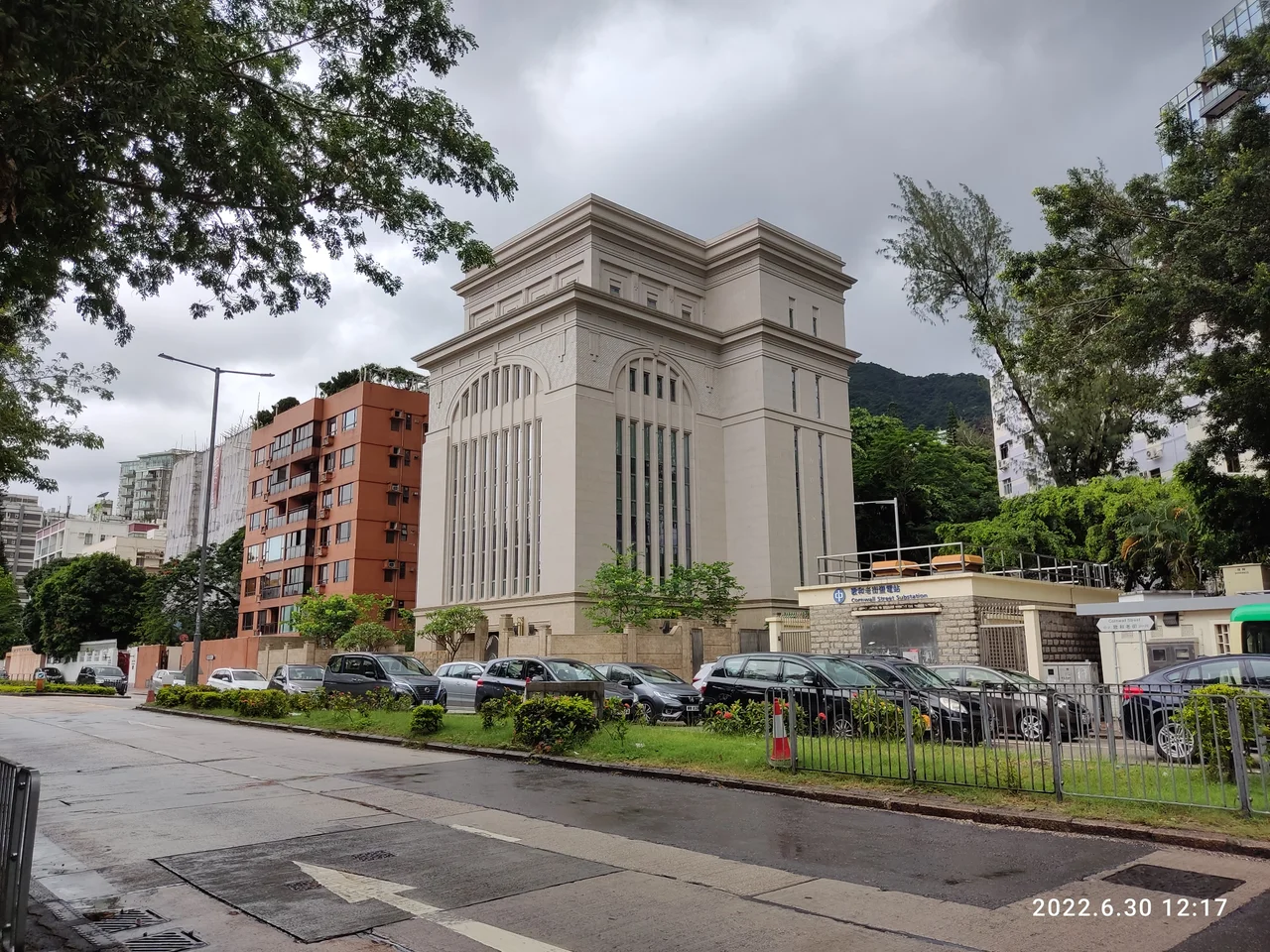

Hong Kong China Temple
The first LDS missionaries arrived in Hong Kong in 1853 and left after a few weeks, overwhelmed by the instability of mid-nineteenth century China. It took nearly a century of smaller efforts before the work found genuine footing — and then another half-century before a temple was announced. That announcement came on October 3, 1992, from Gordon B. Hinckley, then first counselor in the First Presidency, speaking during general conference. What followed was a design problem without a standard solution: how to build a temple in one of the world's most land-scarce cities, on a 0.3-acre site in Kowloon Tong, in a territory that would, within four years of the groundbreaking, revert to Chinese sovereignty.
A Long Path to the Groundbreaking
The history of the LDS Church in Hong Kong is longer than the temple might suggest. In 1853, Hosea Stout, James Lewis, and Chapman Duncan arrived as the church's first missionaries to the territory, but internal turmoil on the mainland forced a retreat within weeks. Nearly seven decades later, in 1921, David O. McKay of the Quorum of the Twelve Apostles offered a dedication of China for missionary work during a prayer at the Forbidden City in Beijing. Formal missionary work in Hong Kong began on July 14, 1949, with a prayer by apostle Matthew Cowley, joined by Henry Aki and mission president Hilton A. Robertson. The growth was gradual: about 30 people attended weekly meetings in 1951, rising to 1,700 members by 1960 and 10,000 by 1975. Groundbreaking for the temple occurred on January 22, 1994, presided over by John K. Carmack of the Seventy.
Building Up Instead of Spreading Out
Land scarcity shaped the temple's form more than any aesthetic preference. In a city where a third of an acre is a significant urban footprint, the design had to stack its functions vertically across six floors. The result is unusual among LDS temples: a single building that houses not only the sacred spaces — the baptistry, celestial room, instruction rooms, and sealing rooms — but also a chapel, mission offices, classrooms, and residential quarters for the temple president and missionaries. Gordon B. Hinckley described it as a 'sanctuary of peace amid the rush and roar' of the metropolis. The exterior is polished Giallo Ornamental and Sunset Gold granite, sourced from Xiamen in Fujian Province across the strait. Its vertical art-glass columns and ornamental walls draw on traditional Chinese architectural elements. Inside, decorative stencils inspired by ancient Chinese ceramics cover the walls, Yulan magnolia motifs appear in art glass throughout the celestial room, and the thunder pattern — a traditional symbol associated with life-giving rain — repeats across interior surfaces.
Dedication and Renovation
Construction concluded in 1996. A public open house ran from May 7 to May 21 of that year, welcoming more than 13,000 visitors including 25 interfaith leaders and 500 VIP guests. The temple was dedicated in seven sessions on May 26–27, 1996. Over the following decades, the building underwent significant renovation: structural reinforcement, exterior redesign, and substantial interior reconfiguration. During this process, the original spire and angel Moroni statue were permanently removed, replaced by a smaller tower. The rededication was performed by Gerrit W. Gong on June 19, 2022. Gong's role carried particular significance — he is the first ethnically Chinese apostle in the church's history, and his presiding over the rededication of a temple in the city where the church's presence on Chinese soil had some of its earliest and most fraught footholds was not lost on those present.
A Hub for a Diverse Membership
The Hong Kong China Temple does not serve only Hong Kong. Its formal jurisdiction extends to members from parts of India, Pakistan, Thailand, Sri Lanka, Singapore, Mongolia, Malaysia, Cambodia, and Indonesia — a list that reflects both the church's growth across Asia and the temple's position as the closest such facility to many of those communities. One community it serves with particular thoughtfulness is the large population of Filipino domestic workers in Hong Kong. Many work six days a week, with Sunday as their only day off — which is normally when LDS temples are closed. In recognition of this constraint, the Hong Kong China Temple opens on Sundays four times a year, specifically to accommodate these workers. The temple president as of 2024 is Simon-Yue-Sang Chan, with Isabel Kit-Fong Chow Chan serving as matron, each appointed for a three-year term.
What the Building Holds
The Hong Kong China Temple is not open to non-members outside of open house events; once dedicated, entry requires a current temple recommend. This means most people who walk past the building on their daily commute through Kowloon Tong have never seen the hexagonal chandeliers with their crystal prisms modeled on Chinese lanterns, or the celestial room with its Yulan magnolia art glass, or the custom furniture with its fretwork and asymmetrical wood grain patterns. The granite exterior gives little of the interior away. But the building's presence in the neighborhood is not invisible — its gardens and water feature occupy a quiet corner of one of Kowloon's more prosperous residential districts, and it has served continuously since 1996 as a gathering point for a community whose members travel, sometimes very far, to reach it. Some of those who attended the original dedication came from Taiwan, Singapore, Thailand, and mainland China. The distance they traveled was part of what the dedication meant.
From the Air
The Hong Kong China Temple sits at approximately 22.34°N, 114.18°E in the Kowloon Tong neighbourhood of Kowloon, just south of the Lion Rock ridge. From Hong Kong International Airport (VHHH) on Lantau, the approach to Kowloon crosses over or near Tsing Ma Bridge and the north Lantau expressway before the urban density of Kowloon becomes visible. Kowloon Tong is a primarily low-rise residential area by Hong Kong standards, distinguished from the denser commercial and housing blocks further south. The temple's relatively modest footprint on a 0.3-acre site makes it difficult to pick out from altitude, but the surrounding grid of Kowloon Tong's street pattern is identifiable. Kai Tak's former runway footprint is visible as a peninsula extending into Victoria Harbour to the southeast.
Nearby Stories
- Chapel of St. Francis Xavier 3.5 km away
- Cuiheng 4.1 km away
- 2015 Shenzhen Landslide 16 km away
- Shunde 31 km away
- Wanshan Archipelago 37 km away
- Nanxiong Formation 96 km away
- Heyuan 149 km away
- Checheng Fu'an Temple 629 km away