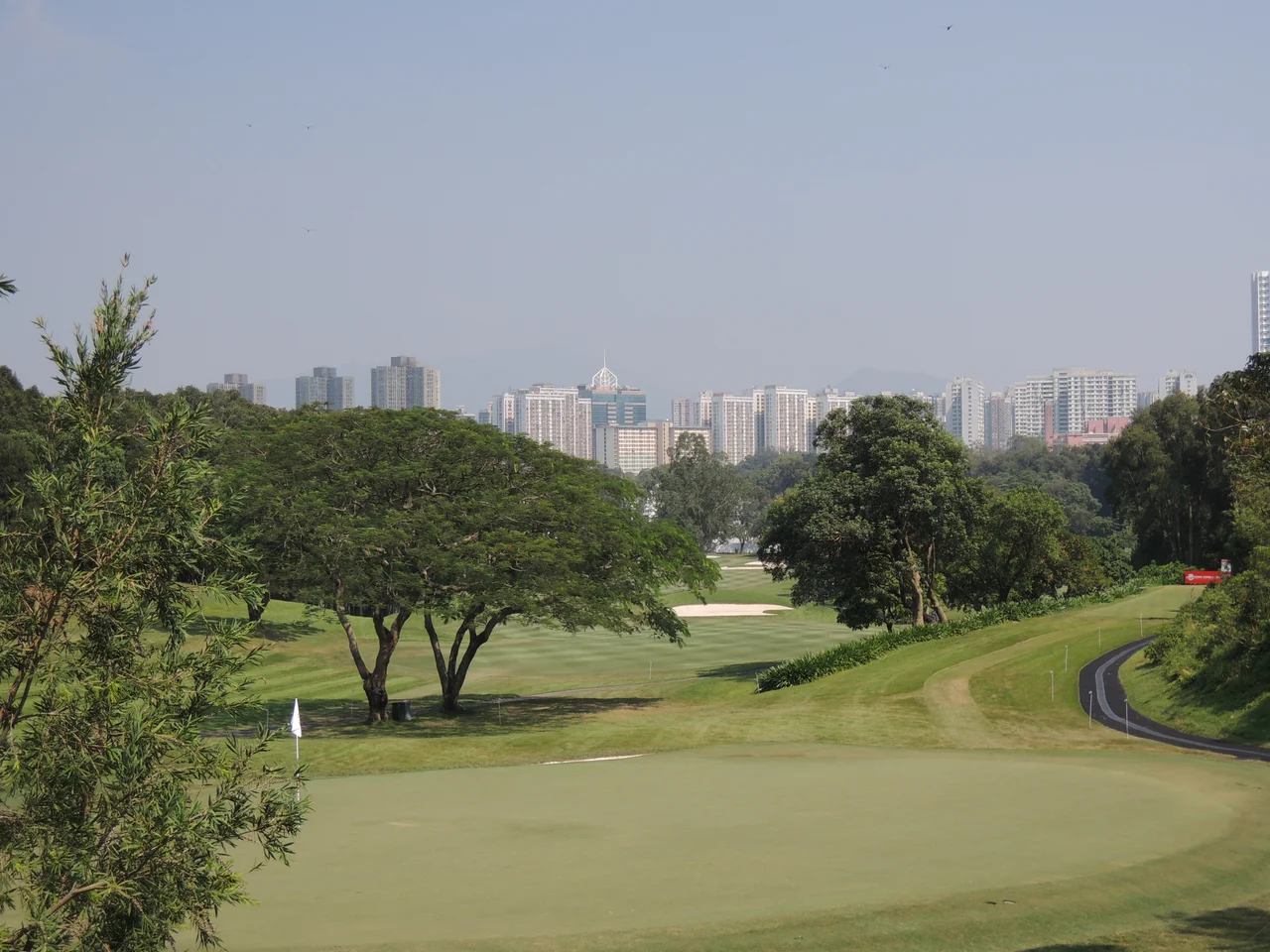

Hong Kong Golf Club
Thirteen men gathered in Happy Valley in 1889, most of them, by the club's own account, having "very little notion of the game" but agreeing to do what they could to establish a foothold for golf in the colony. From that unpromising start grew the Royal Hong Kong Golf Club—and eventually, after the "Royal" was dropped ahead of the 1997 handover, the Hong Kong Golf Club. The move to Fanling happened in 1911, when the 18-hole Old Course opened on land prised loose from local farmers through patient negotiation and gubernatorial influence. That Fanling course is still the club's home. And it is still controversial.
From Happy Valley to Fanling
The club's first home at Happy Valley was shared with cricket, soccer, and other sports, a compromise that frustrated the golfers from the start. Ladies were restricted even more severely: when the club gained exclusive use of Happy Valley in 1903, women were permitted to play on Sundays only. A nine-hole course at Deep Water Bay offered some relief from 1898 onward, but the real solution came in Fanling, where "protracted negotiations" with the government and local farmers eventually yielded enough land for a proper 18-hole course, completed in 1911.
The early course was rough. No trees except near the third green and the clubhouse site. Fairways more rolled mud than grass, dusty on windy days. And grave mounds—what the members called "pimples"—scattered across the fairways, each surrounded by jars of human bones. Through a $50,000 grant arranged by Governor Sir Henry May, most of these were removed by 1920, with compensation paid to the families whose ancestors had been buried there. A captain's chair was later presented to commemorate the disappearance of the last pimple from the Old Course.
War, Grass, and a Shoebox from Cairo
The Japanese occupation of Hong Kong, which began on Christmas Day 1941, was hard on the club. Trees were cut for fuel. Greens were converted to vegetable plots. The New Course was used for military training, leaving foxholes across the fairways. After the war, the club ran an overdraft that at one point exceeded $400,000—at a time when a daily newspaper cost 20 cents.
Recovery involved some creative logistics. To replant the greens, the club needed quality grass. The solution arrived via a sackcloth parcel carried from Uganda to Cairo during the war—a shoebox of seeded soil—and eventually flown from Cairo to Hong Kong in 1951. A club official recalled the Cairo customs officer's suspicion at the damp package; only the intervention of the air crew got it onto the plane. That grass, brought halfway across the world in a shoebox, became the turf that golfers walked on through the 1950s.
The Ecology Nobody Expected
Today the Fanling course is about 44% forested, with 75 hectares of mature lowland secondary forest—an extremely rare habitat in Hong Kong. A 2018 survey by Asia Ecological Consultants recorded over 150 bird species, more than 30 reptiles and amphibians, and 16 mammal species. Collared scops owls, Pallas's squirrels, bamboo pit vipers, and common rose butterflies are regularly seen depending on season.
The course also harbors internationally endangered species: the Chinese pond turtle, Chinese swamp cypress, and Somanniathelphusa zanklon, a freshwater crab found nowhere else on Earth but Hong Kong. This biodiversity argument has become central to the club's legal battle to retain its land—a court fight that pits one of Asia's most exclusive private clubs against Hong Kong's acute public housing shortage, with the territory's High Court overturning approval for 12,000 housing units on the Fanling site in December 2024, citing flaws in the Environmental Protection Department's impact assessment. The government filed an appeal against that ruling in December 2024, and the Court of Appeal was hearing oral arguments as of early 2026; the case remains unresolved.
The Open and the Ordinary
The Hong Kong Open, first played at the club in 1959, has been co-sanctioned by the European and Asian Tours, drawing international fields to Fanling for decades. George Bernard Shaw visited in 1933. Singapore Prime Minister Lee Kuan Yew played a round here with Governor Sir David Trench in 1968, while political turmoil raged elsewhere in the territory. LIV Golf came to Fanling in 2024.
But the club has also maintained quieter traditions. Since 1987 it has run the Cup of Kindness, a charity golf day that has supported a residential care home for disabled young people in Sheung Shui, a home for elderly women in Fanling, and the Heep Hong Society. In 2014 alone, golf events at the club raised over HK$11.5 million for charity. Rural villagers have long had an informal agreement to play parts of the course for free; approximately 800 were registered under the program. The Half Way House pavilion on the Fanling course, built in 1916 in Qing vernacular style with two green dragons competing for the Pearl for Wisdom on its ridgeboard, is itself a Grade III historic building.
A Name and an Identity
In 1897, Queen Victoria granted the club the "Royal" prefix after a letter was sent to her Lord Chamberlain—an honor received with banquets and celebration. In 1996, the club quietly dropped it, in advance of the transfer of sovereignty over Hong Kong from the United Kingdom to the People's Republic of China. The word "Royal" had marked a colonial relationship. Removing it marked something else: the club's decision to remain in a city that was changing, rather than retreating into its imperial past. The club's 2,510 members now include 365 corporate nominee memberships. The Fanling greens are still there. The endemic crabs are still there. The question of what happens to the land is not yet settled.
From the Air
The Hong Kong Golf Club at Fanling sits at approximately 22.49°N, 114.11°E in the northern New Territories, close to the border with Shenzhen. From the air, the distinctive green rectangles of the Old, New, and Eden courses are clearly visible against the surrounding urban development of Fanling and Sheung Shui. The nearest major airport is Hong Kong International Airport (VHHH), roughly 22 nautical miles to the southwest. Sha Lo Tung valley and the Pat Sin Leng Country Park provide orientation landmarks to the southeast. At 1,500–3,000 feet, the course layout—with its forested patches and lily pond near the Fanling clubhouse—stands out clearly in good visibility. Pilots approaching or departing VHHH on northern routes should be aware of the Lo Wu/Lok Ma Chau border corridor nearby.
Nearby Stories
- Chapel of St. Francis Xavier 3.5 km away
- Cuiheng 4.1 km away
- 2015 Shenzhen Landslide 16 km away
- Shunde 31 km away
- Wanshan Archipelago 37 km away
- Nanxiong Formation 96 km away
- Heyuan 149 km away
- Checheng Fu'an Temple 629 km away