.jpg)
Hong Kong Heritage Museum
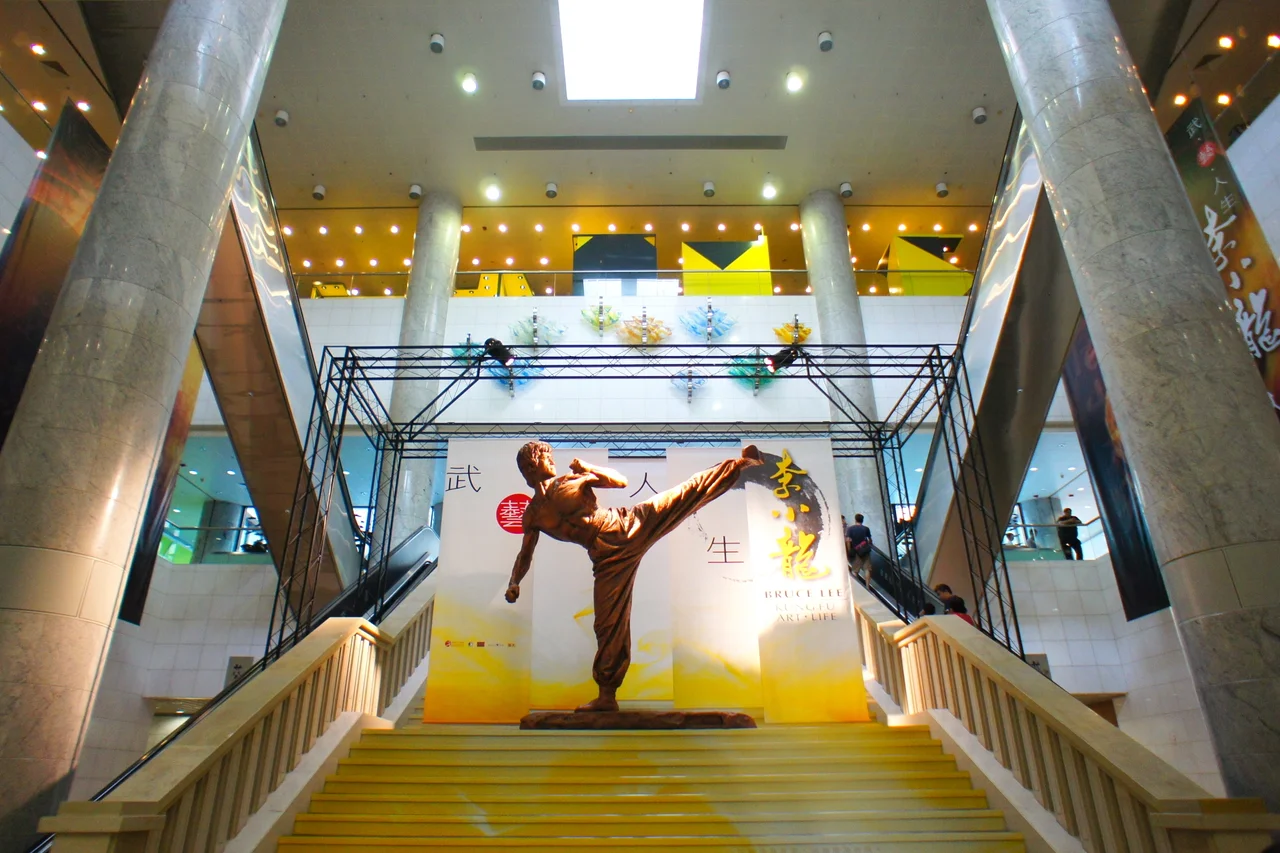
The building alone is a statement. Hong Kong Heritage Museum, which opened on 16 December 2000 beside the Shing Mun River in Sha Tin, is the largest museum building in Hong Kong. Six permanent galleries, six thematic galleries for temporary exhibitions, and capacity for up to 6,000 visitors—all of it managed by the government's Leisure and Cultural Services Department, all of it designed to hold together a culture that has always existed between influences. Cantonese opera in one hall. New Territories village life in another. Bruce Lee in a third. The museum does not try to resolve what Hong Kong is; it puts the pieces in the same building and lets you walk between them.
A Museum Built for the Territory's Scale
The museum's opening in December 2000 came three years after the handover of sovereignty, a moment when questions about Hong Kong identity—what it meant to be from this place, what would endure—felt especially pressing. The building's design firm, Reich+Petch, working alongside Lord Cultural Resources, planned both the six permanent exhibits and the original temporary shows with that cultural weight in mind.
Sha Tin was a deliberate choice of location. The New Territories town sits at the center of a district with deep village roots and rapid modern development—a combination that the Heritage Museum was built to document. The Shing Mun River, straightened into a channeled waterway by urban planners, runs alongside the building. On the other side of the river, a five-minute walk from the Che Kung Temple MTR station on the Tuen Ma Line, the museum receives visitors who arrived not from Hong Kong Island's tourist circuit but from the everyday fabric of the New Territories.
Six Permanent Galleries, Six Different Hong Kongs
The permanent collection ranges widely. The T.T. Tsui Gallery of Chinese Art traces artistic traditions from the mainland into Hong Kong's own practice. The New Territories Heritage Hall documents the walled villages, clan networks, and agricultural rhythms that shaped the region before the new towns arrived. The Cantonese Opera Heritage Hall preserves the performance art that remains central to Cantonese cultural identity—costumes, instruments, historical photographs, and audio recordings of performances stretching back generations.
The Children's Discovery Gallery turns the museum's educational mission tactile: young visitors can handle objects, enter recreated environments, and engage with history rather than just observe it. Other galleries cycle through temporary thematic exhibitions that might address contemporary art, cultural exchange, or specific chapters of Hong Kong's past. The museum also has a cafe and shop, practical anchors that make it a destination for an afternoon rather than a quick visit.
The Jin Yong Gallery
One of the museum's most distinctive permanent spaces is dedicated to Jin Yong—the pen name of Louis Cha Leung-yung, the novelist whose martial arts epics are among the most widely read Chinese-language works of the twentieth century. Born in 1924 in Zhejiang Province and educated partly in Hong Kong, Jin Yong wrote fifteen novels and novellas between 1955 and 1972, including The Legend of the Condor Heroes and The Smiling Proud Wanderer, which were serialized in newspapers and adapted into countless films and television series across East Asia.
Hong Kong was where Jin Yong wrote, edited newspapers, and eventually became a figure of public intellectual life. The gallery at the Heritage Museum holds manuscripts, personal artifacts, first editions, and displays tracing the cultural reach of his fiction—a reach that extended wherever Cantonese and Mandarin speakers carried his stories. He died in 2018 at the age of 94.
Branch Museums and the Network They Form
The Heritage Museum does not stand alone. It manages three branch institutions: the Hong Kong Railway Museum in Tai Po Market, housed in the restored 1913 Kowloon–Canton Railway station building; the Sheung Yiu Folk Museum in a former Hakka village in Sai Kung District; and Sam Tung Uk Museum in Tsuen Wan, a restored eighteenth-century Hakka walled village. Together, these four sites form a network that moves from the urban riverbank in Sha Tin to a working-class rural village to a preserved railway terminus to a fortified clan settlement on the western edge of the territories—covering the physical and cultural geography of the New Territories across a single institutional structure.
For visitors, the connections between them are part of the point. The Heritage Museum explains the context; the Railway Museum shows how the territory was physically connected by rail; the Sheung Yiu and Sam Tung Uk folk museums show how people actually lived in the villages that the railway passed through. Admission to all four is free or low-cost, a choice that keeps them accessible to the communities whose history they hold.
From the Air
The Hong Kong Heritage Museum sits at approximately 22.38°N, 114.19°E on the western bank of the Shing Mun River in Sha Tin, a flat urban district of the New Territories easily identified from the air by the oval of Sha Tin Racecourse immediately to the west. The nearest major airport is Hong Kong International Airport (VHHH), roughly 18 nautical miles to the southwest. From 1,500–2,500 feet, the museum building and its riverside setting are visible near the confluence of the Shing Mun River and the broader Tolo Harbour area. The Che Kung Temple MTR station is directly across the river. Lion Rock Country Park's distinctive ridgeline rises to the south, forming a clear geographic reference point on approach from the Kowloon side.
Nearby Stories
- Chapel of St. Francis Xavier 3.5 km away
- Cuiheng 4.1 km away
- 2015 Shenzhen Landslide 16 km away
- Shunde 31 km away
- Wanshan Archipelago 37 km away
- Nanxiong Formation 96 km away
- Heyuan 149 km away
- Checheng Fu'an Temple 629 km away