
Hong Kong Railway Museum
The station stopped running trains in 1983. By then, the Kowloon–Canton Railway had been electrified, and two new stations—Tai Wo to the north, Tai Po Market to the south—had made the old Tai Po Market stop redundant. The building was declared a monument in 1984. A year after that, the site opened as a museum. Forty years on, it remains free to enter, a small enclave of railway history in the middle of Tai Po—seven coaches on tracks that go nowhere, three locomotives preserved in various states of glory, and a 1913 station house whose curved roof tiles and decorative figurines look like they belong on an old southern Chinese temple rather than a railway platform.
The Line That Built the Territory
The Kowloon–Canton Railway (British Section) opened in 1910, connecting Kowloon to the Chinese border at Lo Wu. Tai Po Market was one of the stops in the New Territories—not the most dramatic, but one of the most consequential for the local economy. When the station building was erected in 1913, it became a center of administration and trade, drawing merchants and goods to Tai Po and boosting the market town's commercial life in ways that would have been impossible without the rail connection.
The line's history is the history of the territory's modern development. It survived the Japanese occupation, the postwar reconstruction, and the rapid population growth of the 1960s and 1970s. Electrification in 1983 transformed it from a steam-and-diesel service into a mass-transit backbone—but that modernization made the old Tai Po Market station obsolete. The building that had served the railway for seventy years became a monument before it became a museum.
Sir Alexander and the Coaches
Three locomotives stand in the museum. The most celebrated is EMD G12 Diesel-electric locomotive #51, nicknamed Sir Alexander after Governor Alexander Grantham, who presided over Hong Kong from 1947 to 1957. Introduced in 1955, it was the first diesel-electric locomotive in Hong Kong, marking the KCR's transition from steam power. When it was retired in late 2003, after a new batch of diesel locomotives arrived, KCR Corporation staff spent more than 1,000 hours restoring it—removing rust, repainting it dark green, and reinstating the traditional logo. It was donated to the museum on 18 May 2004.
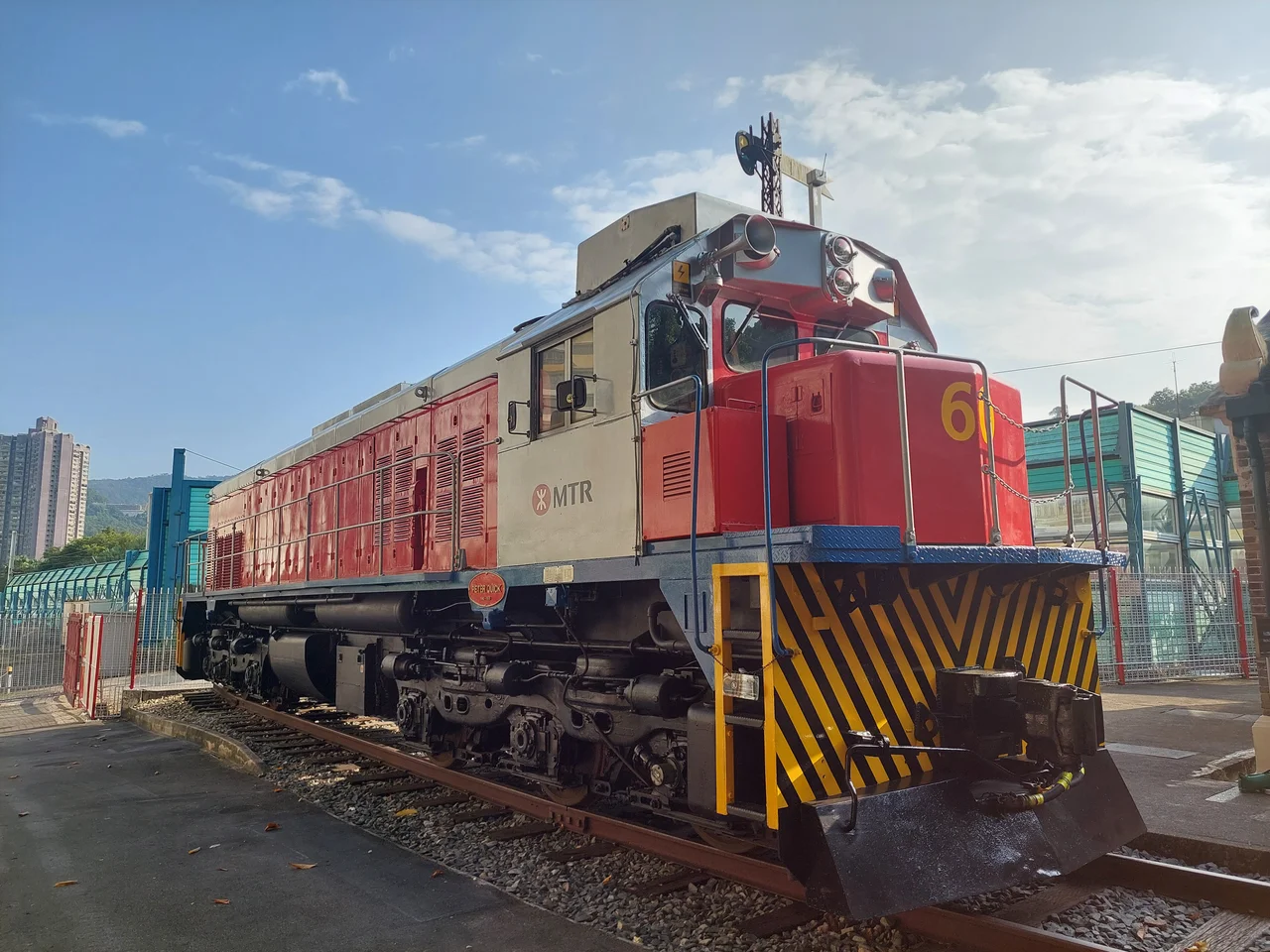
The second locomotive is EMD G26 Diesel-electric #60, known as Peter Quick, purchased in 1973 and eventually leased to the MTR after the MTR-KCR merger. It was retired in 2022 and arrived at the museum in October 2023. The third is a W.G. Bagnall 0-4-4T narrow-gauge steam locomotive (#17BG), which formerly ran on the Sha Tau Kok Railway between Fanling and the border. When that line closed, both locomotives of the pair were shipped to sugar mills in the Philippines. This one was brought back and restored in 1995; its twin is reportedly still undergoing restoration.
Seven coaches line the tracks for visitors to walk through. The oldest is a 1911 third-class coach—its compartment a window into the conditions of early New Territories travel. A 1964 first-class coach shows how much had changed in fifty years. The 1955 third-class coach has been converted into an educational video room.
The Building Itself
The station building has survived when many of its contemporaries did not, and the architecture rewards attention. The exterior is decorated with small carved figurines of the kind found on old southern Chinese temples—figures that would look entirely at home on a clan house in a Hakka village. The roof tiles curve in the indigenous Chinese manner. There is nothing specifically railway-like about the aesthetic; it is a building that looks like it grew from the local landscape rather than being imposed on it by colonial infrastructure planners.
Inside, the exhibition space on the left holds a collection of train tickets and scale models—not only KCR trains but also Japanese Shinkansen and European Eurostar models, a small acknowledgment that rail technology is a global story. The inner room is a restored ticket office and signaling house, preserved to show the working guts of a station that once kept the New Territories' main rail link running.
A Free Museum in a Free Town
Admission to the Hong Kong Railway Museum is free. That fact matters. The museum serves Tai Po's local population as much as it serves tourists, and the free entry ensures that the coaches and locomotives on display remain accessible to the schoolchildren, elderly residents, and curious families who make up its everyday audience. The museum is managed by the Leisure and Cultural Services Department as a branch institution of the Hong Kong Heritage Museum in Sha Tin—part of a network of sites that together document the New Territories' layered history.
The 1913 station building, declared a monument in 1984, has been sitting on these grounds longer than most of Tai Po's current residents have been alive. The trains that use the new Tai Po Market station nearby carry hundreds of thousands of passengers daily on their way to and from the border and the city. Here, on the old platform, seven coaches from 1911 to 1976 wait on tracks that once carried passengers all the way to Canton.
From the Air
The Hong Kong Railway Museum sits at approximately 22.45°N, 114.16°E in Tai Po District, between the urban centers of Sha Tin and Tai Po. The old Tai Po Market station site is visible from lower altitudes as a cluster of curved-roof buildings set apart from the surrounding commercial and residential development. The nearest major airport is Hong Kong International Airport (VHHH), roughly 20 nautical miles to the southwest. Tolo Harbour opens to the northeast, providing a clear geographic reference; the Pat Sin Leng range rises to the north. The East Rail Line tracks are visible running north-south through Tai Po—the active railway corridor passes near the museum's preserved site. Approach at 1,500–2,000 feet for best visibility of the station building's distinctive Chinese-style roof, set within its small park compound.
Nearby Stories
- Chapel of St. Francis Xavier 3.5 km away
- Cuiheng 4.1 km away
- 2015 Shenzhen Landslide 16 km away
- Shunde 31 km away
- Wanshan Archipelago 37 km away
- Nanxiong Formation 96 km away
- Heyuan 149 km away
- Checheng Fu'an Temple 629 km away