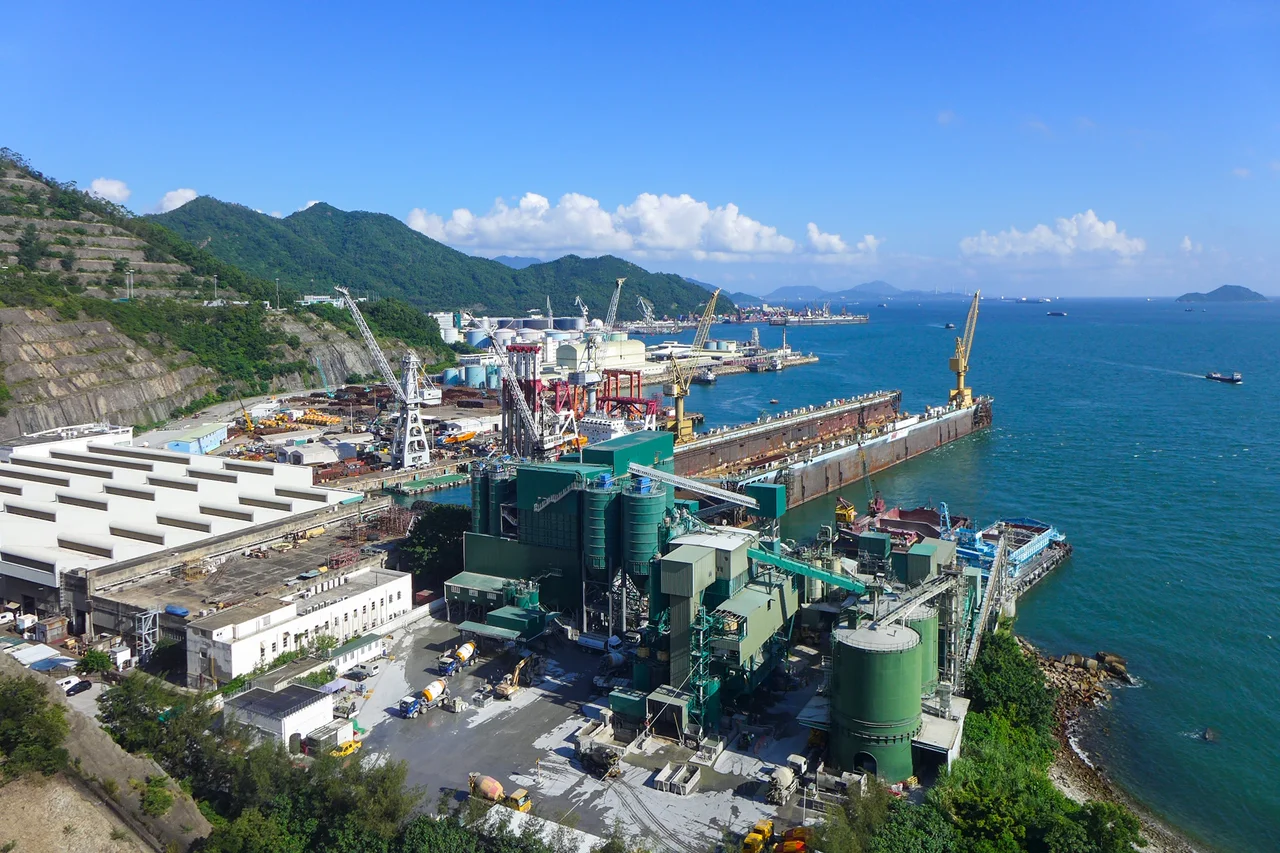

Hongkong United Dockyards
Two of Hong Kong's most famous residential estates — Whampoa Garden in Hung Hom and Taikoo Shing in Quarry Bay — were built on the graves of shipyards. When Hongkong United Dockyards formed in 1973 by merging the Hong Kong and Whampoa Dock and the Taikoo Dockyard, the old sites in Kowloon and on Hong Kong Island became too valuable as real estate to keep for ship repair. So the combined operation moved to Tsing Yi Island, to a reclaimed bay once called Shek Wan — Stone Bay — and the piers and dry docks the merged company left behind were redeveloped into the residential towers that hundreds of thousands of Hong Kong residents now call home. The ships went west. The apartments went up.
A Merger of Two Centuries
The two dockyards that merged to form HUD each carried more than a century of Hong Kong maritime history. The Hong Kong and Whampoa Dock was founded in 1863, in the early decades of British Hong Kong, when the colony's deep harbour and position on the China trade routes made it a natural hub for ship maintenance and repair. The Taikoo Dockyard in Quarry Bay followed in the early 1900s — 1902 or 1905, depending on the source — as the Swire trading empire extended its reach into ship repair to service its fleet. By 1973, when CK Hutchison and Swire agreed to combine the operations, both yards were hemmed in by urban expansion. Urban land in Hong Kong had simply become too expensive and too contested for industrial use. The merger produced Hongkong United Dockyards. A further change in ownership came in 1995.
The Floating Dock at Tsing Yi
The new facility was built on reclaimed land at Tsing Yi Island, in the industrial western approaches of Hong Kong harbour. Rather than constructing a conventional fixed dry dock — a permanent excavation that commits a shipyard to specific vessel dimensions — HUD operates a 40,000-tonne floating dock. The floating dock is towed out to receive a vessel, then ballasted down to allow the ship to float in before being pumped dry for hull work. Two additional berths handle vessels that need repair but do not require the floating dock at all. Four Ramparts 3000 ASD tugs are on hand to manoeuvre ships in and out of the facility — precision work in a busy harbour. The company employs over 400 people including subcontractors, with core services in ship repairs, salvage and towage, and land-based engineering projects.
Police Boats and Local Craft
HUD's most recognizable local contribution was building vessels for the Hong Kong Police Marine Region. Six Sea Rover class command boats were built between 1955 and 1956, before the HUD merger formalized the combined yard; two Sea Lion class command boats followed in 1965, serving the Marine Region until their retirement in 1993. Most of what the yard constructed over its history was destined for Hong Kong waters — local vessels for a local fleet, maintained and repaired within the same harbour they served. The dockyard today is accessible from the urban grid by Green Minibus route 88M, and by Routes 3 and 8 via Sai Tso Wan Road. Tsing Yi, once an island reached only by water, is now tightly connected to the New Territories road network via bridges and tunnels.
What Was Left Behind
The geography of HUD's history is readable in the shape of modern Hong Kong. Whampoa Garden, the residential estate in Hung Hom where the original Hong Kong and Whampoa Dock once operated, takes its name directly from the old yard. Taikoo Shing, one of Hong Kong's largest private housing estates, covers the former Taikoo Dockyard site in Quarry Bay. Both carry the names of the industries they replaced, written into street signs and MTR station names. Stone Bay on Tsing Yi — the site the merged yard now occupies — had no such resonant identity; it was reclaimed land, blank and industrial. HUD quietly does its work there, pulling ships into its floating dock, keeping the vessels of one of the world's most active ports seaworthy. The skyline above Tsing Yi is now dominated by container terminals and highway flyovers. The dockyard fits precisely into that working waterfront.
From the Air
Hongkong United Dockyards sits at 22.35°N, 114.08°E on the southern shore of Tsing Yi Island, west of Kowloon. The floating dock and berths are visible from the air on the waterfront facing the Rambler Channel. Approach from the east along the Kowloon coastline or from the west via the Lantau Channel at 1,500–2,500 feet. Tsing Yi is crossed by the Tsing Ma Bridge approach roads, which serve as a strong visual landmark. The nearest major airport is Hong Kong International (VHHH), approximately 15 km to the southwest on Lantau Island; VHHH is directly visible in clear conditions. The Kwai Tsing container terminals are immediately northeast.
Nearby Stories
- Chapel of St. Francis Xavier 3.5 km away
- Cuiheng 4.1 km away
- 2015 Shenzhen Landslide 16 km away
- Shunde 31 km away
- Wanshan Archipelago 37 km away
- Nanxiong Formation 96 km away
- Heyuan 149 km away
- Checheng Fu'an Temple 629 km away