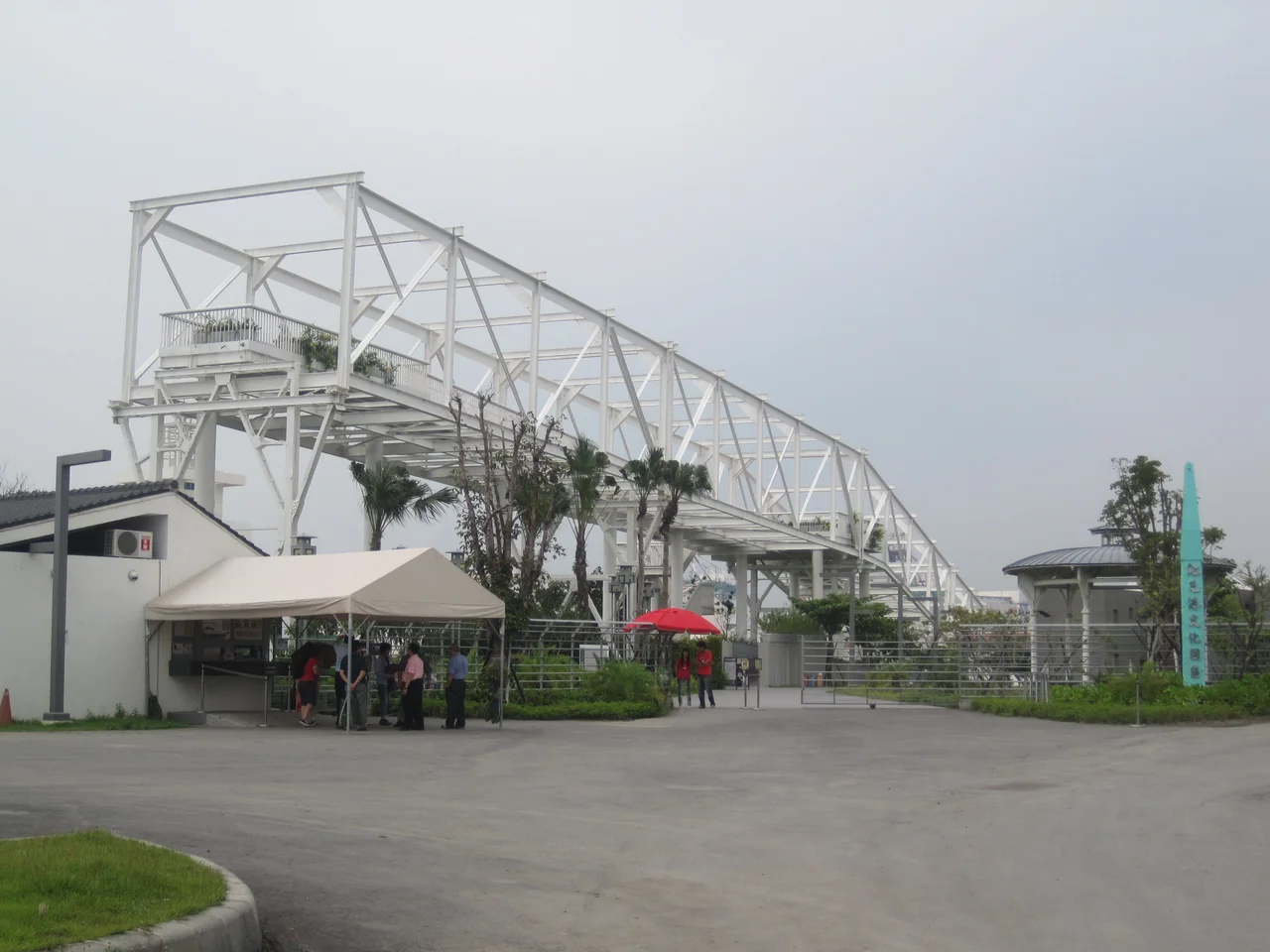

Hongmaogang Cultural Park
In 2007, an entire village disappeared from the southern tip of Kaohsiung. The residents of Hongmaogang had lived along that stretch of coast for generations, fishing the Taiwan Strait and building a tight-knit community rooted in the rhythms of the sea. Then the Port of Kaohsiung's Intercontinental Container Terminal expansion arrived, and the village had to go. The Hongmaogang Cultural Park, opened in June 2012 after three years of renovation, stands on a small reserve of land set aside from the development. It is less a tourist attraction than an act of remembrance — a place that insists the people who lived here are not forgotten.
A Name That Carries History
Hongmaogang means, roughly, 'red-haired harbor,' and the name points to a layer of Taiwanese history that predates even the Qing dynasty. Hongmao — 'red-haired' in Hokkien — was the term local people used for the Dutch colonists who controlled Formosa in the seventeenth century, and the word lingered in place names long after the Dutch departed. The village's name thus quietly embedded a colonial encounter into everyday geography: a fishing community carrying, without fanfare, the memory of a time when European ships anchored in these very waters. That depth of historical layering — Dutch traders, Qing settlers, Japanese rulers, and finally the Republic of China — is part of what made Hongmaogang worth remembering when the bulldozers came.
The Village That Was Relocated
The displacement was not dramatic in the way demolitions sometimes are. The residents of Hongmaogang were not expelled overnight; the process was the slower, grinding kind — negotiations, compensation, the gradual emptying of streets and lanes as families packed up and moved elsewhere in Siaogang District or beyond. By 2007, when the last residents left, the site was handed over to port expansion. The people who had lived there lost their neighborhood: the particular quality of light off the water in the mornings, the smells of the fish markets, the temples and community halls that organized social life. These things cannot be boxed and moved. The park acknowledges that loss directly. It does not pretend the relocation was painless or that a cultural park is adequate compensation for a community's home.
What the Park Preserves
Spread across 3.42 hectares, the Hongmaogang Cultural Park holds several distinct spaces. The Gaozi Tower — its name evoking the Chinese character 高, meaning 'tall' or 'high,' which the tower's silhouette resembles — once housed a revolving restaurant and offers elevated views across the harbor mouth and the Taiwan Strait. An exhibition hall and outdoor exhibition areas document the village's history through photographs, artifacts, and oral history recordings that give voice to former residents. A sky walk, pier, waiting room, and ocean-front platform extend toward the water, restoring a physical connection to the sea that defined Hongmaogang's identity. The park opened in June 2012, roughly five years after the village was cleared.
Memory Against Erasure
Industrial ports, by their nature, consume coastlines. The Port of Kaohsiung is one of the busiest container ports in the world, and its expansion has reshaped the southern waterfront for decades. Hongmaogang was not the first community to make way for freight, and it will not be the last. What distinguishes the cultural park is the explicit decision to hold a space — however modest — where the village's existence is documented and honored. The exhibition hall's records, the physical structures salvaged from demolition, the very act of naming the park after the displaced village: these are small refusals of erasure. The park is accessible from Siaogang Station on the Kaohsiung MRT, making it possible for anyone in the city to come and spend time with that history.
The View from the Water's Edge
Standing on the ocean-front platform at Hongmaogang, with the harbor machinery visible to one side and open water to the other, the tension that defines this place is palpable. Cranes and container ships signal the economic logic that displaced the village; the platform itself signals the cultural logic that insists something was lost worth grieving. The Taiwan Strait stretches west toward the Chinese mainland, the same water that fishing families navigated for generations. On clear days, Cijin Island — the long, narrow barrier island that shelters Kaohsiung's harbor — is visible to the north. The park sits at the edge of things: the edge of the port, the edge of the island, the edge of living memory. It is a quiet place, and deliberately so.
From the Air
Located at 22.5499°N, 120.318°E in Siaogang District at the southern end of Kaohsiung. From the air, the park sits at the mouth of the Port of Kaohsiung's Intercontinental Container Terminal, with the distinctive Gaozi Tower visible as a slender landmark near the waterfront. Cijin Island's narrow strip is visible to the northwest. Approach from the south over the Taiwan Strait for the clearest harbor view; the park lies roughly 8 nautical miles south-southwest of Kaohsiung International Airport (RCKH). Recommended viewing altitude: 2,000–4,000 feet for the harbor context and coastline geometry. Best visibility in the morning hours before afternoon sea haze develops.
Nearby Stories
- Taimali 7.2 km away
- Meinong East Gate Tower 15 km away
- Kunci Temple 20 km away
- Checheng Fu'an Temple 42 km away
- Dongji Island 49 km away
- Orchid Island 69 km away
- South Penghu Marine National Park 77 km away
- Hong Kong 12 549 km away