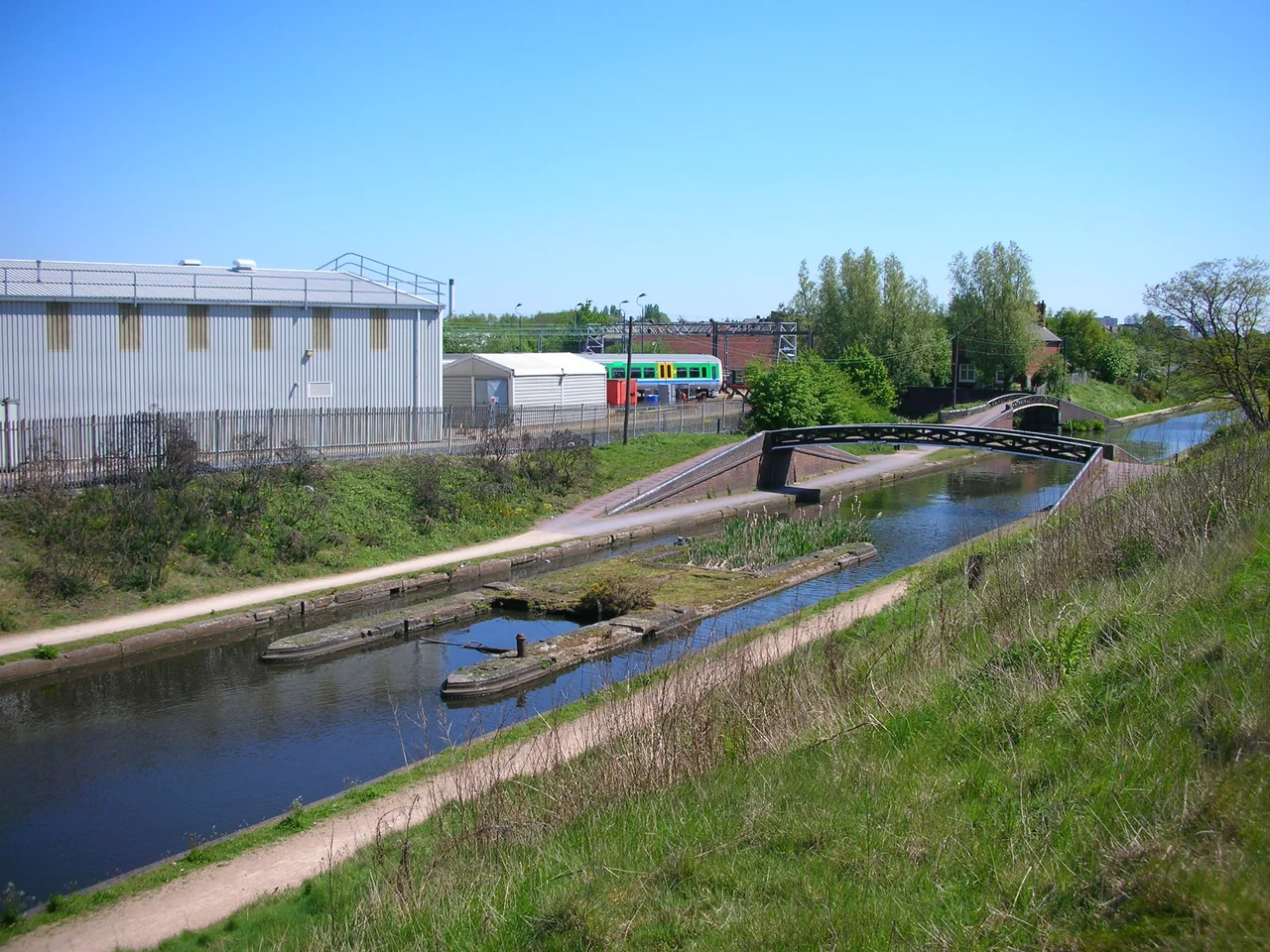

Horseley Ironworks
In May 1822, a curious-looking vessel sailed up the River Seine to Paris. She was made of iron rather than wood, ninety feet long and seventeen feet across, with a flat bottom and a Trevithick high-pressure steam engine. She was called the Aaron Manby, after the Staffordshire ironmaster who had her built, and she was the first iron steamboat ever to put to sea. She had been cast in pieces at the Horseley Ironworks near Tipton in the West Midlands, packed by canal to London, shipped by lighter to the Surrey docks at Rotherhithe to be bolted together, and steamed across the Channel under her own power. She traded between Paris and Le Havre for nearly two decades. The knock-down principle she pioneered, of casting iron in modular sections that could be shipped flat and assembled on site, would change the way the world built bridges and boats.
An estate becomes an ironworks
The Horseley estate, on the edge of Tipton, was sold off at the turn of the 19th century when engineers building the BCN Main Line through the Black Country wanted access to it. Aaron Manby, an ironmaster from Staffordshire, put up an ironworks on the site by about 1815. The location was perfect. The Toll End Communication Canal ran nearby; the coal and iron of the South Staffordshire field were within wagon distance; and the BCN gave a direct line to Birmingham and beyond. Manby brought in serious engineering talent. His son Charles Manby became the first secretary of the Institution of Civil Engineers. James Thomson, the older brother of Lord Kelvin, worked at Horseley as an engineer. Richard Roberts, the inventor of the self-acting mule and one of the great machine tool pioneers, spent time on the site. So did William Johnson. The works became an unusually concentrated incubator of practical industrial science.
The signature canal bridge
What made Horseley famous in the Black Country was its canal bridges. The works developed a distinctive design of cast-iron roving bridge, low arched and elegant, used to carry towpaths over canal junctions so that horses could change sides without unhitching. The Engine Arm Aqueduct of 1825, an iron trough on Gothic arches that carries the Engine Arm Canal over the BCN New Main Line, was a Horseley product. The two roving bridges at Smethwick Junction, cast in 1828, still arch over the water with their makers' name on the iron. Galton Bridge, completed in 1829 to Thomas Telford's design as one of the longest single-span cast-iron canal bridges ever built, was cast at Horseley. The Braunston Towpath Bridges of 1830 sit on the Grand Union Canal in Northamptonshire. By the end of the British canal-building era, Horseley had become one of the most prolific suppliers of canal infrastructure in the country. The pattern was so admired that when Birmingham regenerated Gas Street Basin in the 1990s, the new footbridge linking the Worcester Bar to Gas Street was rebuilt to a Horseley design.
Railways, piers, and a seaplane hangar
As canals declined, Horseley followed the engineers onto the railways. The works cast a viaduct in 1848 for the London and Birmingham line on the way to Holyhead at Shifnal in Shropshire, and a great many other railway bridges. The Richmond Railway Bridge over the Thames, made and erected by Horseley in 1908, still carries trains; the plaque on its parapet reads Richmond Bridge made and erected by the Horseley Co Ld London and Tipton 1908. The works produced locomotives too. As the 20th century arrived, Horseley took on construction steelwork further afield: the pier at Ryde on the Isle of Wight, the Palace Theatre in London, Rugby railway station, a seaplane hangar in Las Palmas in the Canary Islands, and the Dome of Discovery at the 1951 Festival of Britain in London. The firm had spent a century turning Black Country iron into bridges, ships, theatres, and aircraft hangars on three continents.
The end at Dixon's Branch
The firm moved in 1865 to a new site on the now-defunct Dixon's Branch, off the BCN New Main Line, near the South Staffordshire Railway. It carried on under a succession of owners for another 126 years. By the late 20th century, British heavy iron founding was contracting fast. The Tipton works closed in 1991 and the site was redeveloped for housing. Horseley left behind no surviving factory building, but its work is everywhere on the towpaths. Walk along any stretch of canal in Birmingham or the Black Country, and the chances are high that one of the elegant arched bridges crossing the water in front of you was cast in Tipton, in a foundry whose name is now only legible on the iron of the things it made.
From the Air
Horseley Ironworks stood at 52.530 degrees north, 2.044 degrees west, in Tipton, deep in the Black Country west of Birmingham. From 1,500 to 2,500 feet AGL, look for the dense canal network typical of Tipton, with the BCN Main Line, the New Main Line, and various branches threading through industrial and post-industrial estates. The town centre and Tipton railway station are immediately south. Birmingham International (EGBB) is twenty-two kilometres east-south-east, Wolverhampton Halfpenny Green (EGBO) is fourteen kilometres west-north-west, and Coventry (EGBE) is thirty-five kilometres east-south-east. The Black Country is one of England's most densely-built urban landscapes; haze can settle on still summer days.
Nearby Stories
- Shepshed 8.5 km away
- Battle of Evesham 11 km away
- Hixon rail crash 12 km away
- Battle of Cropredy Bridge 12 km away
- Wenlock Priory 15 km away
- RAF Shawbury 16 km away
- Market Bosworth 17 km away