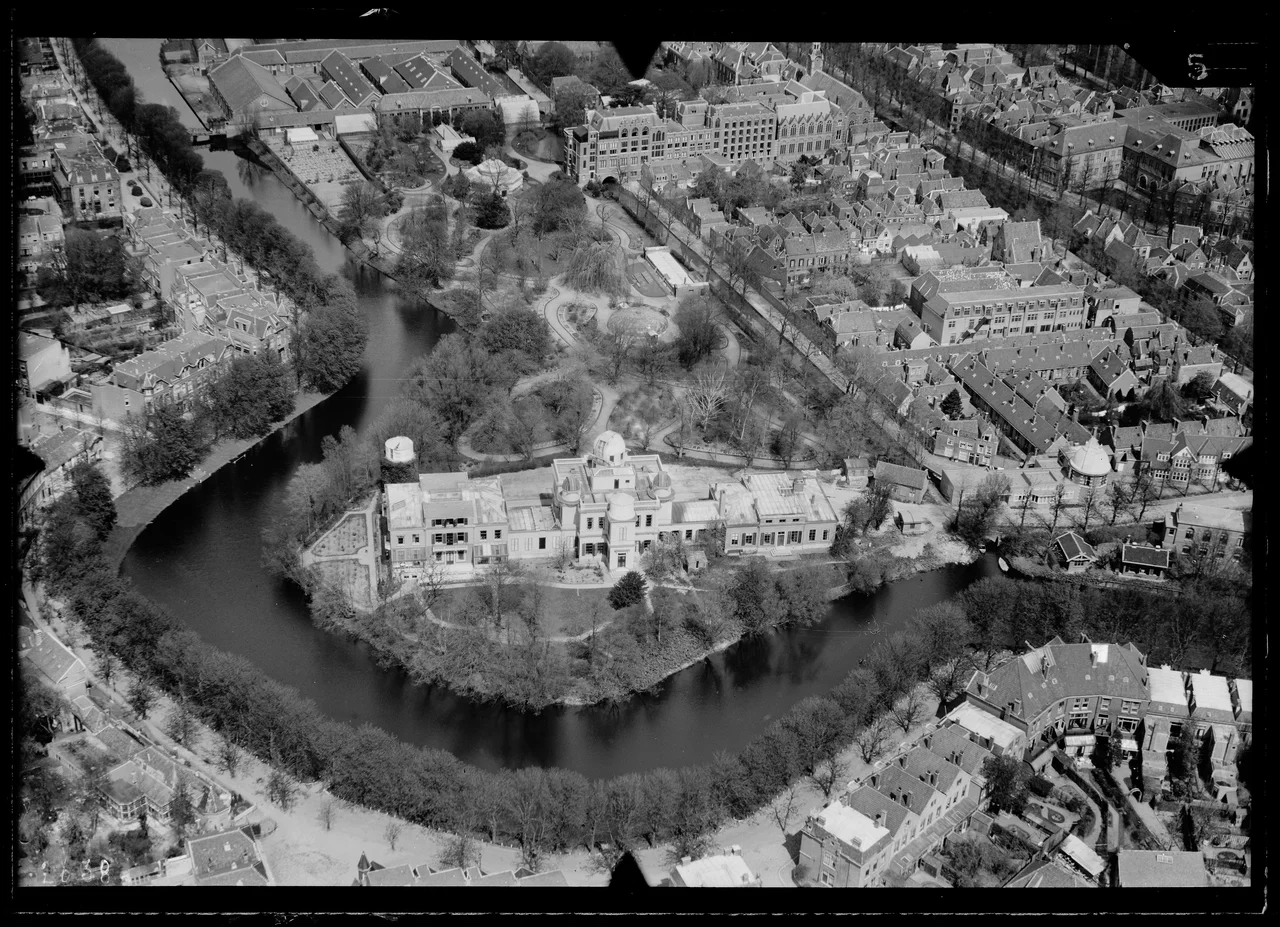

Hortus Botanicus Leiden
Carolus Clusius arrived in Leiden in 1593 carrying tulip bulbs from the gardens of the Holy Roman Emperor in Vienna. He was sixty-six years old, lame from a bad fall on horseback, and famous across Europe for his botanical correspondence. He had been asked to take charge of a thirty-five-by-forty-meter patch of dirt behind the new University of Leiden, intended to teach medical students which plants would heal them and which would kill them. Within a few growing seasons, Clusius had filled the small rectangle with more than a thousand species. Among them, in tidy beds, sat the unfamiliar bulbs from Constantinople that would, within forty years, send a young Dutch republic into the first speculative bubble in modern history.
A Garden for the Medical Students
In 1587, three years before any seed went into the ground, the young University of Leiden petitioned the mayor for a hortus academicus - an academic garden - behind its university building. The request sat in the city's pile of municipal business until 1590, when permission was finally granted. The garden's first purpose was strictly practical. Medical students needed to recognize plants on sight. A doctor in the 1590s carried his pharmacy in his head, and his head had to be filled with the look of foxglove, the smell of valerian, the bitter snap of wormwood. The hortus was a living textbook, a place where physicians-in-training could touch the difference between the plant that healed and the plant that, in slightly larger doses, killed.
Clusius and the Tulip
Clusius was an obsessive correspondent. From Leiden he wrote to gardeners in Constantinople, Antwerp, Vienna, and Salamanca, trading bulbs and seeds and the latest botanical gossip. The tulips he brought from his previous post in Vienna had themselves traveled west from the Ottoman court. He planted them in the Leiden hortus and shared bulbs with the small circle of growers in the surrounding provinces. He famously refused to sell at the prices wealthy merchants offered him - so they broke into his garden and stole the bulbs instead. By the 1630s, those stolen and traded bulbs had been crossed and recrossed into the rare variegated varieties that fueled tulip mania, when a single Semper Augustus bulb could trade for the price of an Amsterdam canal house. The Dutch tulip industry of the twenty-first century, exporting billions of bulbs annually, traces a direct lineage back to those first beds.
What the VOC Brought Home
Clusius leaned on the Dutch East India Company to send back specimens from every port they touched. His successors continued the practice. Herman Boerhaave, prefect from 1709 to 1730 and one of the most famous physicians in Europe, expanded the collection until visiting scholars came to Leiden specifically to walk these paths. A century later, the German physician Philipp Franz von Siebold spent six years on Deshima, the tiny artificial island in Nagasaki harbor that was Japan's only window onto the West. Expelled in 1829 on suspicion of espionage, he shipped his life's collection of Japanese plants - and animals, maps, and ethnographic objects - back to Leiden. Many of his specimens, and their descendants, still grow in the Japanese garden the Hortus opened in 1990 in his honor.
The Old Trees and the Tropical House
Some of the plants here are older than the Dutch Republic that funded them. A tuliptree planted in 1716 still stands; a ginkgo from 1785 still drops its yellow fan-shaped leaves every November. The Orangery, built between 1740 and 1744, is one of the oldest still-functioning greenhouse buildings in Europe. Inside the modern tropical houses, the giant arum Amorphophallus titanum erupts every few years into a meter-tall bloom that smells convincingly of rotting flesh - the Leiden Hortus is one of the few places in Europe where you can witness the cycle. The garden also holds one of the largest Asian orchid collections in the world, a quiet specialization that grew out of three centuries of Dutch maritime reach into the East.
An Oasis in the Old Town
Walk in from the Rapenburg canal and the city falls away. The garden is laid out around the original university buildings, with a reconstruction of Clusius's 1594 plot opened in 2009 based on a surviving plant list. Pond herons stand still as statues in the long water; the Victoria amazonica spreads its meter-wide pads under the glass; the Asian Araceae unfurl leaves that look like architecture. Generations of Leiden students have come here to sit, to study, to be quietly amazed. The Hortus is not the oldest botanical garden in the world - Padua in Italy holds that title by half a century - but it is the oldest in the Netherlands, and the one that, more than any other, gave the country its national flower.
From the Air
Hortus Botanicus Leiden sits at 52.156°N, 4.484°E, in the southwest of Leiden's historical core, sandwiched between the Academy building and the old Leiden Observatory. The compact grid of greenhouses and the bell-curve roof of the Orangery are the clearest visual cues from the air; the green rectangle of the garden itself stands out against the dense red rooftops of central Leiden. Recommended viewing altitude is 1,500-3,000 ft AGL. Nearest airports: Rotterdam The Hague (EHRD) about 15 nm south, Schiphol (EHAM) about 17 nm northeast. Mind the heavily restricted Schiphol TMA.
Nearby Stories
- Woerden Train Disaster 2.5 km away
- Ransdorp 5 km away
- Barendrecht 9.6 km away
- 1973 Dutch Grand Prix 10 km away
- Dussen Castle 14 km away
- Moermond Castle 15 km away
- HMS Cressy 20 km away
- Hollandse Kust West Offshore Wind Farm 34 km away