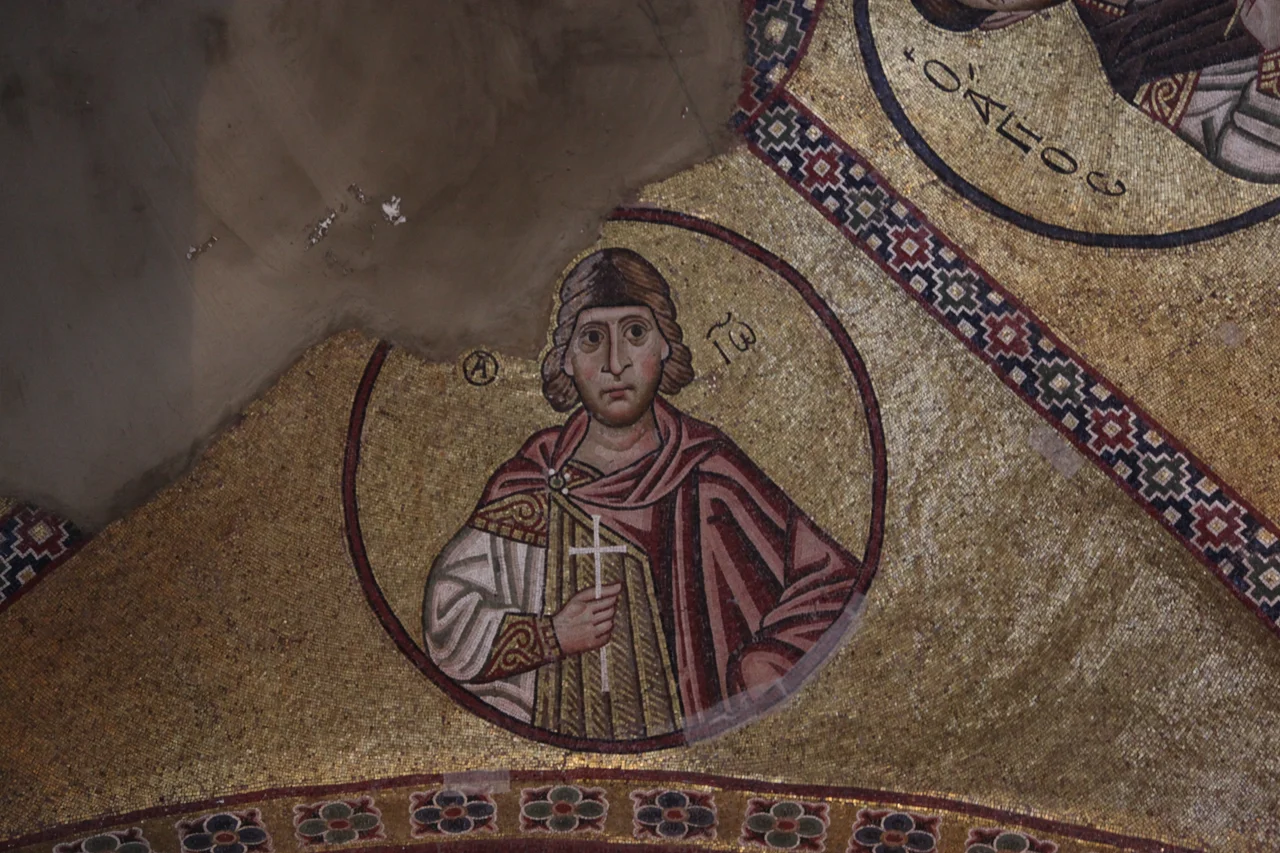
_-_North_ceiling_-_detail_02_(S.John).jpg)
Hosios Loukas
Gold does not age the way other colors do. The tessera — tiny cubes of glass and stone pressed into wet plaster more than a thousand years ago — catch the light inside the Katholikon of Hosios Loukas exactly as the craftsmen who set them intended. Christ Pantocrator gazes down from the apse. The Virgin holds her child in the conch. Saints and martyrs line the walls in medallion portraits, their faces rendered with an economy of line that implies authority rather than decorating it. This monastery on the slopes of Mount Helicon, built in the early eleventh century on the grave of a hermit who predicted the reconquest of Crete, is one of the supreme achievements of Middle Byzantine art — and it has been quietly accumulating holiness in its hillside fold for more than a thousand years.
The Hermit of Steiris
Luke of Steiris — Hosios Loukas, the Venerable Luke — was not the Luke of the Gospels. He was a hermit and local holy man who spent his life in this corner of Boeotia and Phocis, dying on 7 February 953. What made him famous beyond his death was a prophecy: he had predicted that the Emperor Romanos would recapture Crete from Arab occupation. The island was indeed reconquered in 961, not by Romanos I (who reigned when Luke made the prediction) but by the general Nikephoros Phokas under Romanos II — close enough, the faithful decided, to confirm the hermit's gifts.
A small church, the Church of the Theotokos, was built over Luke's tomb during the reign of Romanos II (959–963). The monastery grew around it. By the early eleventh century, the larger cathedral church — the Katholikon — had been added, tentatively dated to around 1011–12. The two churches stand side by side, joined at the wall, their different scales and forms creating the compound that pilgrims have been visiting ever since.
A Church Built in Gold
The Katholikon of Hosios Loukas is the earliest surviving domed-octagon church — a form in which eight piers arranged around the perimeter of the nave support a hemispherical dome that rests on four squinches. No drum interrupts the transition from octagonal base to dome; the geometry resolves itself elegantly, pulling the eye upward. The walls are opus mixtum: bands of brick alternating with stone and marble, finished at some points with patterns that echo Arabic geometric ornament — a reminder that Byzantium was not isolated from its neighbors.
But the walls are almost beside the point. What draws visitors — and drew pilgrims for centuries — is the decoration. The Katholikon contains the best-preserved mosaic complex from the Macedonian Renaissance, the cultural flowering of tenth- and eleventh-century Byzantium. Gold backgrounds, solemn faces, luminous robes: the aesthetic is not naturalistic in the modern sense but it is precise and intentional, a visual theology in which every figure's position, gesture, and gaze carries meaning. The monastery was reputed throughout Byzantium for the lavishness of its adornment — icons, silk curtains, silver plate, carved marble — only a fraction of which survives.
The Crypt's Older Darkness
Beneath the Katholikon, accessible by a narrow stairwell on the south side, lies a burial crypt that predates the church above it. It has three sections: an entrance passage, a main space with nine groin-vaulted bays, and three vaulted side passages once used as bone vaults. The frescoes here — most painted after 1048, according to current scholarship — include eight lunettes depicting Christ's Passion and Resurrection, and forty medallion portraits of apostles, martyrs, and abbots.
Art historian C.L. Connor has described the crypt as containing 'the most complete programme of wall paintings surviving from the Middle Byzantine period.' The colors are muted compared with the Katholikon's gold and lapis, but the figures have an intimacy that the larger church's formal grandeur does not allow. The sanctuary of the crypt includes a prosthesis niche and a chancel barrier, evidence that the Eucharist was celebrated here in connection with the burial rites and healing cult of Saint Luke — pilgrims slept by his tomb hoping for cures through incubation.
A Site That Has Outlasted Its Contexts
Hosios Loukas has moved through many hands without losing its essential character. In 1206, during the Latin occupation of Byzantium following the Fourth Crusade, the papal legate Benedict of Porto gave the monastery to the canons of the Holy Sepulchre. Greek monastic life eventually resumed. The monastery has seen Ottoman rule, Greek independence, two world wars — and still its monks maintain the liturgical life that the building was made to house.
In 1990, UNESCO inscribed Hosios Loukas as a World Heritage Site, grouping it with the monasteries of Nea Moni on Chios and Daphni near Athens as the three principal surviving monuments of Middle Byzantine monastic architecture. The three sites differ in detail — Hosios Loukas is the largest — but share the same moment of creativity, the same sense that Byzantine civilization had reached a high-water mark it was trying to fix in mosaic and stone. At Hosios Loukas, it succeeded.
From the Air
Hosios Loukas is located at 38.395°N, 22.746°E on the lower slopes of Mount Helicon, near the town of Distomo in Boeotia, approximately 160 km northwest of Athens. From altitude the monastery is visible as a cluster of red-tiled roofs and stone walls on a terrace cut into olive-covered hillside, with the dramatic ridge of Helicon rising behind it and the Gulf of Antikyra visible to the south. Approach from the southeast at 7,000–9,000 ft gives a clear view of the monastery's setting in its valley. The nearest major airport is Athens International (LGAV), approximately 155 km to the southeast. The site is best seen from low altitude on a clear morning, when the angle of light on the stone walls is sharpest.
Nearby Stories
- Battle of Vasilika 7.9 km away
- Siege of Negroponte (1470) 8.5 km away
- Battle of Kalavryta 13 km away
- Church of the Nativity of the Theotokos, Limni 14 km away
- Pellene 16 km away
- Panagia Varnakova Monastery 18 km away
- Megara 21 km away
- Karpenisi 41 km away