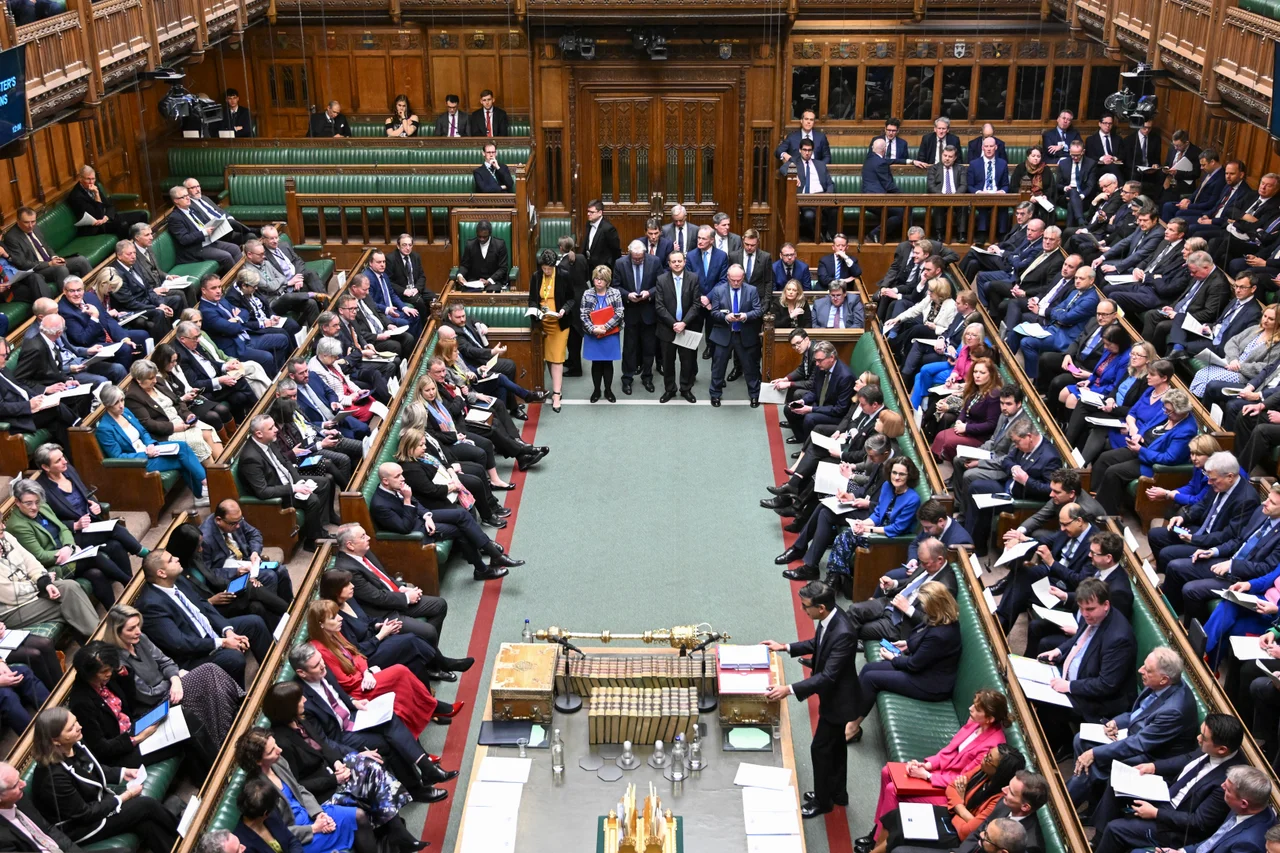

House of Commons of the United Kingdom
When the gentleman in black tights known as Black Rod arrives at the door of the House of Commons each November, the door is slammed in his face. He knocks three times with a black rod and is granted admittance only then, to inform the Members that the Monarch awaits them in the Lords. The ritual is a memory of 1642, when Charles I marched into the Chamber with an armed force to arrest five MPs for treason - and was famously told by Speaker William Lenthall that he had neither eyes to see nor tongue to speak save as the House directed. No monarch has set foot in the Commons since.
Thirteen Feet
The current Chamber is small, rectangular, modestly decorated in green. It was rebuilt by Giles Gilbert Scott after German bombs destroyed Charles Barry's chamber on the night of 10 May 1941 during the Blitz. Churchill insisted that the essential features of Barry's design be preserved - the cramped benches, the lack of seats for everyone, the deliberate intimacy. The distance across the floor between the government and opposition benches is thirteen feet. Tradition holds that this is two swords' length, the gap kept to prevent rival members from running each other through, though weapons have been banned in the chamber for centuries and the explanation is probably symbolic. Red lines drawn in front of each set of benches mark the limit that members may not cross during debate, in honour of the same long-dead duelling instinct.
The 650
The Commons has 650 members elected from constituencies by first-past-the-post: 543 from England, 57 from Scotland, 32 from Wales, 18 from Northern Ireland. The Speaker presides from a chair designed by Augustus Pugin and modelled on a chair he made for King Edward's School, Birmingham, where the chief master sits in something called Sapientia, Latin for wisdom. The current Speaker, Sir Lindsay Hoyle, follows the modern tradition - inaugurated by Betty Boothroyd - of not wearing the long wig. His three deputies are titled, for reasons no longer relevant, the Chairman of Ways and Means and the First and Second Deputy Chairmen of Ways and Means. The committee they once chaired was abolished in 1967, but the names remained because nothing in this building is changed quickly.
Speaker Lenthall's Inheritance
The Speaker is supposed to be politically neutral, and by convention faces no major-party opposition in their constituency. They vote only to break ties, following Speaker Denison's rule from 1867 - always to allow further debate, or to reject a motion without a clear majority. Such ties are rare: between July 1993 and April 2019, more than twenty-five years passed without one. To resign from the Commons, a member must apply for one of two ancient sinecure offices - Crown Steward and Bailiff of the Chiltern Hundreds, or Crown Steward and Bailiff of the Manor of Northstead - because a 1623 resolution declared that members could not simply resign. The fiction has held for four hundred years.
The Whips
Most of the work is done by Whips. They are members of parliament who keep their party in line on votes, calling colleagues from their constituencies on three-line whips and ensuring that, when a division is called, party loyalists troop into the right lobby - the Aye or No lobby on either side of the Chamber. Members who defy them risk demotion or deselection. Pairing is the gentleman's agreement by which an MP from one party and an MP from the opposite party both agree to skip a vote so that neither side gains an advantage. A bisque is permission from the Whips to miss a vote for constituency business. Until 1998, if you wanted to raise a point of order during a division, you had to wear a hat to signal you were not debating; collapsible top hats were kept in the chamber for the purpose.
Prime Minister's Questions
Every Wednesday for half an hour, the Prime Minister stands at the dispatch box and is questioned by members from across the House. The exchange is theatrical and bruising - jeers, calls of order from the Speaker, rehearsed quips and the occasional moment of genuine substance. Tony Blair faced PMQs once a week. Margaret Thatcher faced it twice. The format is unique among the world's parliaments. Many of the Commons traditions - the calling of members by constituency rather than name, the absence of direct second-person address, the requirement that members never call each other by Christian name - exist to preserve a fiction that all are colleagues regardless of partisan rage. Customarily a member of Parliament addressing the chair will refer to a Privy Counsellor as the Right Honourable Member for [constituency], to a fellow soldier or sailor as the Honourable and Gallant Member, and to a member of their own side as my Honourable Friend.
Things Thrown
Sessions have occasionally been interrupted by objects flying from the galleries: leaflets, manure, flour, a canister of CS gas in 1970. Even members have caused chaos. In 1976 the Conservative MP Michael Heseltine, in the middle of a furious debate, seized the gold-plated mace from the centre of the Chamber and brandished it, an act of constitutional outrage; the mace was returned and he kept his career. The most famous disruption remains Charles I's incursion. The Speaker still leaves the building at the front of a ceremonial procession each day in a wig and gown, followed by the Serjeant-at-Arms carrying that same mace - the symbol of the authority of the Crown and of the House of Commons together. The Chamber's quorum is 40 members for any vote. The annual salary of an MP, as of April 2023, is £86,584. The work begins at noon on most days and ends, in theory, by 10:30 pm.
From the Air
The Palace of Westminster sits at 51.4995°N, 0.1247°W on the north bank of the Thames at the bend below Westminster Bridge. The Commons Chamber is in the centre-west of the Palace, flanked by Elizabeth Tower (Big Ben) to the north and Victoria Tower to the south. From 1,500-2,500 ft AGL the gold spires of both towers and the long green roof of the Chamber are unmistakable, with Westminster Abbey just to the west. Nearest airports: London City (EGLC) 4 nm east, London Heathrow (EGLL) 14 nm west, RAF Northolt (EGWU) 13 nm northwest. The river runs east-west here, giving a clear sightline along the Thames from the London Eye on the south bank.
Nearby Stories
- Battle of Britain, Northfleet 1.1 km away
- Bayham Old Abbey 5.4 km away
- Catharine Macaulay 6.4 km away
- Hatfield rail crash 8.8 km away
- Chequers 8.9 km away
- Chelmsford Cathedral 10 km away
- Queen Victoria Hospital 13 km away
- Fishbourne Roman Palace 36 km away