
House of Lords
On 19 March 1649, three months after the execution of Charles I, the English Commons declared that the House of Lords was useless and dangerous to the people of England, and abolished it. The Lords stayed abolished for eleven years until Cromwell died and the monarchy returned in 1660. Three hundred and seventy-five years later, the body that the Commons declared useless still meets in a lavish gilded chamber upholstered in red leather, with around 800 members - almost none of them elected by anyone.
The Red Chamber
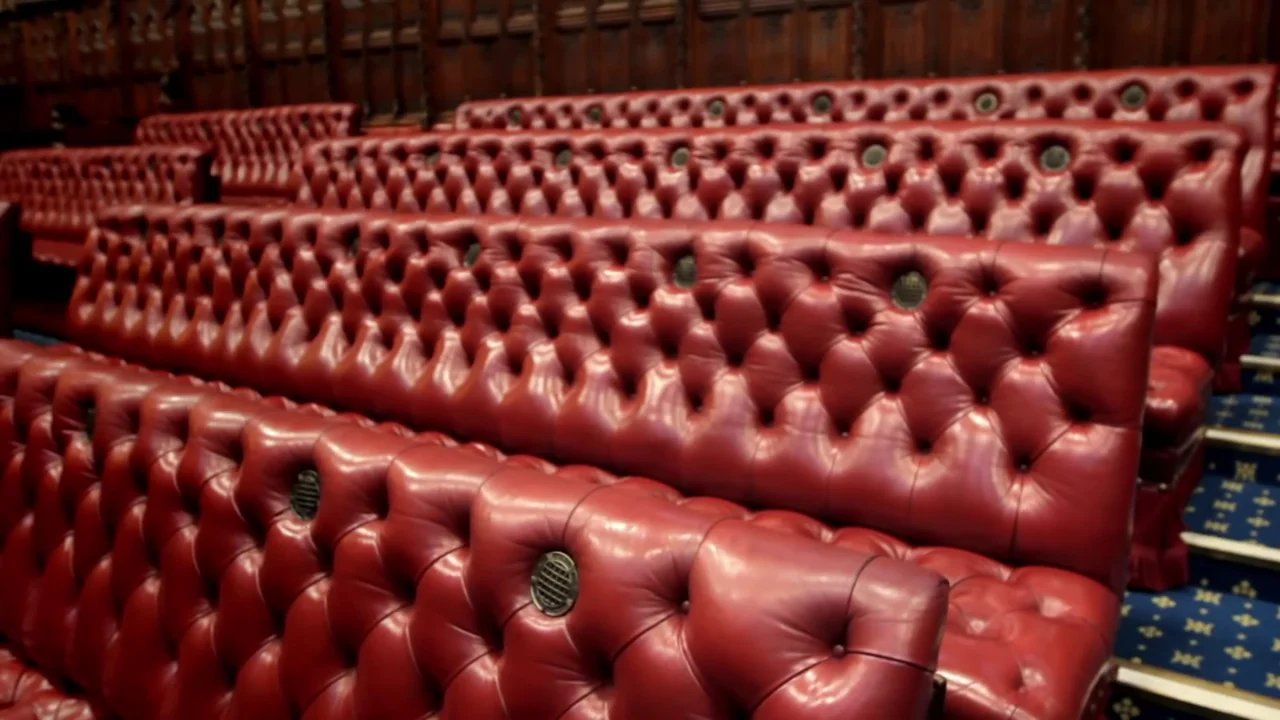
The Lords Chamber is everything the Commons isn't. Where the Commons is small, green, and modestly furnished, the Lords is enormous, scarlet, and gilded. The benches are red leather. The walls are panelled in oak with bronze and gold. At the southern end stands the throne, used by the monarch only for the State Opening of Parliament, when the King reads out his government's legislative plans in a speech written by the Prime Minister. The presiding officer sits not on a chair but on the Woolsack, a large red cushion stuffed with wool from across the realm and the Commonwealth - a medieval reminder that English wealth was built on sheep. There are only about 400 seats. The chamber routinely seats fewer than half its members on any given day, and peers complain of jostling for space during big votes.
Lords Temporal and Spiritual
The members come in three flavours. Life peers - currently around 670 - are appointed by the monarch on the Prime Minister's advice, usually for political or public service, and hold their seats until they die or resign. Hereditary peers were almost all expelled in 1999 by the Blair government's House of Lords Act, which left only 92: 90 elected from their own ranks plus the Earl Marshal and the Lord Great Chamberlain ex officio. And there are the Lords Spiritual - 26 Church of England bishops including the Archbishops of Canterbury and York, plus the Bishops of London, Durham and Winchester, plus the 21 longest-serving of the rest. The United Kingdom is one of only three countries in the world to give religious figures permanent seats in its national legislature; the other two are Iran and Vatican City.
What They Do
The Lords cannot stop legislation, only delay it. Under the Parliament Acts of 1911 and 1949, money bills can be delayed only a month, and other public bills for no more than one calendar year. The Lords cannot extend a Parliament's term beyond five years. By the Salisbury Convention, they do not block legislation that was promised in the governing party's election manifesto. What remains is the function the chamber describes as revising - reading bills carefully, proposing amendments, occasionally sending things back to the Commons with a polite request to think again. Many peers are former ministers, judges, scientists or doctors. Some are donors. The Honours (Prevention of Abuses) Act of 1925 made it illegal to buy a peerage. A 2015 study found that of the 92 people nominated for peerages between 2005 and 2014 from outside public life, 27 had made significant donations to political parties.
The Old Courts
Until 2009, the Lords also served as the United Kingdom's highest court. Twelve Law Lords - the Lords of Appeal in Ordinary, appointed for the purpose under the Appellate Jurisdiction Act 1876 - heard appeals in panels of five from English, Welsh, Northern Irish and Scottish courts. They sat not in the Chamber itself but in committee rooms upstairs, then delivered their judgements in the Chamber as legislative speeches, in a strange constitutional fiction. The arrangement was finally ended by the Constitutional Reform Act 2005, which created the Supreme Court of the United Kingdom, housed across Parliament Square in the Middlesex Guildhall. The Lord Chancellor, who had once been simultaneously a cabinet minister, the presiding officer of the Lords, and the most senior judge in England and Wales - a position offensive to anyone trained in the separation of powers - was finally separated from the judiciary by the same act.
Acasta Reform
Almost every twentieth-century government planned to reform the Lords; almost none succeeded. The Labour Party committed in its 1997 manifesto to removing the hereditary peerage, and Tony Blair's government did so in 1999 - but only as a compromise that left 92 hereditaries until a second stage of reform that has not yet arrived. In 2003 MPs voted ten times on what should replace the Lords; every option lost. Nick Clegg's House of Lords Reform Bill of 2012 collapsed against Conservative backbench opposition. Keir Starmer's government, elected in 2024, introduced the House of Lords (Hereditary Peers) Bill to remove the remaining 92, with longer-term plans for an elected second chamber the party has chosen not to pursue in its first term. The chamber remains, as Bagehot called it in 1867, an embodiment of compromise.
Standing Order 32
When the debate gets heated, a peer may rise and move that the Clerk read Standing Order 32: That all personal, sharp, or taxing speeches be forborn. The Journals of the House of Lords record only four occasions on which the order has actually been invoked since the procedure was invented in 1871. The more common remedy is the motion that the noble Lord be no longer heard, used eleven times since 1884. Members are not addressed by name but by title and territory: the noble Earl, the noble Lord, the noble Baroness, my noble friend. Speeches are addressed not to the Speaker but to the House as a whole, by the words My Lords. The current attendance allowance is £342 per sitting day, plus expenses. Most peers attend irregularly. Some never come at all. The chamber, in the words of one of its own committees, is too large by perhaps three hundred peers - but how to make it smaller is a question the chamber has, characteristically, not answered.
From the Air
The House of Lords occupies the southern half of the Palace of Westminster at 51.4995°N, 0.1247°W, beneath Victoria Tower (the tall square one at the south end of the Palace), with the Chamber visible as part of the long roofline along the Thames between Westminster Bridge and Lambeth Bridge. From 1,500-2,500 ft AGL the Palace is unmistakable - look for Big Ben at the north end and Victoria Tower at the south. Nearest airports: London City (EGLC) 4 nm east, London Heathrow (EGLL) 14 nm west, RAF Northolt (EGWU) 13 nm northwest. The Thames bends here, making this the most photographed riverscape in London.
Nearby Stories
- Battle of Britain, Northfleet 1.1 km away
- Bayham Old Abbey 5.4 km away
- Catharine Macaulay 6.4 km away
- Hatfield rail crash 8.8 km away
- Chequers 8.9 km away
- Chelmsford Cathedral 10 km away
- Queen Victoria Hospital 13 km away
- Fishbourne Roman Palace 36 km away