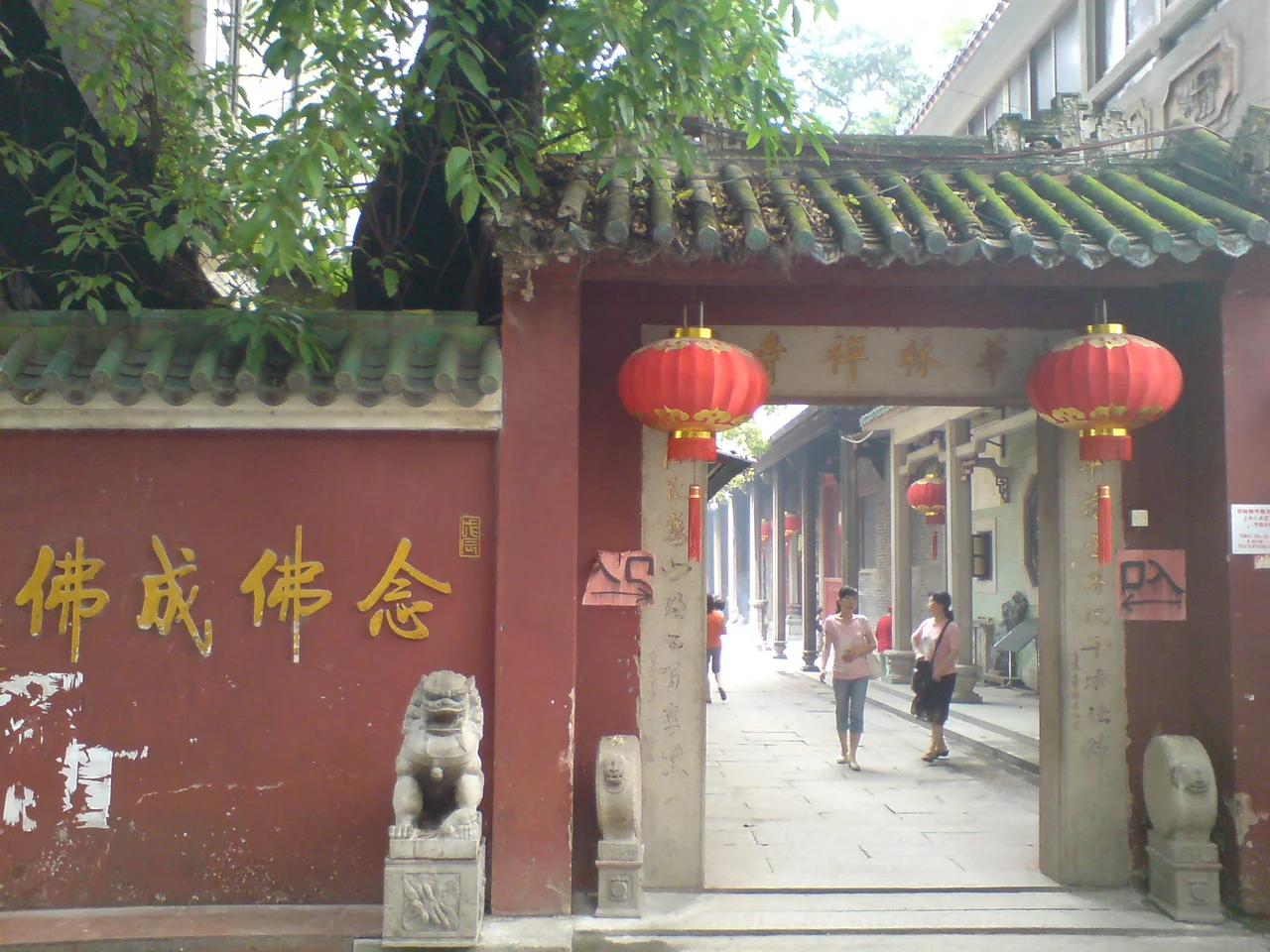

Hualin Temple (Guangzhou)
Somewhere in the 520s AD, a missionary monk arrived by sea in Panyu — the port city that would become Guangzhou — and according to centuries of tradition, he helped establish a monastery. The monk was Bodhidharma, later credited with bringing Chan (Zen) Buddhism to China and with the legendary nine-year meditation that defined his legacy. The monastery he may have touched became, in time, the Hualin Temple: a place that carried the weight of that founding story for fifteen hundred years, even as wars, revolutions, and reconstructions transformed everything around it.
The Monk Who Crossed the Sea
Bodhidharma's arrival in China is one of the great origin stories of East Asian Buddhism, and its details have been contested by scholars almost from the beginning. The source article notes that while the Xilai Monastery — the temple's original name — is traditionally credited to Bodhidharma, he may have come to China as early as the Liu Song dynasty, which would predate the Liang dynasty foundation by several decades. What history records with more certainty is that Emperor Wu of the Liang formally established the Xilai Monastery in Panyu in the AD 520s. The name means something like "coming from the west" — a fitting title for a site linked to a monk who crossed the sea to bring Indian Buddhist teachings east. Whether Bodhidharma himself laid the foundations or simply passed through, his association with the site gave it a spiritual authority that outlasted dynasties.
Renamed and Rebuilt
The monastery existed under various names and conditions through the Tang, Song, and subsequent dynasties. Its most significant renaming came in 1655, when the Zen master Zongfu undertook a rehabilitation of the temple grounds and gave it the name it carries today: Hualin, meaning roughly "forest of transformation" or "forest of Chinese Buddhism." Zongfu's renovation came during the turbulent early Qing, when the new Manchu dynasty was still consolidating its rule over a resistant south. Religious institutions offered a kind of continuity across political ruptures, and the temple's reconstruction under Zongfu represented both a spiritual renewal and a physical one. The complex that took shape included a hall dedicated to five hundred arhat figures — the enlightened disciples of the Buddha — arranged in the elaborate sculptural tradition that made such halls among the most visually striking spaces in Chinese Buddhist architecture.
Five Hundred Faces, Then None
The hall of five hundred arhats was the temple's most celebrated feature. Each figure was individual — different posture, expression, attribute — representing a person who had achieved enlightenment through specific practice and specific struggle. Collectively they formed a kind of census of the human range, five hundred paths to liberation rendered in gilded clay or stone. The temple also housed a gilded Ashoka Pagoda, commemorating the great Indian emperor who had spread Buddhism across South Asia nearly a millennium before the temple's founding. During the Cultural Revolution, which swept through China from 1966 onward, both the arhat statues and the pagoda were destroyed. The hall that held them, one of the defining spaces of the temple, was stripped of its sculpture. The loss of five hundred unique figures is the kind of damage that cannot be precisely measured — each arhat was an irreplaceable work of craftsmanship, a face in a tradition that stretched back a thousand years.
A Neighborhood Anchor
The Hualin Temple sits in Guangzhou's old commercial district near the former foreign factory area, a neighborhood that was already ancient when the first Western traders arrived. Today, the street outside is part of Guangzhou's famous jade and jewelry market — a district of small shops selling carved stone, pearls, and ornaments, drawing buyers from across China and abroad. The contrast is characteristically Cantonese: sacred space and commercial energy coexisting, separated only by a gate and a change in atmosphere. Inside, incense burns and worshippers move through the halls. Outside, the negotiation of prices in rapid Cantonese is the background music of daily life. The nearby metro station bears the temple's name, which is its own kind of recognition — Hualinsi Buddhist Temple station on Line 8, anchoring the ancient site to Guangzhou's twenty-first century infrastructure.
What the Temple Represents
Hualin stands in a neighborhood of remarkable religious density. The Guangxiao Temple, one of the oldest in the city, is nearby. The Six Banyan Temple, built around the same period, is a short distance away. These sites together map a layer of Guangzhou's history that predates the city's fame as a trading port, reaching back to when it was first being shaped as a center of Chinese Buddhist teaching and practice. The tradition attributes Hualin's founding to a legendary figure. The physical evidence suggests a long history of construction, destruction, and reconstruction. Both things are true. The temple today is a living religious site, not a museum, and the monks and lay practitioners who use it are part of a continuity that the Cultural Revolution interrupted but did not end.
From the Air
Hualin Temple is located at 23.119°N, 113.241°E in the Liwan District of Guangzhou, near the city's historic commercial core west of the modern downtown. Approaching from the south or west at 3,000–5,000 feet, the older low-rise fabric of Liwan District is visible west of the Pearl River bend. The temple is in the dense street grid of the old city, not individually identifiable from altitude but positioned approximately 3 km west-northwest of Haizhu Bridge. Guangzhou Baiyun International Airport (ZGGG) lies roughly 27 km north-northeast. The Pearl River and Canton Tower to the southeast provide standard orientation references.
Nearby Stories
- Shunde 12 km away
- 2015 Shenzhen Landslide 15 km away
- Mount Luofu 23 km away
- Qingyuan Maglev Tourist Line 32 km away
- Kaiping 56 km away
- Heyuan 90 km away
- Chikan, Kaiping 92 km away
- Erlitou Site Museum of the Xia Capital 1257 km away