.JPG)
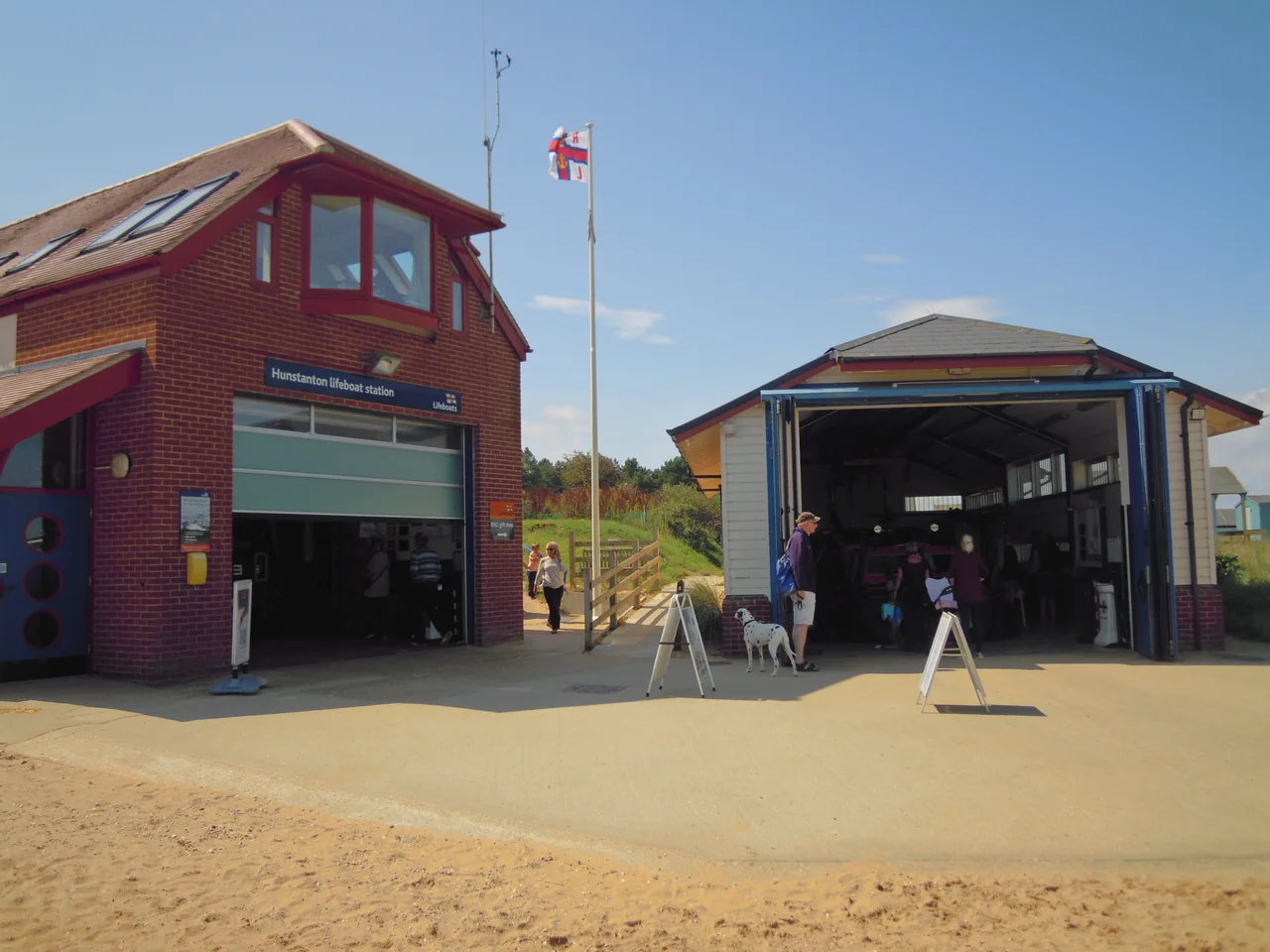
Hunstanton Lifeboat Station
Every lifeboat station on the east coast of England faces east, out to the North Sea. Hunstanton is the exception. Sitting on the eastern edge of The Wash — the wide, square-mouthed bay where Norfolk bends to meet Lincolnshire — the station faces west. The geography is unusual, and so is the challenge: at low tide, the broad expanse of mud flat and shallow water between the boathouse and navigable depth can stretch for considerable distances, making a launch that would be straightforward at other stations a test of equipment and nerve.
Two Hundred Years at The Wash
A lifeboat was first placed at Hunstanton in 1824 by the Norfolk Shipwreck Association — a local response to the particular dangers of The Wash, where shifting sandbanks and treacherous tides have claimed vessels for centuries. The first boat apparently fell into disrepair by 1843 and was never replaced.
The Royal National Lifeboat Institution reestablished the station in 1867, following a visit by the assistant Inspector of Lifeboats. The new boathouse was built close to the original site. When the 1867 lifeboat arrived — a 32-foot self-righting vessel, transported free of charge by the Great Eastern Railway, which also ran a special excursion train from London for spectators — it was taken through the town in grand procession before being formally named and launched on demonstration.
The new boat proved its value quickly. In January 1868, it saved 16 people from the barque Thetis of Gothenburg, and 15 from the steamship SS Harmonia of Hamburg. Two rescues, 31 lives, in the station's first winter of service.
The Tractor Innovation
Hunstanton's particular geography — miles of beach and mudflat at low tide — made it one of the most difficult launching environments for a conventional lifeboat station. When the tide was out, the boat had to be hauled across terrain that would bog down a horse-drawn carriage. The RNLI recognized this as a problem shared by several coastal stations with similar conditions, and chose Hunstanton as the test site.
On 26 March 1920, a Clayton agricultural tractor successfully towed the lifeboat to the water's edge in the first trial. It worked. Hunstanton received the first specially adapted tractor before the equipment was rolled out to other stations with comparable terrain. The innovation made launches possible at states of tide that had previously been prohibitive, and changed the operational capacity of stations facing similar challenges around the British coast.
The station closed in 1931 — the RNLI periodically rationalizes its coverage — but reopened in 1979 when an increase in marine incidents in The Wash made clear that a service was again needed.
A Hovercraft on The Wash
Today Hunstanton operates two vessels. One is conventional: the Spirit of West Norfolk (B-848), an inshore lifeboat in service since May 2011. The other is less so: the Hunstanton Flyer (H-003), an H-class hovercraft that has been on station since 2003.
The hovercraft was built by Griffon of Southampton for £122,000, funded by the staff and pensioners of the Civil Service, Royal Mail, and British Telecom through their lifeboat fund. It weighs 2,500 kilograms, its hull is marine-grade aluminium and fibre-reinforced composite, and it runs on twin Volkswagen Golf turbo diesel engines. A hovercraft can cross the mud flats that would stop a conventional lifeboat or a rescue vehicle — crossing the problem terrain that has defined Hunstanton's challenge since 1824. The vessel is named the 'Hunstanton Flyer,' which feels appropriate: a craft that skims the surface of The Wash, lifting over the mud that has thwarted rescues for two centuries.
The People Behind the Station
Stations like Hunstanton run on volunteers. The crew members who won awards for a rescue in 1985 and again in 1988 — Alan John Clarke earning the RNLI Bronze Medal twice — were local people going out in difficult conditions because the conditions demanded it.
In 2007, the Queen's Birthday Honours included an MBE for Margaret Lumley Bullen, chair of the Hunstanton Ladies Guild, for services to charity. She had spent her wartime career working with the code-breakers at Bletchley Park, a secret she had kept for fifty years. The lifeboat station had been part of her community's life for all of that time and longer — two institutions, one devoted to codebreaking and one to rescue at sea, connected by a woman who had quietly served both.
From the Air
Hunstanton Lifeboat Station lies at 52.954°N, 0.503°E at Old Hunstanton on the east shore of The Wash. The nearest airport is King's Lynn (EGYL), approximately 20 km to the south. From the air, The Wash is immediately recognizable: the wide, shallow bay between Norfolk and Lincolnshire, with its extensive areas of mud flat and sand bar visible at low tide. The lifeboat station sits at the edge of the cliffs near Old Hunstanton, with the striped chalk and carrstone cliffs of the headland visible. Looking west across The Wash on a clear day, the Lincolnshire coast is visible. EGSH (Norwich) is approximately 65 km to the east.
Nearby Stories
- Maud Foster Windmill 2 km away
- Cley Marshes 4.3 km away
- Narborough Bone Mill 6.2 km away
- RAF Attlebridge 6.5 km away
- Crowland Abbey 13 km away
- HMS Cobra 19 km away
- Alford Windmill 23 km away
- RAF Binbrook 25 km away