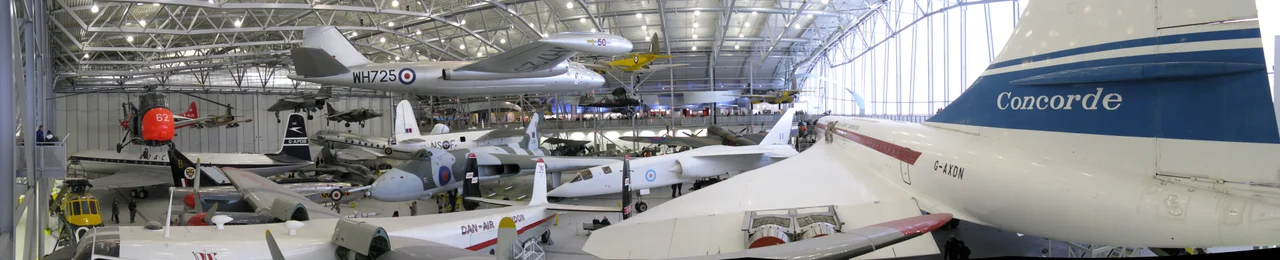

Imperial War Museum Duxford
In August 1938, a Supermarine Spitfire took off from Duxford for the first time in operational service, piloted by a squadron that had just become the first in Britain to fly the new aircraft. Two years later, Duxford's Spitfires and Hurricanes were fighting the Battle of Britain from the same grass and concrete. By 1961, the last operational flight had left. The airfield sat derelict for years. Then volunteers started arriving to restore the aircraft, and the airshows began. Today Duxford is still an active airfield — and Britain's largest aviation museum.
A Century in the Air
Duxford Aerodrome was selected in 1917 as a Royal Flying Corps training site in southern Cambridgeshire. It became a fighter station in 1925 and retained that role until the end. During the Battle of Britain, Duxford served as a sector station for RAF Fighter Command's No. 12 Group. American forces arrived in April 1943 when the 78th Fighter Group flew in with Republic P-47 Thunderbolts, later switching to North American P-51 Mustangs. Until the German surrender in 1945, those pilots flew bomber escort and ground attack missions across occupied Europe. After the war, changing defence priorities pushed the RAF's fighter force north. Duxford's last operational flight was in July 1961. In 1968, United Artists used the derelict site to film the movie Battle of Britain, demolishing a First World War hangar during the shoot to simulate an air raid.
From Ruin to Museum
When the Ministry of Defence announced its intention to dispose of Duxford in 1969, the Imperial War Museum requested permission to use one of the hangars for storage. Within two years, ten aircraft had arrived and volunteers from the East Anglia Aviation Society were restoring them. The first airshow ran in 1973. A display in June 1976 drew 45,000 people. Permanent transfer of the entire site to the museum came in February 1976. Visitor numbers jumped from 167,000 in the first season to 340,000 the following year. Two million visitors had come by 1982. More than thirty of Duxford's original buildings carry listed status, including three First World War hangars. The operations block, where controllers once directed Duxford's aircraft during the Battle of Britain, is open to the public and preserves its wartime operations room intact.
Norman Foster's American Air Museum
The most striking building on the site is the American Air Museum, designed by Norman Foster and opened by Queen Elizabeth II on 1 August 1997. Its curved concrete roof — shaped as a section of a torus, 90 metres wide and 100 metres deep — was built to accommodate a B-52 Stratofortress with its 61-metre wingspan. The roof weighs 6,000 tonnes and hangs 18.5 metres above a floor that covers 6,500 square metres. It won the 1998 Stirling Prize, the judges calling it 'dramatic, awe-inspiring, an object of beauty.' The SR-71 Blackbird on display inside is the only example of its type outside the United States; it set a flight altitude record of 85,069 feet in July 1976. A C-47 Skytrain suspended from the ceiling flew in all three major Allied airborne operations: the Normandy landings, Operation Market Garden, and the Rhine Crossing.
An Airfield That Still Flies
Duxford remains a licensed civil airfield with two runways — an 880-metre grass strip and a 1,503-metre concrete runway. Private aviation companies based here include The Fighter Collection and the Old Flying Machine Company. The most celebrated aircraft is Sally B, a B-17 Flying Fortress and the only airworthy example of its type in Europe. Regular airshows bring Spitfires, Hurricanes, Red Arrows, and warbirds from across the world. The annual American Air Day is held in conjunction with US Air Force units from nearby RAF Lakenheath and RAF Mildenhall. Beyond the aircraft, Duxford's Land Warfare Hall — though announced for permanent closure in 2024 — housed Montgomery's command vehicles alongside tableaux from the North African campaign, Falklands, and Northern Ireland.
From the Air
IWM Duxford lies at 52.093°N, 0.129°E, approximately 8 nautical miles south of Cambridge. The airfield (ICAO: EGSU) is active; exercise extreme caution when overflying. The site is bordered to the east by the M11 motorway, which provides an unmistakable landmark. At low altitude the distinctive arc of Norman Foster's American Air Museum and the rows of historic hangars are clearly visible. Cambridge City Airport (EGSC) is approximately 6 nautical miles to the north. The site is best viewed at 1,500–2,000 feet in clear conditions.
Nearby Stories
- Kentwell Hall 2.5 km away
- Thetford Hoard 2.8 km away
- King's Ely 6 km away
- Bedford 7.8 km away
- White House Farm murders 13 km away
- Oundle 14 km away
- Hemel Hempstead 14 km away
- North Weald Airfield 15 km away