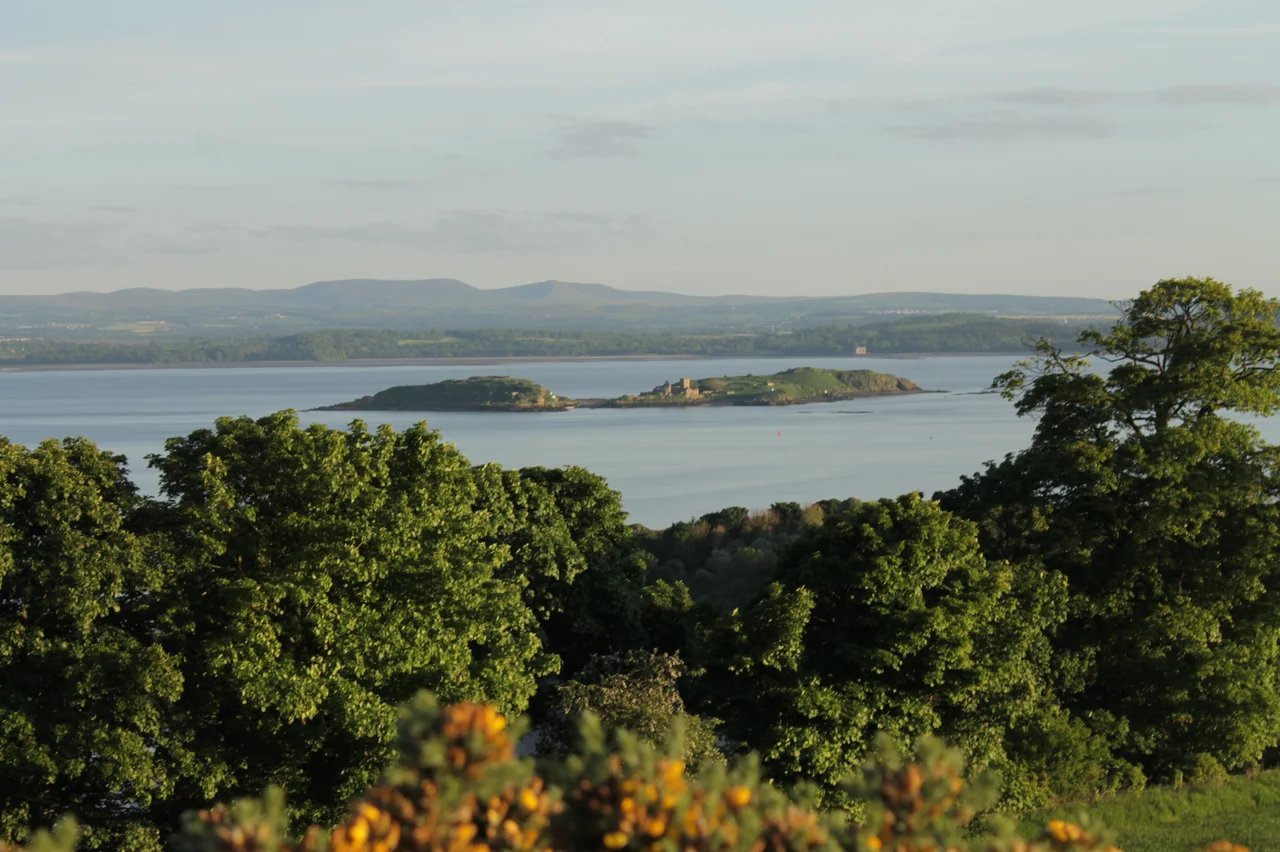

Inchcolm
In 1335 an English ship raided Inchcolm Abbey and stole, among other treasures, a statue of Saint Columba. According to the chronicle, the ship then nearly wrecked itself on the next island over and only barely limped into harbour at Kinghorn. The sailors took the hint. They returned the statue, sailed back to England in calm weather, and the story made its way into Scottish memory as proof of what happens when you steal from a saint. Inchcolm has been collecting that kind of story for fifteen centuries. The Iona of the East, monks called it, hiding in plain sight in the Firth of Forth.
Iona of the East
Inchcolm lies in the Firth of Forth, about a mile and a half east of the great Forth bridges, separated from the Fife shore by a narrow stretch of water called Mortimer's Deep. Tradition holds that Saint Columba - the Irish missionary who founded the monastery on Iona on Scotland's west coast in 563 - visited Inchcolm in 567. The island took its name from him much later, in the 12th century: Inch from the Gaelic innis for island, Colm for Columba, whose relics were held at Dunkeld Cathedral, originally the head of Inchcolm's diocese. A primitive stone-roofed hermit's cell, surviving inside the later abbey grounds, may go back as far as the 12th century. A hogback stone in the visitor centre dates to the late 10th century, probably Scotland's earliest type of Danish-influenced monument. Christianity was already old on Inchcolm when the Augustinian canons arrived.
Building an Abbey
The first priory on Inchcolm was established in the 1100s. In 1235, King Alexander II elevated it to an abbey of the Augustinian order. Through the 13th and 14th centuries, the abbey buildings grew - church, cloister, chapter house, refectory, dormitory - around a quiet rectangular plan, the canons singing the offices to the sound of waves on three sides. Walter Bower, abbot from 1418 to 1449, wrote the Latin Scotichronicon there, one of the most important historical sources for medieval Scotland. The island was part of the diocese of Dunkeld, also dedicated to Columba, and several medieval bishops were buried inside the abbey church. The cloister survives in better condition than most of its mainland equivalents - it has been called the best-preserved monastic cloister in Scotland. Distance, water, and isolation kept iconoclasts away.
English Raids and a Returned Saint
The Wars of Scottish Independence in the 14th century made the Forth a war zone. English raiders attacked Inchcolm repeatedly. In 1335 the famous theft and supernatural return of Columba's statue persuaded one ship's crew to think twice. In 1384 another English raid tried to set the abbey alight, but a strong wind put the flames out before they could take hold. The story of saintly weather became part of the abbey's self-understanding. The island also served as a prison during the 14th and 15th centuries. Archbishop Patrick Graham of St Andrews was interned here, and in 1427 James I confined Mariota, Countess of Ross, the mother of Alexander, Lord of the Isles. In 1547, after the Battle of Pinkie Cleugh, an English force under Sir John Luttrell fortified the island with 100 hagbutters and 50 labourers; the Earl of Angus tried to take it back in October but failed. An 8 January 1548 inventory records the English armaments in remarkable detail - culverins, sakers, falcons, fowlers, port pieces, ninety arquebuses. In April 1548 Luttrell abandoned the island and destroyed his own fortifications.
Reformation, Reformation Survivor
After the Protestant Scottish Reformation of 1560, the monastic community at Inchcolm was disbanded. On the mainland, Reformers stripped or destroyed many abbeys; on the island, the buildings could not be reached easily enough for thorough demolition. The result is that Inchcolm Abbey survives in better condition than almost any other Scottish monastic house. In the same century the island passed to Sir James Stewart, whose grandson became the third Earl of Moray by marriage. The Earls of Moray still carry the courtesy title Lord St Colme, dating from 1611 and taken directly from the island. In the 1880s a worker found a human skeleton built upright into one of the abbey's walls. Nobody knows whose body it was or when it was placed there. Inchcolm keeps these mysteries, and the ones it does not let go remain its own.
Guns Against the Kaiser
During both World Wars, Inchcolm was a key node in the defences of the Firth of Forth. Throughout the First World War it served as the headquarters of what was called the Middle Defences - a continuous anti-submarine and anti-boat boom strung across the Firth to protect the naval anchorage between Inchcolm and the Forth Rail Bridge. When the Grand Fleet moved from Scapa Flow to the Forth in 1916, the defences were strengthened. The 576 Cornwall Works Company of the Royal Engineers tunnelled under the eastern hill to connect a new battery of guns to its magazine on the protected side of the island. Concrete bunkers and gun emplacements still survive on the east end, where the abbey's cloister and the war's gun-pits coexist as ruins of different centuries. The island is roughly three sections: the eastern military complex; the lower central part with the small natural harbour and the visitor shop; and the larger western end where the abbey sits.
Seals, Puffins, and Black Rats
Inchcolm is now in the care of Historic Scotland and accessible during the warmer months via boat tours from South Queensferry's Hawes Pier. The 2011 census recorded no usual residents. Wildlife has the run of the place. Seals haul out on the surrounding rocks. Between April and July puffins nest on the northern rockface and can be seen bobbing in the water as they hunt for fish. The island also hosts one of the very few colonies of black rats remaining in Britain - the species that arrived on medieval ships and that the more aggressive brown rat has displaced almost everywhere else. There are no stoats or hedgehogs, so seabirds can lay eggs on the ground without too much risk. The current human population is a Historic Scotland monument manager and a residential steward. The Augustinian canons would recognise the silence. The seventeen centuries of Columban prayer, English bombardment, royal imprisonment, and twentieth-century coastal artillery have all left their traces. Inchcolm holds them all and still feels, somehow, peaceful.
From the Air
Inchcolm sits at 56.029N, 3.30W in the Firth of Forth, between the Fife shore and the City of Edinburgh - about 1 nm offshore from Aberdour and 2.5 nm east of the Forth bridges. From the air the island is small but distinct, roughly 1 km long and oriented east-west, with the abbey's tall central tower easily visible on the western half. Easy landmarks: the Forth Rail Bridge (the iconic red cantilever) is 2.5 nm west, the Forth Road Bridge and Queensferry Crossing immediately beside it, Aberdour Castle 2 nm north on the Fife shore, Edinburgh city centre 5 nm south. Edinburgh Airport (EGPH) is 8 nm south-southwest. Best viewing altitude 1,500-2,500 ft, ideally with the Forth bridges in the same frame for scale. Seals and puffins are visible on the surrounding water in season. Cold sea haar can blanket the island even when Edinburgh is clear.
Nearby Stories
- Ardoch Roman Fort 2.2 km away
- Craignethan Castle 3.1 km away
- Haddington 3.8 km away
- Balvaird Castle 4.3 km away
- Battle of Kilsyth 9.4 km away
- Siege of St Andrews Castle 9.9 km away
- Neidpath Castle 11 km away
- Melrose Abbey 15 km away