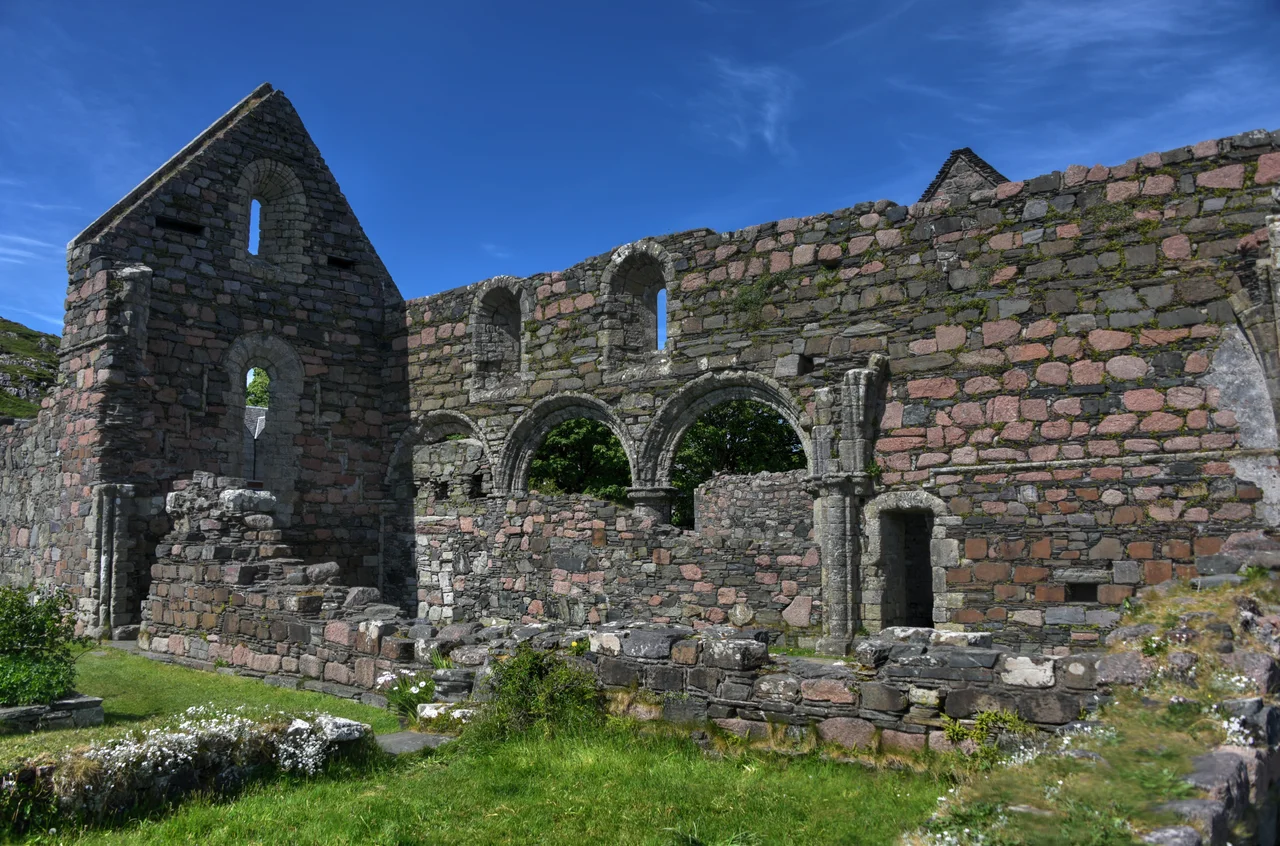

Iona Nunnery
Three. There were only ever three Augustinian houses for women in medieval Scotland. One at Perth, one at Carinish on North Uist, and one on Iona, founded shortly after 1203 by Bethoc, daughter of Somerled and sister of Raghnall who had built the great Benedictine abbey just up the lane. Bethoc became prioress. The other two are gone. Iona's nunnery survives as the most complete medieval nunnery ruin in Scotland, walled, roofless, and quiet in its precinct beside the only village on the island.
Bethoc, Daughter of Somerled
The story starts with a Hebridean dynasty. Somerled, the twelfth-century half-Gaelic, half-Norse lord who carved out a sea-kingdom across the western isles, founded a line that splintered into the great clans Donald, MacDougall, and MacRory. After his death in 1164 his children divided his work. Raghnall mac Somhairle endowed a Benedictine monastery on Iona in 1203, restoring the island's old Columban prestige under a new continental rule. His sister Bethoc was given charge of a sister house. Augustinian canonesses, following the moderate rule that took its name from St Augustine of Hippo, were unusual in Scotland. The community here was always small. A surviving headstone, now in the Iona Abbey museum, marks the death of one of Bethoc's distant successors, Anna MacLean, prioress, who died in 1543. The top half of the slab remains, a carved figure in a long robe, the inscription almost gone. She had perhaps three decades left before the Reformation closed the house for good.
An Irish Plan in Hebridean Stone
The nunnery was laid out in the Irish manner. The church is a small three-bay nave with a passage along the north side and a chapel off it to the east. South of the church, the cloister forms a square fourteen metres on a side, though it was smaller in the earliest phase and expanded later. The east range carried three ground-floor rooms with a dormitory above. The south range housed the refectory. The west range, now buried beneath the modern road, was probably the guest wing, the side closest to whoever might arrive at the door. The whole complex is built of local schist and granite, the masonry now bare to the sky, the walls knee-high to chest-high to head-high in different places. A floor was inserted in the sixteenth century to give the nuns a little more usable space. They had less than fifty years left to use it.
Reformation, Ruin, and Care
The Scottish Reformation reached Iona in the sixteenth century and dissolved both abbey and nunnery. The abbey was eventually restored, beginning in the 1870s and completed across the twentieth century, but the nunnery was left to weather. By the 1760s, when Samuel Johnson and James Boswell came through, the ruin looked much as it does today. The site was still used as a burial place for women after the buildings had collapsed. Restoration work happened in 1923 and again in 1993, stabilising what remained without rebuilding what was lost. Historic Environment Scotland now manages it as a scheduled monument, free to enter, in a walled precinct beside the modern village called Baile Mor. Tourists walking up from the ferry pier reach the nunnery first, then St Oran's Chapel, then the abbey. The order is accidental, but it reads as a kind of sequence: women's house, kings' burial ground, monks' church. Almost the whole religious landscape of medieval Iona, in half a mile.
From the Air
Iona Nunnery lies at 56.33 N, 6.39 W in the village of Baile Mor on the eastern side of Iona, about 200 yards west of the ferry pier from Fionnphort on Mull. No airport on Iona. Nearest is Tiree (EGPU) some 22 nm northwest, or Glenforsa (EGEH) 28 nm east on Mull. Recommended viewing altitude 1,500-2,500 ft. Visual landmarks: Iona Abbey 400 yards north of the nunnery, the larger and more obvious roofed complex; St Oran's Chapel between them; the white sand beaches of the north end of the island; the Sound of Iona between Iona and the Ross of Mull. The nunnery footprint is small but the green precinct around it stands out from the air.
Nearby Stories
- Coll 4.6 km away
- Skerryvore 5.4 km away
- Moy Castle 7.5 km away
- Eden (2016 TV Series) 17 km away
- Oronsay 17 km away
- Jura Distillery 27 km away
- Barra Head 42 km away
- SS Justicia 62 km away