
Ionian Village
In 1966, the government of Greece gave the Greek Orthodox Archdiocese of North and South America 2,840 acres of pine forest and beachfront on the northwestern coast of Elis. Aristotle Onassis provided supporting sponsorship. Archbishop Iakovos of America, who had led the marches with Martin Luther King Jr. and represented the Greek Orthodox Church in America at a pivotal moment in its history, had a more intimate project in mind: a place where the children of Greek immigrants could encounter the country their parents and grandparents had left. Four years later, the camp opened.
A Gift from Greece, Received in Pine Forest
The land that became Ionian Village sits on the north-west coast of the Elis regional unit, near the village of Vartholomio, west of the trading town of Amaliada. The 11,500 stremmata — roughly 11.5 square kilometers — of campus occupies a stretch of Ionian coastline where the pine trees run down toward a private beach. The Ionian Sea begins just beyond the shore. On clear days, the island of Zakynthos is visible offshore to the northwest.
The camp was formally established in 1970 at the initiative of Archbishop Iakovos, who conceived it as a means of fostering cultural and religious ties to Greece for the children of Greek immigrants who had come to the United States and Canada in the early and mid-20th century. Many of those immigrants' children and grandchildren had grown up American in every practical sense. Ionian Village was an answer to the question of what connecting them to their heritage might look like in practice: not a museum visit, but three weeks of living it.
How the Summer Works
Each summer, Ionian Village runs two identical 20-day sessions. Approximately 200 campers per session fly together from New York to Athens, then travel by motor coach to the campus near Vartholomio — a journey that is itself a kind of orientation. The summer staff are selected from qualified Orthodox Christian young adults; medical staff and summer clergy are also present, principally drawn from the United States.
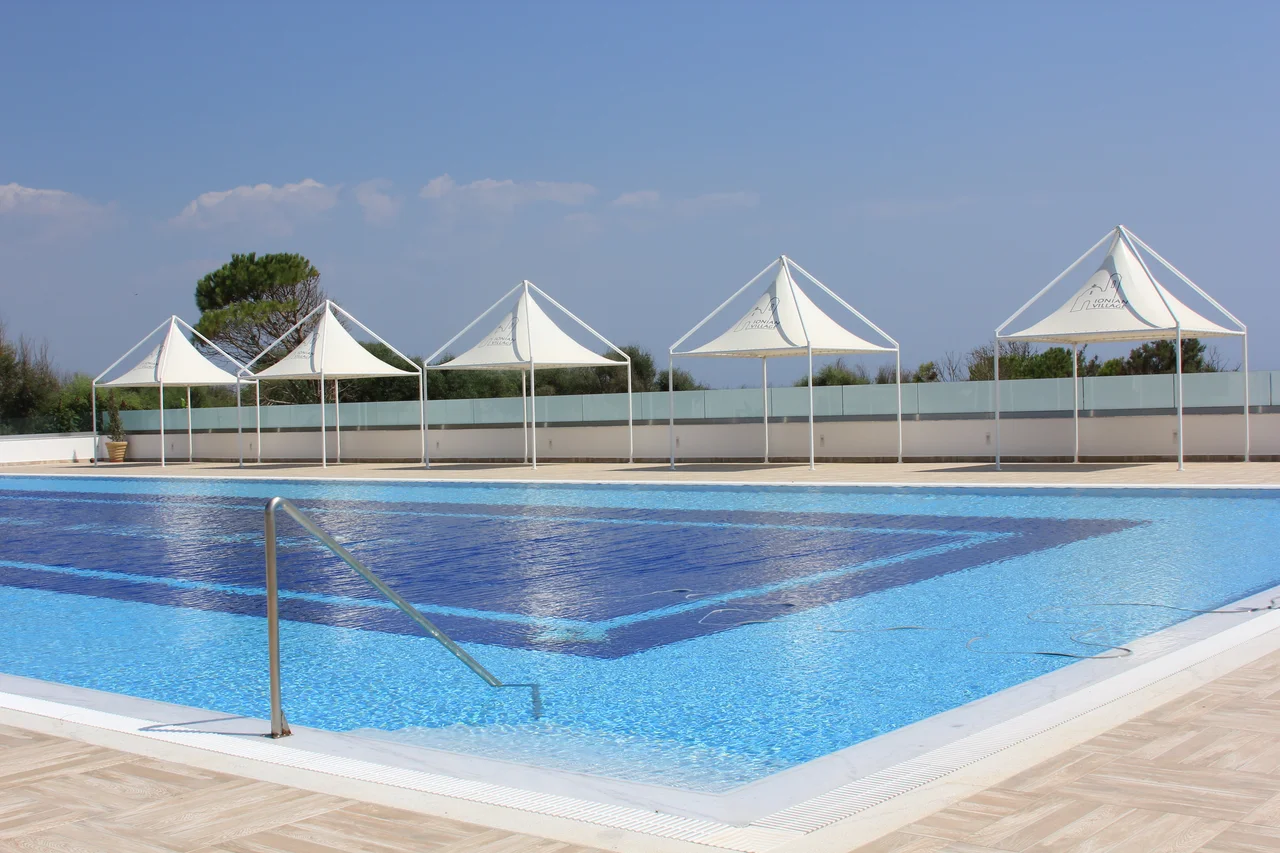
The daily program divides between in-camp days and travel days. In-camp days combine athletics, arts and crafts, music, and Greek cultural programming, with time in the Olympic-sized pool or on the private beach. Travel days take campers to historical sites across the region: ancient Olympia, the mountain town of Kalavryta, the city of Patras, and the Ionian islands of Zakynthos, Corfu (Kerkyra), Aegina, and Cephalonia (Kefalonia). The program ends with three nights in Athens — the Acropolis, the Changing of the Guards at Syntagma Square, shopping in Monastiraki.
In addition to the two main sessions, the camp offers IV Next, a 12-day program for young adults aged 18 to 25, and IV Pilgrimage, a 12-day program for private groups of 10 to 20 adults in the late summer.
Jacqueline Kennedy Onassis and the Ethousa
In July 1975, Jacqueline Kennedy Onassis came to Ionian Village. She was there to open a new recreational building — named the Ethousa — dedicated in memory of Aristotle Onassis, who had died in March of that year. The building was intended for use by clergy and medical staff, and for the camp's "Flextivities" and music and Greek culture programming. Mrs. Kennedy Onassis unveiled a commemorative plaque at the opening.
The moment connected two threads of Greek-American life in the 1970s: the Orthodox diaspora institution that Archbishop Iakovos had built, and the world of Greek shipping and international influence that Onassis had represented. Both were invested, in different registers, in the relationship between Greece and the Greek communities of America. The Ethousa still stands on the campus.
The Tornado of September 2016
On the morning of September 8, 2016, a tornado struck the area of Vartholomio. It made first landfall directly on the Ionian Village campus. The damage was extensive: more than 600 pine trees were knocked down or uprooted, the pool's glass was shattered, the petting zoo was destroyed with animals wounded and killed, and the structures housing the camp's outdoor programs were wrecked. The cabins and the Ethousa suffered minor but significant exterior damage.
The Saint Iakovos Chapel, dedicated to the patron saint for whom Archbishop Iakovos was named, suffered little to no damage. The total cost of repairs was estimated at around $1.5 million. A rebuilding fund was established; by December 25, 2016, it had raised close to $600,000. The campus was restored and the camp has continued to operate in subsequent summers.
Fifty-Five Summers on the Ionian Coast
More than 20,000 people have attended Ionian Village since 1970 — a figure that covers multiple generations. Some who came as high school campers have returned as staff; some who came as staff have sent their own children. The institution that Archbishop Iakovos founded as a bridge between Greek-American identity and Greece itself has, over more than five decades, become part of what it means to grow up Greek Orthodox in America.
The camp's physical setting — the pine forest, the private beach, the chapel at the center of the campus, the amphitheater open to the evening stars — remains essentially what it was in the 1970s, rebuilt after the tornado and continually maintained. Its location on the Elis coast places it within easy distance of ancient Olympia, of Byzantine and Frankish monuments in Elis, and of the same Ionian islands that have been part of the Greek world since antiquity. For the campers who arrive each summer from New York, the bus ride from Athens to Vartholomio is the first time many of them have seen this landscape. For the camp, it is just another summer.
From the Air
Ionian Village lies at approximately 37.83°N, 21.15°E on the northwestern Elis coast, near the village of Vartholomio. From the air at 1,500–3,000 feet, the 11.5-square-kilometer campus — a broad stretch of pine forest running down to a private beach — is distinguishable from the surrounding agricultural land. The private beach and the Ionian Sea shoreline are the easiest identifiers. Zakynthos is visible offshore to the northwest. The nearest major airport is LGRX (Araxos), approximately 25 km to the northeast. The camp is not open to general visitors; it operates as a private facility during the summer season.
Nearby Stories
- Astras 4.5 km away
- Heraea (Arcadia) 5.3 km away
- Battle of Lepanto 6.7 km away
- Ionian Islands 9.7 km away
- Saint Gerasimos Monastery 14 km away
- Alpheus (deity) 16 km away
- Salmeniko Castle 19 km away
- 2018 Ionian Sea Earthquake 20 km away