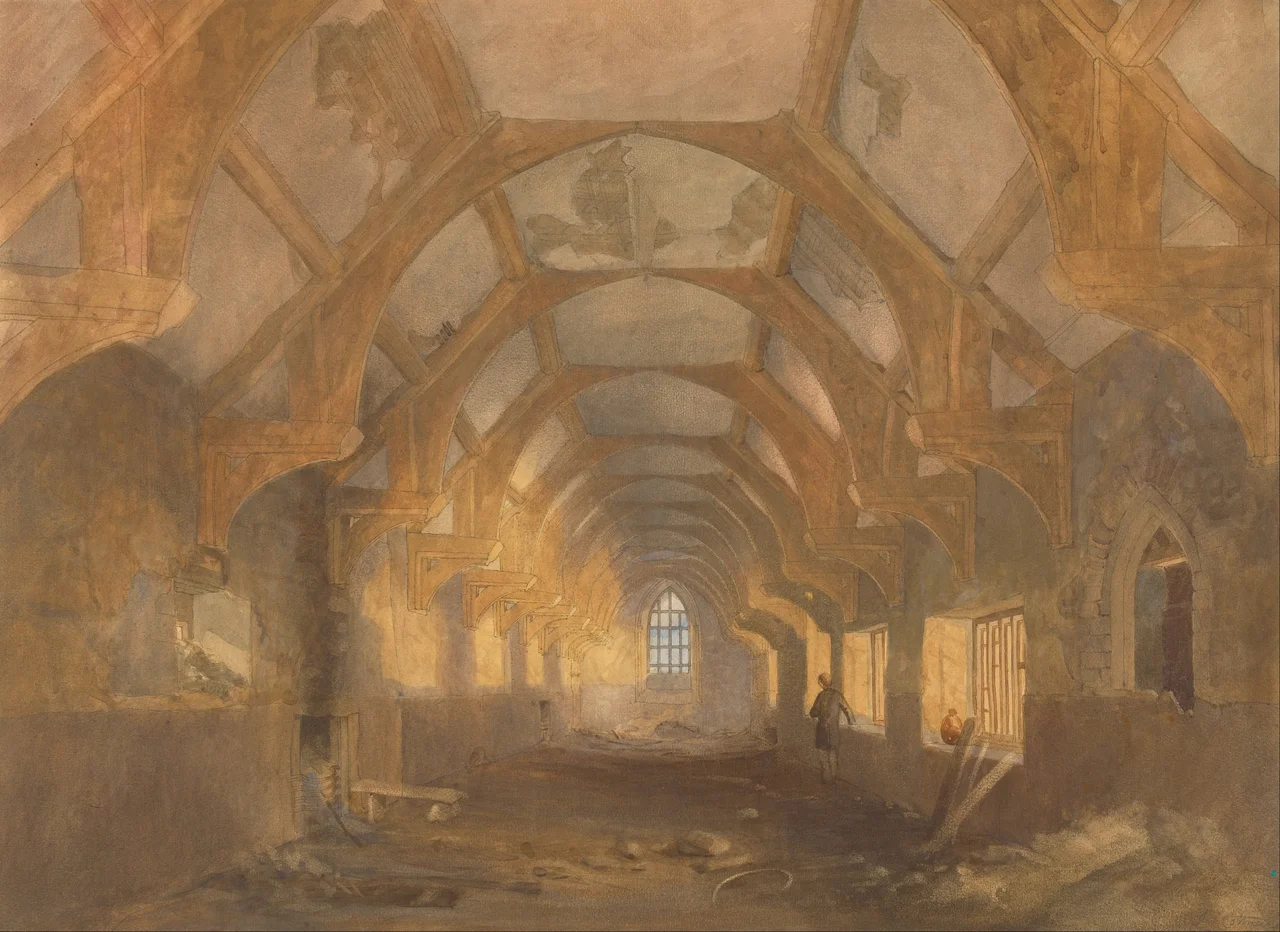

Ipswich Blackfriars
In 1327, when workers excavating the priory cemetery at Ipswich Blackfriars uncovered a skeleton missing its right hand, forensic analysis suggested an identification: Richard de Holebrok, of Tattingstone near Ipswich, who in that same year had been attacked by a mob, tied to a tree, and had his hand cut off. The wound had healed. Richard had survived — and, it seems, had eventually been buried at the Blackfriars, among the earls and merchants and outlaw MPs who sought the prayers of the Dominican friars. Even in the soil, the 14th century speaks.
Founded by a King
King Henry III established the Dominican friars at Ipswich in 1263, purchasing land from Hugh son of Gerard de Langeston and giving it to the friars to live there. The Blackfriars were the second of three mendicant communities in the town: the Franciscan Greyfriars had arrived before 1236, the Whitefriars came around 1278–79. In the founding phase, Robert Kilwardby — appointed Provincial Prior of the Dominicans in England in 1261, and later Archbishop of Canterbury — acquired additional property on the friars' behalf. Edward I gave alms when visiting in April 1277. Queen Eleanor's executors donated 100 shillings in 1291. Royal patronage continued for decades, and the friary grew.
The Benefactors and the Buried
The Blackfriars' cemetery and church attracted the burials and bequests of Suffolk's leading families. Roger Bigod, the 5th Earl of Norfolk, was among the major benefactors. Sir Robert de Ufford, Earl of Suffolk, was commemorated here. Adam de Brandeston, sometime Member of Parliament and deputy butler of Ipswich, was outlawed for felony — but had requested burial at the friars preachers, and his will specifying it was proved in December 1362. Gilbert Boulge, an Ipswich wool merchant, held a knight's fee and was buried here in 1380. About 250 burials were uncovered in excavations of the priory cemetery, each one a story of medieval Ipswich life and death.
A Misread Ruin
When the artist Joshua Kirby made his prospect and plan of the Blackfriars site in 1748, more than two centuries after the Dissolution, he misidentified most of what remained. What he took for the friary church was in fact the refectory. The building he identified as the refectory had been the dormitory. The structure he assumed was the cloister was a post-medieval construction called Christ's Hospital. The real church — a substantial aisled nave 135 feet long and 55 feet wide — had already vanished. It was not until the 1970s and 1980s, through scholarly reanalysis and excavations by the Suffolk County Council team, that the true layout was understood. The footprint of the church, discovered exactly where the revised analysis predicted, is now preserved as a grassed open area between Foundation Street and Lower Orwell Street.
What the Dissolution Left
By the 1530s the Blackfriars were leasing out properties they had no immediate use for — gardens, a mansion, lodgings with names like Friar Woodcoke's lodging — as income dwindled. In November 1538, Bishop Yngworth arrived and the friary closed. The buildings were leased and then sold to William Sabyn, a naval sea-captain who had served as controller of the Ipswich customs, Bailiff, Portman, and Member of Parliament. He died in 1543 and the property passed through further hands to the Borough of Ipswich. The last of the monastery buildings — the former dormitory, which had served as a schoolroom — was demolished in 1849. What remains today is a fragment of sacristy wall, some preserved footings, and interpretation panels on the grass where a Dominican church once stood.
From the Air
Located at 52.05°N, 1.16°E in central Ipswich, Suffolk, within the historic town centre. The Blackfriars site lies between Foundation Street and Lower Orwell Street, close to the River Orwell and Ipswich waterfront. Nearest airports: Ipswich Airport (EGSE), approximately 2 miles northeast; Norwich Airport (EGSH), approximately 45 miles north. Recommended viewing altitude 1,500–2,500 feet to appreciate the medieval street pattern of Ipswich. The waterfront and dock areas are visible to the south.
Nearby Stories
- Walton-on-the-Naze 2.7 km away
- Clare, Suffolk 9.5 km away
- RAF Lakenheath 10 km away
- RAF Hardwick 11 km away
- Beeleigh Abbey 13 km away
- Four Days' Battle 45 km away
- Southern Bight 75 km away
- Battle of Lowestoft 79 km away