.jpg)
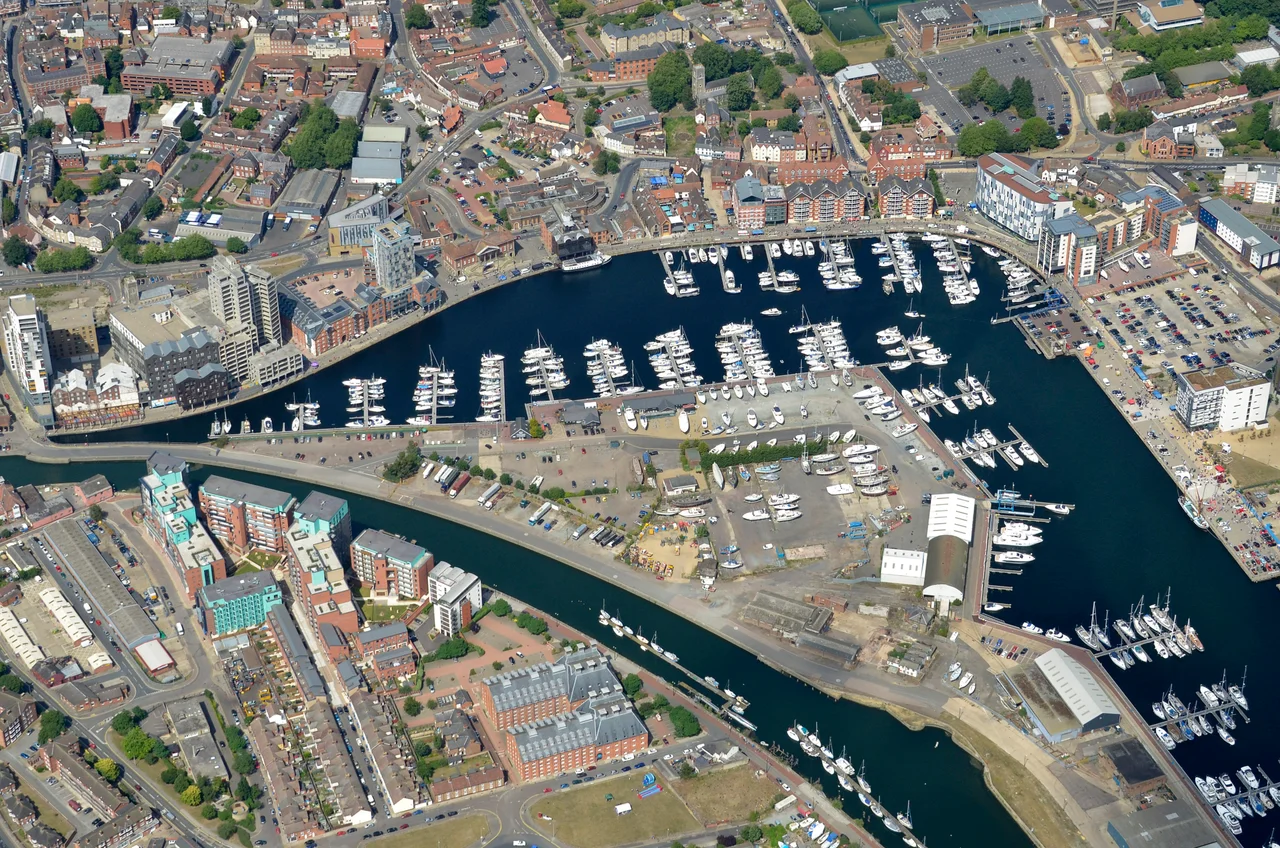
Ipswich Docks
When the wet dock at Ipswich opened in 1842, it was the largest enclosed dock in the United Kingdom. Thirty-three acres of water held permanently at high tide by a single lock at the southern end. Ships that had once jostled at the Common Quay, with its silted approaches and its eight-foot draft restriction, could now lie alongside warehouses regardless of the tide. The town had been the great Saxon trading port of East Anglia, the place from which English wool sailed to Flanders and where Continental wine and Baltic timber came ashore. The new dock was meant to put it back in that league. For a while, it did.
The Sixteenth-Century Glory and Its Decline
Ipswich enjoyed what one chronicler called a great trade in the sixteenth century. By the seventeenth, the trade had slipped. London and the new ports of the Thames estuary took more and more of it. The Common Quay on the River Orwell silted up to the point where any vessel drawing more than eight feet had to anchor three miles downstream at Downham Reach and tranship its cargo into lighters, flat-bottomed barges that could navigate the shallows. Every ton of grain or coal cost extra to move twice. By the early nineteenth century the once-busy Suffolk port was a backwater. Something drastic was needed.
The Engineering Solution
In 1837 an Act of Parliament authorised the Ipswich Dock Commissioners to build a wet dock. The engineer Henry Robinson Palmer, vice-president of the Institute of Civil Engineers, designed it. The plan diverted the Orwell westwards along a New Cut, leaving a horseshoe of the old river bed behind, which became the dock. A lock at the southern end maintained the water level. Construction took five years. The investment of £25,000 had to be supplemented by borrowing £100,000 and then £20,000 more, plus an additional levy of sixpence per ton on imported coal. The dock opened in 1842 to immediate acclaim and immediate use. The Parliamentary act had included an unusual public-access clause requiring the commissioners to allow all persons, with cattle and carriages, free access to the dock and quays, and to contribute to the health and recreation of the inhabitants of Ipswich. A Victorian port that doubled as a public park.
Fossil Dung and Suffolk Fields
The new dock attracted new industry, most strikingly the coprolite factory founded by Edward Packard in 1849. Coprolites, in this Victorian context, were not strictly fossil dung but fossilised phosphatic nodules dug from the local crag deposits. Packard ground them, treated them with sulphuric acid, and produced superphosphate, one of the first artificial fertilisers. East Anglian farming was transformed. Yields rose. Packard's company grew into one of the largest fertiliser manufacturers in Britain. The factory gave its name to Coprolite Street, which still runs along the dock's eastern edge, a small street with one of the more unusual etymologies in Suffolk. The crag deposits eventually played out and the coprolite industry faded by the early twentieth century, but for a generation, the Ipswich docks essentially helped feed the country.
Lock After Lock
By the 1870s the original lock could no longer take the bigger steam vessels coming in. The Ipswich Docks Act 1877 authorised a larger lock at the dock's southern entrance and the laying of tram lines along the strip of land, called the Island, between the New Cut and the dock itself. The Act was one of seven major pieces of legislation that shaped the docks across the next century, from the original 1837 Act to the Port of Ipswich Harbour Revision Order of 2002. Each generation rebuilt for bigger ships and different cargoes. Grain, timber, fertiliser, malt, oil. The dock that had been built for sailing brigs eventually handled coasters and small bulk carriers. It was always a working port until, gradually, it was not.
Waterfront Reborn
By the late twentieth century, container ships went to Felixstowe and Harwich. The Ipswich grain stores emptied. The maltings went quiet. From 1999 onward, a major regeneration began. The University of Suffolk built its main campus along the north quay. Old warehouses became apartments, offices, restaurants. A cinema and bars filled the spaces around the dock's edge. Yachts from Fairline and elsewhere moor where coasters once unloaded. The tall ship Stavros S Niarchos has visited; pleasure boats are now permanent residents. The wet dock that broke records in 1842 has reinvented itself again, no longer the largest of its kind but one of the most thoroughly reused. Suffolk's biggest piece of industrial heritage still holds water, just for different reasons.
From the Air
Ipswich Docks lies at 52.052 N, 1.162 E at the head of the Orwell estuary in central Ipswich, just south of the medieval town centre. Cruise at 2,000-3,000 feet to make out the distinctive horseshoe of the wet dock, the New Cut to its west, and the modern waterfront development along its quays. The Orwell estuary widens to the south toward Felixstowe and Harwich. Active airfields: London Stansted (EGSS) 40 miles southwest, RAF Wattisham (EGUW) 8 miles northwest, Norwich (EGSH) 35 miles north. Watch for traffic to/from Felixstowe and Harwich, and active Stansted approaches.
Nearby Stories
- Walton-on-the-Naze 2.7 km away
- Clare, Suffolk 9.5 km away
- RAF Lakenheath 10 km away
- RAF Hardwick 11 km away
- Beeleigh Abbey 13 km away
- Four Days' Battle 45 km away
- Southern Bight 75 km away
- Battle of Lowestoft 79 km away