.jpg)
Ipswich
Walk out of Ipswich railway station and a particular kind of English visual collision hits you. Across the river, the cylindrical glass tower of the Willis Building, designed by Norman Foster in 1975 and now Grade I listed, reflects the sky. Beside it, sixteenth-century timber-framed cottages lean over the same pavement. Behind both, Saxon street patterns still organise the town centre, while concrete tower blocks from the 1960s rear up against the skyline. No other place in East Anglia compresses so many centuries of building into so few square miles. Ipswich has been important for so long that it kept forgetting to throw the old town away.
The Saxon Port
Ipswich, called Gippeswic by the Anglo-Saxons, was already a major trading port by the seventh century. Pottery kilns here produced Ipswich Ware, the first wheel-thrown pottery made in Britain after the Romans left, and shipped it across the kingdom. Frisian and Frankish ships came up the Orwell estuary loaded with wine and millstones. Wool went out. The town grew until it was, briefly, one of the most important commercial centres in northern Europe. It was also the birthplace of Thomas Wolsey, son of an Ipswich butcher, who rose to become Cardinal Archbishop of York and Lord Chancellor under Henry VIII. Wolsey founded a college in his hometown in 1528. When he fell from royal favour the next year, the college was demolished. Only Wolsey's Gate survives, a small brick arch on College Street, a fragment of what might have been Oxford-on-the-Orwell.
Medieval Churches Everywhere
Ipswich has the third-largest concentration of medieval church towers in England, behind only the City of London and Norwich. Walk the town centre and you find them every few streets: St Margaret's with its hammerbeam roof, St Mary at the Elms with its Norman doorway, St Lawrence in the Buttermarket, Blackfriars in ruins among trees. Many are deconsecrated, repurposed as community spaces, antique shops, or simply preserved. They mark the wealth of medieval Ipswich, when the wool trade through the docks made the town one of the richest in the kingdom. Each parish needed a church grander than its neighbours. The competition produced an architectural inheritance that survived the Reformation, the Civil War, the Blitz and post-war urban renewal more or less intact.
Decline and Reinvention
When deepwater ships outgrew the Orwell estuary in the twentieth century, container trade shifted to Felixstowe and Harwich. Ipswich slumped. For decades it was a town that nothing much happened to. Then in the 1970s, London's financial firms began moving back-office operations out of the capital, and Ipswich became a hub. Royal Bank of Scotland, Willis Faber and Dumas, Norwich Union and AXA built office complexes north of the river. Foster's circular Willis Building, completed in 1975, was one of the first skyscrapers to be listed Grade I while its architect was still alive. The waterfront, around the old wet dock, was redeveloped from the late 1990s onward. Old grain warehouses became apartments. The new University of Suffolk built its main campus along the quay. Ipswich began breathing again.
Christchurch and Constable Country
On a low rise overlooking the town, Christchurch Park stretches across 80 acres of mature trees, ornamental ponds, and tennis courts. At its heart, Christchurch Mansion is a redbrick Tudor house built in 1548 on the site of an Augustinian priory dissolved by Henry VIII. It now holds one of the best collections of Constable and Gainsborough paintings outside London. Both painters worked the Suffolk landscape just south and west of Ipswich, in the river valleys the Victorians named Constable Country after the Stour Valley scenes the painter made famous. The Haywain itself shows Flatford, a few miles south on the A12, where the National Trust now runs the mill that Constable's father owned. Stand on the Ipswich bank of the Orwell and you are looking at exactly the soft, weathered, light-filled countryside that English landscape painting was invented to describe.
Football, Witches, and the Suffolk Punch
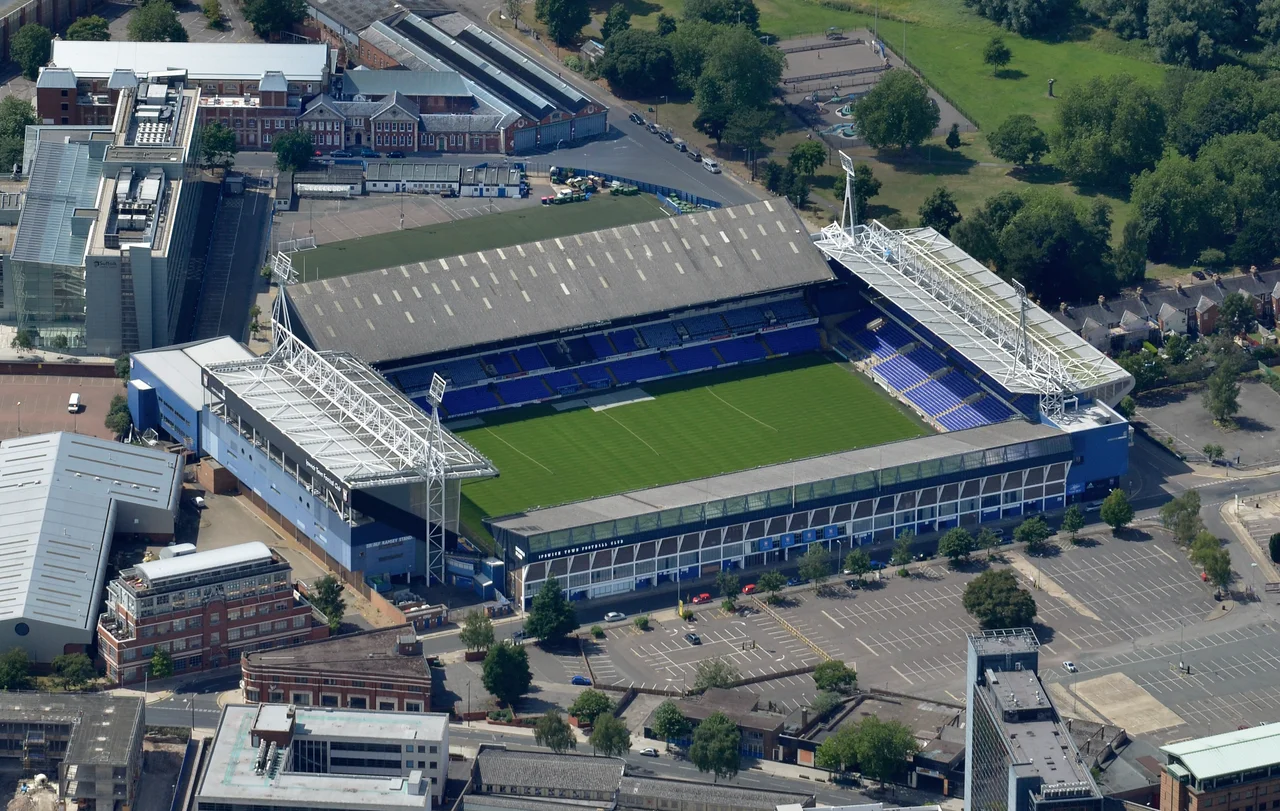
Ipswich Town Football Club was founded in 1878 and rose to win the First Division title in 1961-62 under manager Alf Ramsey, who would later manage England to World Cup victory in 1966. The club won the FA Cup in 1978 under Bobby Robson and the UEFA Cup in 1981. Their crest carries the Suffolk Punch, the red-chestnut draught horse native to the county and now critically endangered. The Ipswich Witches race motorcycle speedway at Foxhall Stadium, named for the witch trials that periodically swept Suffolk in the sixteenth and seventeenth centuries. The Buttermarket Centre and Sailmakers Shopping Centre handle modern shopping. Around the corner, the Ancient House of 1660s plasterwork still shows the four continents the seventeenth century knew. Ipswich is not pretty in the picture-postcard sense, but it is dense with stories. Most English towns are not. Ipswich is.
From the Air
Ipswich sits at 52.059 N, 1.156 E at the head of the Orwell estuary in southern Suffolk, 70 miles northeast of London. Cruise at 3,000-4,000 feet to take in the medieval town core, the distinctive cylindrical Willis Building, the redeveloped wet dock waterfront, and the Orwell widening southeast toward Felixstowe. Christchurch Park is the green space on the north side. Active airfields: London Stansted (EGSS) 40 miles southwest, RAF Wattisham (EGUW) 8 miles northwest, Norwich (EGSH) 35 miles north. Watch for Stansted approach traffic, active Wattisham helicopter circuits, and heavy shipping into Felixstowe.
Nearby Stories
- Walton-on-the-Naze 2.7 km away
- Clare, Suffolk 9.5 km away
- RAF Lakenheath 10 km away
- RAF Hardwick 11 km away
- Beeleigh Abbey 13 km away
- Four Days' Battle 45 km away
- Southern Bight 75 km away
- Battle of Lowestoft 79 km away