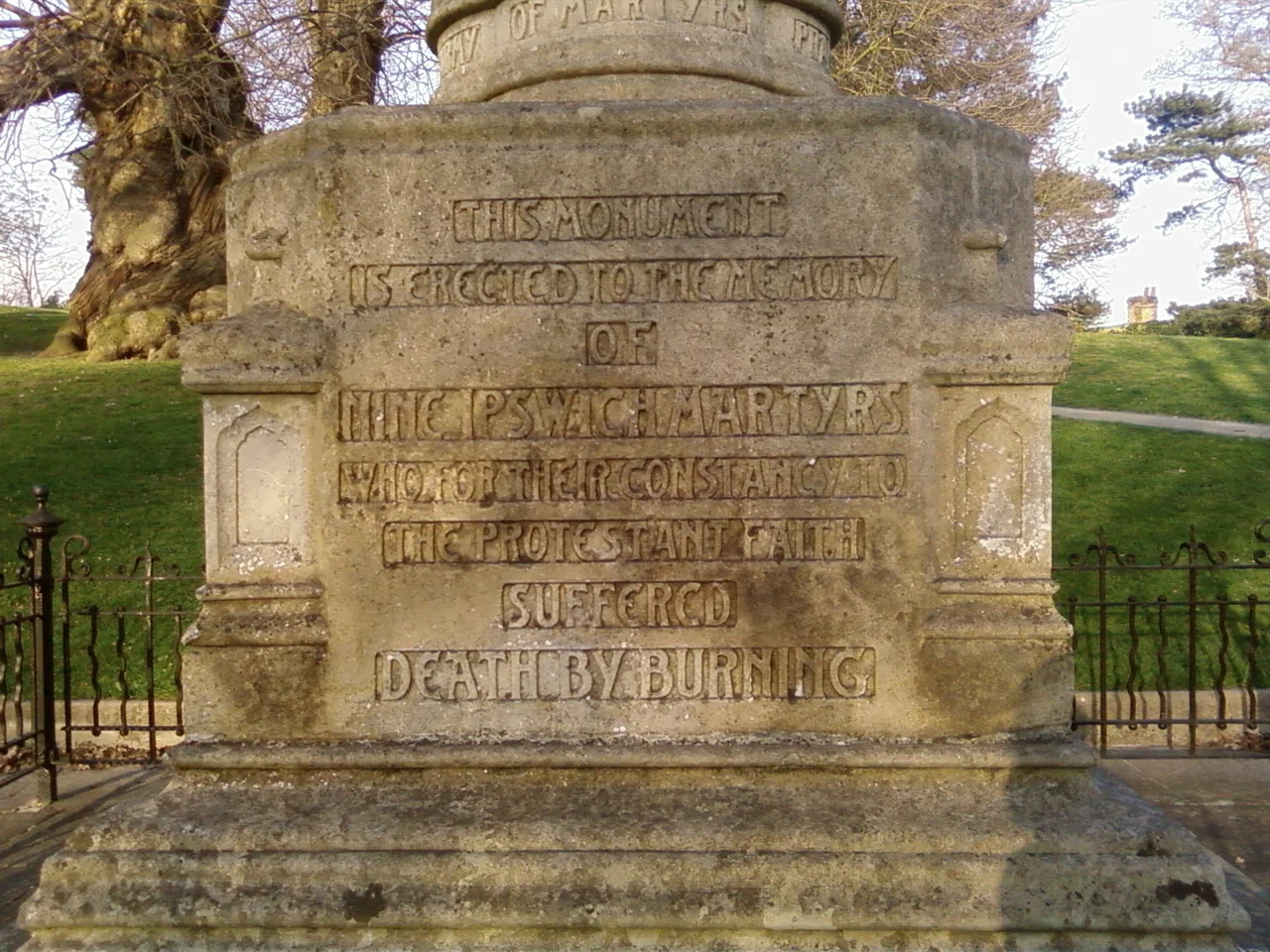

Ipswich Martyrs
On 19 February 1556, two women from Ipswich were tied to a single stake on the Cornhill, in the square in front of the town's Moot Hall. Their names were Agnes Potten and Joan Trunchfield. They were neighbours, perhaps friends. They had been condemned together for refusing to renounce their Protestant faith during the Marian persecutions. The fire was lit. They died together, in one fire, as the official record put it. Four and a half centuries later, their names are carved on a granite obelisk in Christchurch Park, a short walk from where they burned. They are two of the nine people remembered as the Ipswich Martyrs.
Who They Were
Not theologians. Not bishops. The Ipswich Martyrs were ordinary East Anglians: a man from Earl Soham, a minister from East Bergholt, weavers and labourers from Ipswich itself, a man and a woman from Grundisburgh arrested together at the same farmhouse. Nicholas Peke of Earl Soham was burnt in Ipswich in 1515, the earliest of the nine. Kerby and Roger Clarke were condemned together in 1546; Kerby died at Ipswich, Clarke at Bury St Edmunds. Robert Samuel, the minister at East Bergholt, was burnt at Ipswich in 1555. Agnes Potten and Joan Trunchfield died together in 1556. John Tudson of Ipswich was burnt at London. William Pikes of St Margaret's parish was burnt at Brentford. Alexander Gooch of Woodbridge and Alice Driver of Grundisburgh were arrested together, condemned together, and burnt on the same day in the same fire at Ipswich on 4 November 1558, just weeks before Mary Tudor died and the persecution ended.
What Burning Meant
Death by fire was not quick. The condemned were tied to an upright wooden stake set in a pile of faggots, bundles of brushwood. If the wind blew and the wood was dry, the fire took hold rapidly and asphyxiation came within a few minutes from smoke inhalation. If the wood was damp, or the fire was deliberately slow, the burning could last an hour or more. Foxe's Book of Martyrs, John Foxe's 1563 chronicle of these deaths, records that some of the Suffolk martyrs were given small bags of gunpowder hung around their necks by sympathisers in the crowd, to shorten their suffering. The Cornhill in Ipswich, where the executions happened, is a public square now lined with banks and chain stores. People walk through it on lunch breaks without noticing what once happened on the cobbles.
Alice Driver
She was the most defiant of them. A Grundisburgh farmer's wife, illiterate, in her thirties when she was arrested. Interrogated by Bishop Hopton at Melton, she was asked if she would not be silent. She answered: I am compelled, of conscience, to declare the truth. They cut off her ears for that, before she was returned to prison. At her execution on 4 November 1558, she was burnt alongside Alexander Gooch on the Cornhill. Witnesses recorded that she went to her death with the calm of someone who had already settled the question. Foxe quotes her as saying she had a love for her fellow Christian that no fire could touch. She was about thirty when she died. Twenty days later, Mary Tudor was dead and the persecution stopped. If Alice had been able to wait three more weeks, she would have lived.
The Other Suffolk Dead
The Ipswich nine were part of a larger pattern. The Marian persecutions killed Protestants across Suffolk: at Hadleigh, Beccles, Yoxford, Laxfield, Wetheringsett, Stowmarket, Framsden, Hintlesham, Haverhill, Winston, Mendlesham, Stoke-by-Nayland, East Bergholt, Dedham, Thwaite, Bedfield, Crowfield, Long Melford, Somerton, Little Stonham. The most famous was Dr Rowland Taylor, rector of Hadleigh, burnt on Aldham Common in 1555 after refusing to allow a Catholic mass in his church. His ghost is said to haunt both Hadleigh and Aldham. Eighty years later, in 1645, on the same Cornhill where the Marian martyrs had died, a woman known only as Widow Lakeland was executed on the orders of Matthew Hopkins, the self-styled Witchfinder General who terrorised East Anglia during the Civil War. The same Ipswich square hosted Protestants killed for being Protestant and a poor old woman killed for being suspected of witchcraft. The stake makes no theological distinctions.
Rescue From Forgetting
By the late nineteenth century, the Ipswich Martyrs had been mostly forgotten. Then a Suffolk woman named Nina Frances Layard, an antiquarian and archaeologist, began researching them. Between 1898 and 1900 she published a series of articles in the East Anglian Daily Times, which became the book Seventeen Suffolk Martyrs in 1902. Her work shamed Ipswich into a memorial. Subscriptions were raised. The site originally chosen was the Cornhill itself, where the burnings had happened, but the project met opposition there. Instead, a 27-foot obelisk of Ketton stone and red granite was erected in Christchurch Park, and unveiled on 16 December 1903 by the Dean of Canterbury. Its inscription is simple: This monument is erected to the memory of nine Ipswich martyrs who for their constancy to the Protestant faith suffered death by burning. Nine ordinary people. Pulled back, by an Edwardian Suffolk schoolteacher and an antiquarian's persistence, from the fire of forgetting.
From the Air
The Ipswich Martyrs' Memorial stands at 52.062 N, 1.159 E in Christchurch Park, on a low rise just north of central Ipswich. The execution site itself, the Cornhill, lies a short walk south at the heart of the medieval town centre, between the Town Hall and the Buttermarket. Cruise at 2,500-3,000 feet to take in Christchurch Park's mature woodland and the granite obelisk visible among the trees, with the dense medieval Ipswich street pattern below. Active airfields: London Stansted (EGSS) 40 miles southwest, RAF Wattisham (EGUW) 8 miles northwest, Norwich (EGSH) 35 miles north.
Nearby Stories
- Walton-on-the-Naze 2.7 km away
- Clare, Suffolk 9.5 km away
- RAF Lakenheath 10 km away
- RAF Hardwick 11 km away
- Beeleigh Abbey 13 km away
- Four Days' Battle 45 km away
- Southern Bight 75 km away
- Battle of Lowestoft 79 km away