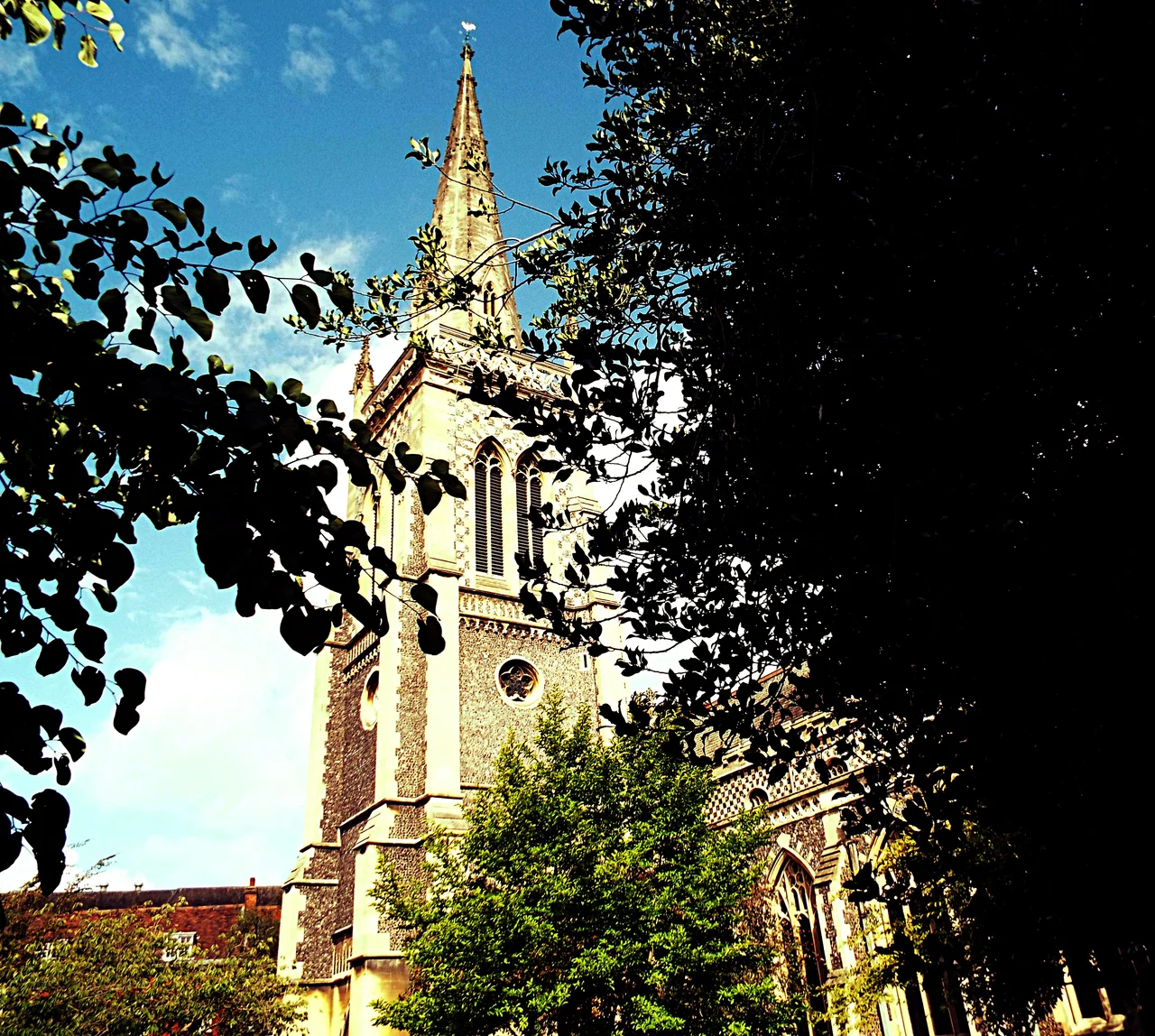

Ipswich Minster
In the churchyard, in the year 1200, scribes set down the words that made Ipswich a town. The charter granted to the burgesses by King John was drafted here, in the open air outside the door of St Mary-le-Tower, while the bells overhead marked the hours. Eight hundred and twenty-five years later, on a January morning in 2025, that same church received a new title - Ipswich Minster - in recognition of a role it had quietly been filling for centuries. The building is mostly Victorian now, rebuilt between 1860 and 1870 by Richard Phipson with money from a banker named George Bacon. But the site beneath it has been a place of Christian worship since at least 1086, when the Domesday commissioners came through and wrote it down.
A Site Older Than the Building
What stands at the corner of Tower Street today is not the medieval church the Anglo-Saxons knew. By the mid-nineteenth century, the old fabric had become unsafe, and Richard Phipson - the diocesan architect who would later design Ipswich's great Victorian churches - was commissioned to rebuild. He kept the dedication, the bells, and the tower's commanding position above the town's old market quarter. Beneath the new stonework, however, the site is far older. The Domesday Book records a church here in 1086, which means there was already a Christian community gathering on this ground when William the Conqueror's surveyors arrived. The town that grew up around it inherited that continuity. When Ipswich celebrates its origins, it points to the churchyard where the 1200 charter was written - the legal moment when a busy Anglo-Saxon trading port became, formally, a borough.
The Tower and Its Bells
The bells in the tower carry a long memory. In 1553, the parish inventory listed five bells and a Sanctus. The bell-founder Miles Graye of Colchester recast the treble in 1607 and the tenor in 1610 - work that put the tower's voice on the surviving record more than four hundred years ago. In 1865, the church became the first in Suffolk to hang a peal of twelve bells, a distinction it still claims. Most of the bells in the tower today were cast by John Taylor & Co of Loughborough, the same foundry that cast Big Ben's hour bell. One bell, the seventh, came from Mears & Stainbank of London. A sharp second was added in 1980, refining the diatonic ring with a chromatic note - a small modernisation in a tower whose business has changed remarkably little since the seventeenth century.
An Organ With Three Centuries Inside It
Behind the choir stalls stands a three-manual pipe organ whose oldest parts trace back to an instrument built by Renatus Harris in 1690. Harris was one of the great English organ-builders of his age, working in fierce rivalry with the Smith dynasty for commissions across the country. Successive generations of builders extended what he left behind - Henry Willis in the Victorian period, Spurden Rutt later, and Bishop & Son after that - each adding their own voicing and reeds without removing what came before. The result is an organ that contains, layered inside its case, more than three centuries of English organ-building tradition. The specification is preserved on the National Pipe Organ Register, and the instrument is still played for the round of services that has continued, more or less unbroken, since before the Civil War.
Why a Minster Now
On 19 January 2025, the Bishop of St Edmundsbury and Ipswich led a service that formally redesignated St Mary-le-Tower as Ipswich Minster. The title is unusual - most English minsters carry names anchored in the deep Anglo-Saxon past, when a minster was the mother church of a wide rural district. The Ipswich designation was about the present rather than the past. For decades, St Mary-le-Tower had served as the civic church of the town: hosting the mayor's services, the carol concerts that brought together the town's institutions, the moments of public mourning and celebration. The new title formalises that role. Inside, a chancel-pier memorial brass commemorates Hamilton Anne Douglas-Hamilton, vicar from 1915 to 1925, who served through the First World War and its aftermath. Four more brasses lie set into the chancel floor, the kind of patient witness that an old church accumulates simply by remaining in place.
From the Air
Ipswich Minster sits in central Ipswich at 52.06 degrees north, 1.16 degrees east, with its tall pinnacled tower visible from the air against the modern waterfront's high-rises. Recommended viewing altitude is 1,500-2,500 feet, with the Orwell estuary running south-east to Felixstowe as the main navigation reference. Nearest airfields are RAF Wattisham (EGUW) to the west and Norwich Airport (EGSH) to the north. East Anglian weather brings frequent low cloud off the North Sea; clear days favour mornings.
Nearby Stories
- Walton-on-the-Naze 2.7 km away
- Clare, Suffolk 9.5 km away
- RAF Lakenheath 10 km away
- RAF Hardwick 11 km away
- Beeleigh Abbey 13 km away
- Four Days' Battle 45 km away
- Southern Bight 75 km away
- Battle of Lowestoft 79 km away