
Ipswich School
Cardinal Thomas Wolsey was, by most measures, the most powerful man in England after Henry VIII. He was also, almost certainly, a former pupil of the grammar school in his hometown of Ipswich. When he decided to build a grand college there in 1528, the existing school was absorbed into his grand vision — and then, two years later, demolished along with it when the half-built college was torn down after Wolsey's fall from royal favor. The assets were misappropriated by Henry VIII and used for palaces, including the Palace of Whitehall. The pupils went back to the old house on Felaw Street. The school survived. The cardinal did not.
Six Centuries and Counting
The oldest documentary evidence of the school dates to 1399 — a legal dispute over unpaid fees, which is perhaps an appropriately human way to enter the historical record. The first clear reference to a grammar school appears in 1416. From those medieval origins, the school has occupied a series of premises across Ipswich: Richard Felaw's house from 1483, a Dominican friary from 1614, temporary premises during a building crisis in the 1840s, and finally the current site on Henley Road, where Prince Albert laid the foundation stone in 1851. The buildings have changed. The motto has not. Semper Eadem — Always the Same — are the words of Queen Elizabeth I, whose 1566 charter formally established the school as a royal foundation after Thomas Cromwell had secured it a new endowment following Wolsey's ruin. The Monarch of the United Kingdom remains the school's Visitor to this day.
A Library for All Seasons
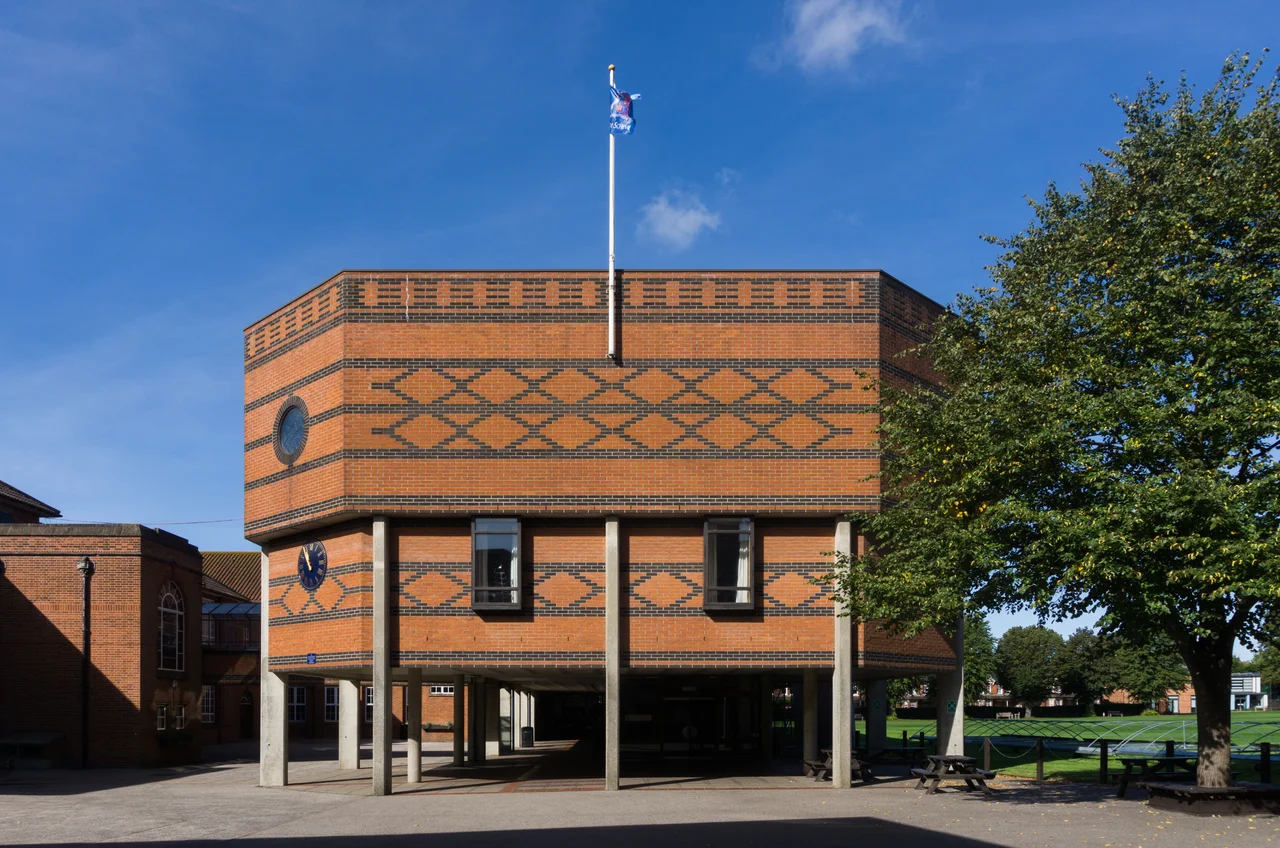
The school's library building, completed in 1982, is one of its architectural surprises. Designed by local architect Birkin Haward as his final major work, raised on concrete pillars in red brick with horizontal blue banding, it earned Grade II listed status in 2018 for its innovative design. The building's four corners each contain a circular stained glass roundel designed by John Piper and made in collaboration with glassmakers Patrick Reyntiens and David Wasley. Each window faces a different compass direction and represents a season, an age of life, and a classical element: spring and youth and earth in the northeast; summer and adulthood and air in the southeast; autumn and maturity and fire in the southwest; winter and old age and water in the northwest. The north-west corner, which receives the least direct sunlight, has the most reflective themes. Piper designed them in 1981. They have been looking out from the building ever since, one face per season, watching children come and go.
The Remarkable Alumni
The list of former pupils known as Old Ipswichians is long and varied enough to feel almost implausible. Cardinal Wolsey himself heads the roll, followed by Thomas Howard, 2nd Duke of Norfolk, who commanded at Flodden. H. Rider Haggard, who wrote King Solomon's Mines, attended. So did Charles Scott Sherrington, who won the Nobel Prize in Physiology or Medicine in 1932 for his work on the nervous system. George Henry Alexander Clowes, born here in 1877, was the researcher who mobilized Eli Lilly's resources to mass-produce insulin, making the treatment of diabetes possible at scale. More recently, Henry Patten, born 1996, won Wimbledon Men's Doubles in 2024. Alexander Albon, the Thai-British Formula 1 driver for Williams Racing, is a graduate. The Town Library of Ipswich, with books dating back to the 15th century, is kept in the headmaster's study, held on behalf of the town. The school has always been, in some sense, Ipswich's institution.
Brick and Cricket
The Victorian buildings on Henley Road — Tudor-style brick, with both the main building and chapel carrying Grade II listed status — surround a central playing field and cricket square. Cricket has been played on that ground since at least 1859, when Suffolk faced an All England Eleven in the first recorded match there. The ground hosted its first Minor Counties Championship match in 1935 and has hosted 33 such matches in total, along with a single List A fixture in the 1966 Gillette Cup between Suffolk and Kent. The school now operates with six day houses named after notable figures from its own history — Holden, Rigaud, Sherrington, School, Broke and Felaw — a single boarding house called Westwood, and the annual Ganzoni Cup, which ties it all together in the kind of competitive institutional ritual that British schools do remarkably well. One of a handful of schools in the country to have Eton Fives courts, Ipswich School has never entirely shed its medieval habit of doing things slightly differently from everyone else.
From the Air
Located at 52.06°N, 1.15°E on the northern edge of central Ipswich. From the air, the school's playing fields are visible just north of Christchurch Park. The River Orwell and Ipswich docks lie to the south. Norwich Airport (EGSH) is approximately 40 miles to the north-northeast. The school sits in a densely settled residential area of Victorian and Edwardian housing north of the town center.
Nearby Stories
- Walton-on-the-Naze 2.7 km away
- Clare, Suffolk 9.5 km away
- RAF Lakenheath 10 km away
- RAF Hardwick 11 km away
- Beeleigh Abbey 13 km away
- Four Days' Battle 45 km away
- Southern Bight 75 km away
- Battle of Lowestoft 79 km away