
Iranian Embassy Siege
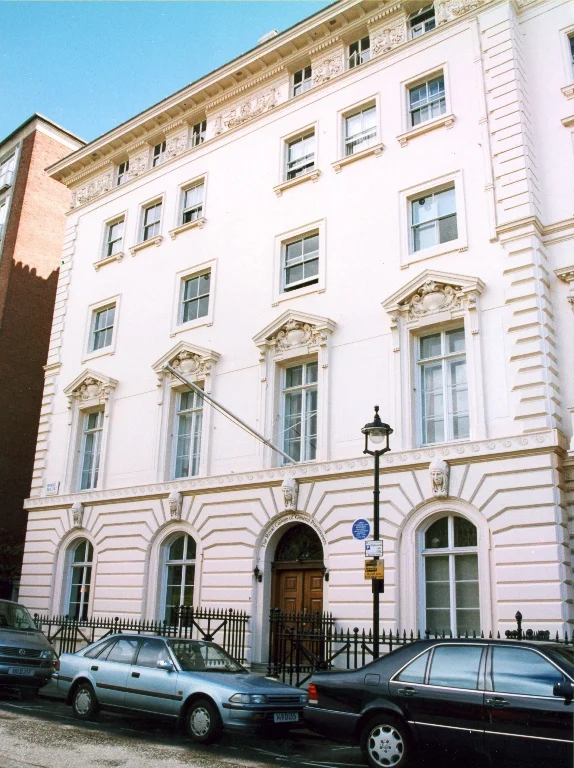
Number 16 Princes Gate is a white stucco terrace house facing Hyde Park, a building that looks like it should be hosting a charity reception. On the morning of 30 April 1980, a young diplomat named Abbas Lavasani was at his desk inside, working as the embassy's chief press officer. By nightfall on 5 May he would be dead, the building would be on fire, and millions of Britons watching the snooker final would have switched over to see masked soldiers abseiling past the curtains.
The Men with Bags
Six men crossed the threshold at 11:25 that Wednesday morning. They were Khuzestani Arabs, sent from Iraq and armed by Saddam Hussein's intelligence service, calling themselves the Democratic Revolutionary Front for the Liberation of Arabistan. Their leader, who called himself Oan, wanted independence for the Arabic-speaking minority in the Iranian province of Khuzestan, and he wanted ninety-one of his countrymen released from Iranian prisons. He took twenty-six hostages, including a Metropolitan Police constable named Trevor Lock who had been guarding the door. Lock had drawn his revolver as Oan rushed past, then thought better of firing. He hid the gun under his uniform jacket and kept it hidden for the next five and a half days, a fact known to no one in the building.
Negotiation, and the Loss of It
Margaret Thatcher's government decided within hours that no safe passage would be granted. The police negotiators, working from a forward post in the Royal College of General Practitioners next door, traded broadcast statements for hostages. A pregnant Iranian press officer named Hiyech Kanji was released. So was the BBC producer Chris Cramer, who had become so ill that even Oan agreed he had to leave. The other journalist who had walked in to apply for a visa that morning, the sound recordist Sim Harris, stayed inside. By the fifth day the gunmen were exhausted and the negotiators were stalling, waiting for Arab ambassadors who never came. The food sent in may or may not have been spiked - the operation's commander considered it and decided against it. On the sixth morning, Oan said he would kill a hostage if no ambassador arrived by 1:45 pm.
Abbas Lavasani
Lavasani was twenty-nine. He was a believer - a supporter of the revolution that had brought Ayatollah Khomeini to power the year before - and the diplomatic post had been his life's ambition. During the siege he had argued with his captors, told them they were enemies of Iran, said that if a hostage had to die it should be him. At 1:45 pm three shots came from inside the embassy. Police were not certain anyone had really been killed; pathologists later determined Lavasani had been shot earlier. His body was dumped on the front steps that evening. After it was recovered, the Commissioner of the Metropolitan Police signed control of the operation over to Lieutenant-Colonel Michael Rose of the SAS. The signed note now sits in a glass case at the Crime Museum in New Scotland Yard.
Seventeen Minutes
At 7:23 pm two SAS teams began the assault. One team abseiled down the back of the building; another rappelled to the front balcony while a third lowered a stun grenade through a skylight. One trooper became tangled in his rope, and the explosives planned for the second-floor window had to be abandoned for sledgehammers. A fire started in the curtains and burned the stranded soldier's legs - he was treated later at St Stephen's Hospital and recovered. The cameras outside captured Sim Harris vaulting across the parapet, a masked figure with a Heckler & Koch directing him to safety. Inside, the gunmen opened fire on the hostages they were holding in an upper room, killing Ali Akbar Samadzadeh, a temporary embassy employee, and wounding two others. Trevor Lock tackled Oan as the soldiers came onto the landing; Oan was shot and killed. Five gunmen died in the building. One, Fowzi Nejad, was identified by Sim Harris as he tried to hide among the hostages on the embassy's back lawn.
After the Cameras
Trevor Lock was awarded the George Medal and spent the rest of his life as a quiet man who rarely spoke about what he had done; he died in 2025, still uncomfortable with the word hero. Fowzi Nejad served twenty-seven years in British prison, became eligible for parole in 2005, and was released in 2008 - not given asylum, but not deported either, because returning him to Iran was likely to mean his execution. The embassy building stayed shuttered until 1993. The BBC interrupted the World Snooker Championship final to broadcast the assault, and the SAS, which had been a half-secret regiment fighting an obscure war in Northern Ireland, suddenly became the most famous unit in the British army. Two hostages were dead. Five gunmen were dead. The Iranian government called Lavasani and Samadzadeh martyrs. They had been ordinary men, doing their jobs at a desk.
Princes Gate Today
Number 16 was repaired and reopened. It still serves as the Iranian Embassy. The white terrace looks much like it did before the siege, except for a small detail or two - the architectural details visible to anyone walking from the Royal Albert Hall toward Hyde Park Corner. The Royal College of General Practitioners is still next door, in the building from which Mike Rose's men watched the windows for six days. There is no plaque. The events live in Operation Nimrod documentaries, in the opening of every SAS recruitment story since, and in a strange afterlife on screens: in the video game Rainbow Six Siege, where a playable character named Thatcher canonically participated in the assault, the building flickering forever in pixelated copies.
From the Air
The Iranian Embassy at 16 Princes Gate sits at 51.5017°N, 0.1720°W, on the south side of Hyde Park between the Royal Albert Hall and Knightsbridge. Approach altitude 1,500-2,500 ft AGL gives a clear view of the white terrace facing the park. Nearest airports: London Heathrow (EGLL) 12 nm west, London City (EGLC) 8 nm east, RAF Northolt (EGWU) 10 nm northwest. The diversion of low-flying aircraft over the building during the siege was a deliberate acoustic cover for the SAS preparations next door.
Nearby Stories
- Battle of Britain, Northfleet 1.1 km away
- Bayham Old Abbey 5.4 km away
- Catharine Macaulay 6.4 km away
- Hatfield rail crash 8.8 km away
- Chequers 8.9 km away
- Chelmsford Cathedral 10 km away
- Queen Victoria Hospital 13 km away
- Fishbourne Roman Palace 36 km away