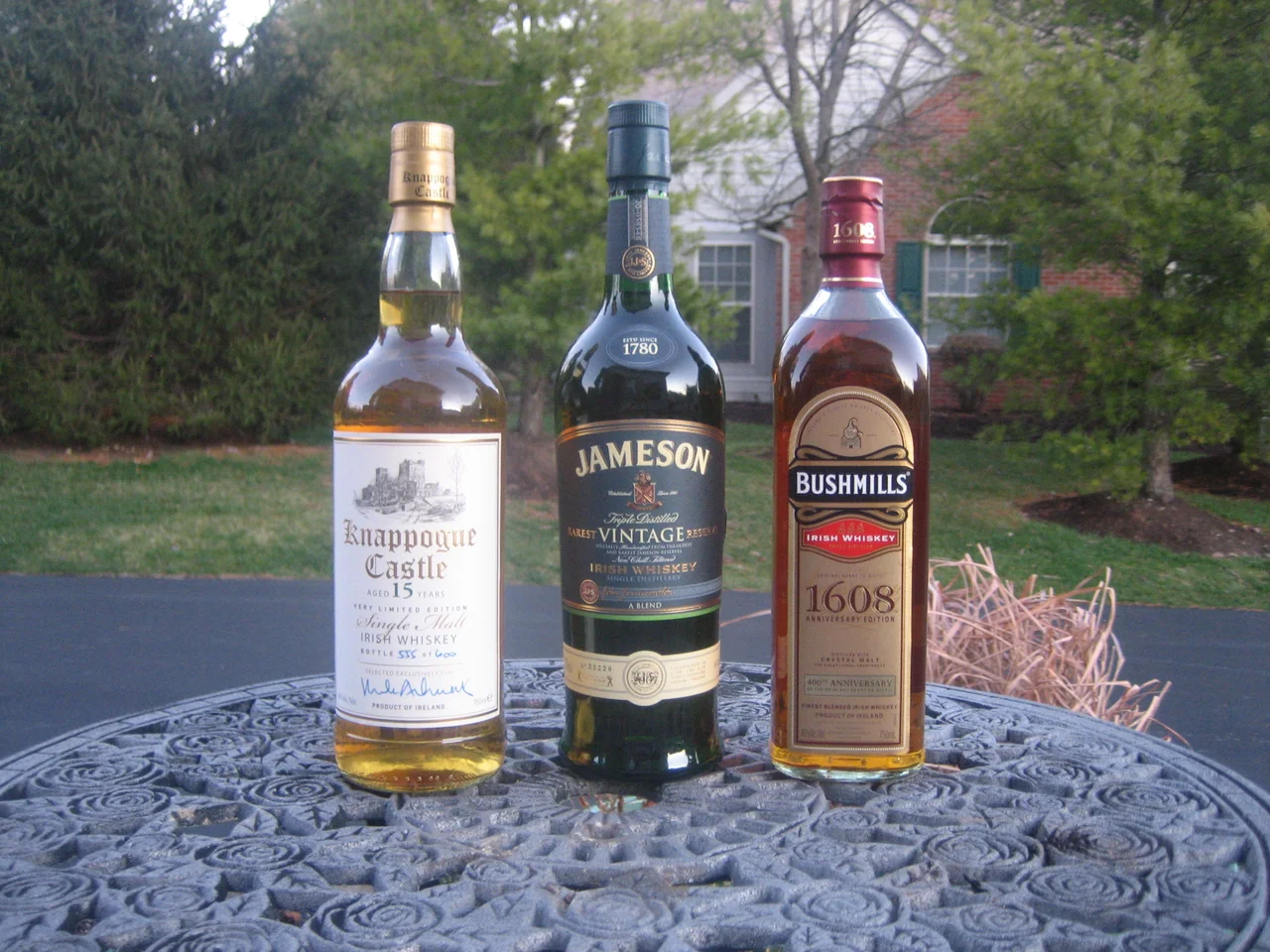

Irish Whiskey
The Irish call it uisce beatha. Water of life. The phrase, anglicized over centuries into the word whiskey itself, started as a literal translation from Latin - aqua vitae - the term medieval monks used for the perfumed distillates they carried home from southern Europe around the year 1000. Somewhere between the perfume bottle and the parish, the Irish made a small, momentous adjustment. They drank it. By 1556 the Parliament of Ireland was already complaining that whiskey had become 'universally throughout this realm made,' and grumbling about how its consumption did the populace no good. The complaints did not stop the distilling. The complaints almost never do.
A World on Fire for Irish Whiskey
For most of the nineteenth century, Irish whiskey was the most popular spirit on Earth. In 1887, when the British historian Alfred Barnard published his great survey of distilleries across Britain and Ireland, twenty-eight Irish distilleries were still operating. Dublin's giants - Roe's Thomas Street, Jameson's Bow Street, Power's John's Lane, William Jameson's Marrowbone Lane, the so-called 'big four' - produced almost ten million gallons a year between them. Roe's alone made over two million. Across the Atlantic, more than sixty percent of all whiskey sold in the United States carried an Irish label. The distillers were proud, prosperous, and stubborn. Asked to consider the new Coffey still that could produce lighter, blendable spirit in industrial quantities, they refused. They would stick with pure pot still. The market, they believed, would always come to them.
The Collapse
The market did not come to them. It went to Scotland. A cascade of catastrophes hit in the early twentieth century: the Irish War of Independence, the Civil War that followed, and the Anglo-Irish Trade War that cut off whiskey exports to Britain and the Commonwealth - then Ireland's biggest market. Then Prohibition in the United States closed the second-biggest market. Counterfeiters poured rotgut into Irish-labeled bottles and ruined the brand abroad. The Irish Free State imposed protectionist policies that capped exports. At the same time, the Scots embraced the Coffey still and the lighter blended whiskies the modern world wanted. By the 1960s, only a handful of Irish distilleries remained. In 1966 three of them - John Jameson, Powers, and the Cork Distilleries Company - gave up their separate identities, merged as Irish Distillers, and closed their old facilities to build one new plant in Midleton, County Cork. By 1972, Bushmills joined them. The entire Irish whiskey industry was now two distilleries, owned by one company.
The Slow Return
The turn started in 1987 with an outsider. John Teeling, an academic and entrepreneur, opened Cooley Distillery in County Louth - the first new Irish distillery in generations and the only one outside the Irish Distillers monopoly. For years he was alone. Then, slowly, Irish whiskey began to grow again, and then explode. Since 1990 it has been the fastest-growing spirit category in the world, with exports climbing more than fifteen percent every year. Kilbeggan, the old Westmeath distillery that had stood derelict since 1954, fired up its copper stills again in 2007, exactly fifty-four years to the day after they fell silent. Tullamore began distilling Tullamore D.E.W. in Tullamore again in 2014, after a sixty-year break. By the time the boom was fully on, more than thirty distilleries had opened across the island - from Dingle on the western Atlantic edge to Echlinville in County Down. Today over thirty Irish distilleries are in operation, and more are coming.
The Three Styles, and a Fourth
Walk into any Irish distillery tour and you will be told the styles. Single malt is made entirely from malted barley, distilled in pot stills within a single distillery - the same style Scotland uses for its single malts, often triple-distilled here for a smoother spirit. Single pot still is the Irish original: a mash of both malted and unmalted barley, all distilled in pot stills at one place. The unmalted grain was originally a workaround for a nineteenth-century tax on malt, but it survived because the Irish learned to love its spicy, oily character. Grain whiskey is made in continuous Coffey stills - lighter, more neutral, the workhorse of the bottle. Most Irish whiskey on the shelf is blended, mixing pot still or single malt with grain. Redbreast and Green Spot, both produced at Midleton, are the most celebrated survivors of the pure pot still tradition. Connemara, Cooley's peated single malt, breaks every other rule about Irish whiskey not being smoky.
Heart of the Story, in Cork
If Irish whiskey has a beating heart today, it sits in Midleton, twenty-five kilometers east of Cork city. The Old Midleton Distillery, built in 1825, houses the largest pot still ever built - 31,618 gallons, so big the still room had to be assembled around it. Beside the old stone buildings, the new plant launched in 1975 produces Jameson, Powers, Paddy, Midleton Very Rare, Redbreast, Green Spot, and most of the other recognizable Irish whiskey names. The old distillery still stands, copper still and all, now a visitor center. Tourists wander through the same buildings where, a century ago, the industry's collapse seemed final. The bottles they sip from at the end of the tour are filled at a plant that is, by most measures, the largest whiskey distillery in the world. Water of life, indeed. It nearly died. It came back.
From the Air
Centered on the Midleton distillery complex at 51.92 degrees N, 8.16 degrees W, eighteen kilometers east-northeast of Cork city. Cork Airport (EICK) lies seventeen kilometers southwest. The distillery's tall stainless-steel column stills are visible from the air at the eastern edge of Midleton town, beside the Owenacurra River. Best viewing altitude 3,000 to 5,000 feet for a clear look at the layout. Cork Harbour to the south, the Knockmealdown Mountains to the northwest in clear weather.
Nearby Stories
- St. Declan's Monastery 0.8 km away
- Aghavrin House 2.4 km away
- Mitchelstown Castle 7.4 km away
- Clonakilty 9.5 km away
- Inislounaght Abbey 16 km away
- Walter Siepmann 23 km away
- Newcastle West 33 km away
- SM U-27 110 km away