
Isaac Newton Institute for Mathematical Sciences
On 23 June 1993, a mathematician named Andrew Wiles walked to a lectern in a Cambridge auditorium and, at the end of a lecture series, wrote a few final lines on a blackboard. Then he said that he thought he would leave it there. The audience understood immediately. Wiles had just announced a proof of Fermat's Last Theorem — a problem that had defeated mathematicians for 358 years, since Pierre de Fermat scribbled a margin note in 1637 claiming he had a proof too wonderful to fit in the available space. The announcement was made at the Isaac Newton Institute for Mathematical Sciences. The building that housed that moment had been open for less than two years.
A National Institute in a University
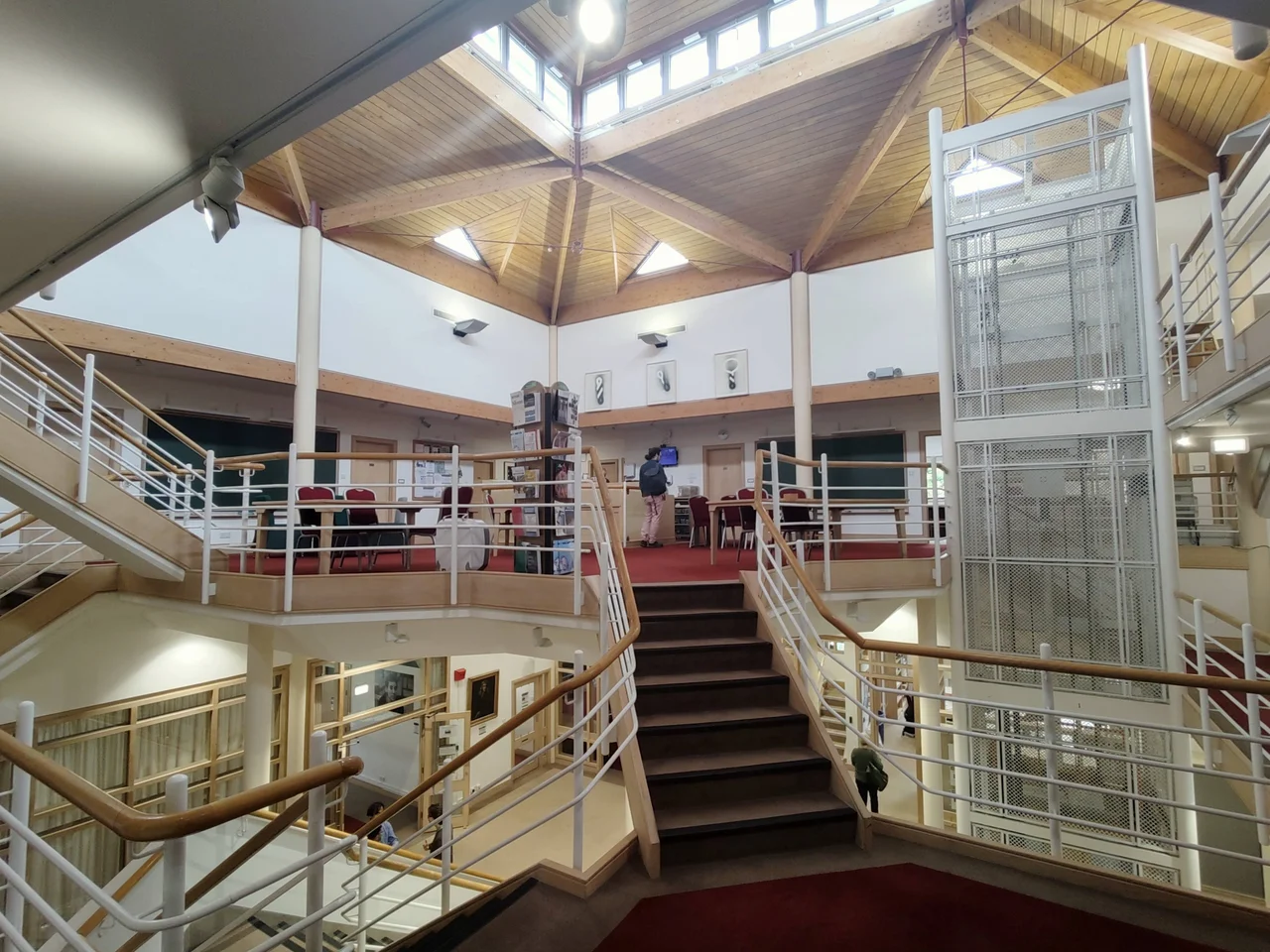
The Isaac Newton Institute was chosen through a national competition run by the Science and Engineering Research Council in the late 1980s to be the UK's national research institute for mathematical sciences. The land was provided by St John's College, Cambridge. Trinity College funded the first five years of running costs. The London Mathematical Society provided additional support. It opened in 1992 on the Cambridge Centre for Mathematical Sciences campus, in a building purpose-designed for collaborative mathematical work — with blackboards everywhere, wide corridors for pacing, and common rooms designed to encourage the informal conversations that often matter more than formal lectures. The building's interior photographs often look more like a philosophy department than a science facility: people gathered in pairs, writing on boards, thinking aloud.
How Mathematics Is Done Here
The Institute does not operate like a conventional university department. It runs intensive research programs that bring together mathematicians from around the world for periods of months at a time, focused on a specific area of mathematics or its applications. Programs are selected by a Scientific Steering Committee of mathematical scientists from across the spectrum of mathematical research. The criterion is simple: scientific merit and the likelihood of significant impact. During these programs there are workshops, lectures, and courses for participants. The work ranges across the entire span of mathematical sciences — pure mathematics, applied mathematics, theoretical physics, statistics, and whatever the boundaries between them happen to contain. Since 2021, the Institute has been directed by Ulrike Tillmann, a Fellow of the Royal Society known for her work in algebraic topology. Her predecessors include Sir Michael Atiyah, one of the most influential mathematicians of the twentieth century, who served as the first director from 1991 to 1996.
Fermat's Margin, Wiles's Years
The proof that Wiles announced in that June 1993 lecture was not quite finished — a gap in the argument was discovered later that year, and Wiles, with the help of former student Richard Taylor, fixed it by September 1994. The corrected proof was published in 1995. But the moment of announcement happened here, in this building, at a program on L-functions and Arithmetic. Wiles had worked on the problem in near-total secrecy for seven years, telling almost nobody. When he finally presented the work over three days of lectures — ostensibly titled "Modular Forms, Elliptic Curves, and Galois Representations" — those in the room gradually understood what they were witnessing. The Isaac Newton Institute was, by then, already the right kind of place for such a moment: somewhere that took mathematics with the seriousness the discipline demands, named for the man who invented calculus in a room not far away.
Named for Newton
Isaac Newton matriculated at Trinity College, Cambridge in 1661. He was largely self-taught during his student years, reading Descartes and the latest mathematical works on his own while the official curriculum focused on Aristotle. By 1666 — the year plague closed Cambridge and Newton retreated to the family farm at Woolsthorpe-by-Colsterworth — he had developed what became calculus, understood the laws of motion and universal gravitation, and decomposed white light into its spectrum using a prism. He returned to Cambridge and remained for nearly thirty years, as Lucasian Professor of Mathematics from 1669. The institute that carries his name sits roughly a mile from his old college rooms. In 1999, the Institute was awarded a Queen's Anniversary Prize in recognition of world-class achievement in education — appropriate recognition for a place dedicated to the kind of thinking Newton made foundational.
Mathematics as Infrastructure
Funding for the Isaac Newton Institute comes from five UK Research Councils — covering biological sciences, engineering, economic and social research, environmental sciences, and physics — which together support about 55 percent of its activity. The remainder comes from philanthropic individuals, trusts, and private companies, as well as the University of Cambridge itself. The diversity of funders reflects a basic reality: mathematics underpins everything. The Institute's programs have touched fluid dynamics, quantum field theory, computational biology, financial mathematics, cryptography, and climate modeling. Abstract and applied mathematics blur at its edges. What the Institute has always offered is simply the time, space, and concentration of talent to do the work properly. Andrew Wiles had most of that at Princeton. But the moment he chose to announce it, he chose Cambridge.
From the Air
The Isaac Newton Institute sits on the west side of Cambridge at approximately 52.210°N, 0.103°E, within the Centre for Mathematical Sciences campus on Clarkson Road. Cambridge City Airport (EGSC) lies about 3 miles to the east. The campus, with its distinctive low-profile buildings, is visible from the air near the western edge of central Cambridge. Approach from the east at 1,500–2,000 feet for a clear view of the mathematical sciences complex and the surrounding university grounds.
Nearby Stories
- Walden Abbey 4.6 km away
- Bury St Edmunds 5.5 km away
- RAF North Pickenham 8.1 km away
- Ampthill 9.5 km away
- RAF Wittering 10 km away
- Murder of Una Crown 12 km away
- Colchester Community Stadium 18 km away
- John Bunyan Museum 19 km away