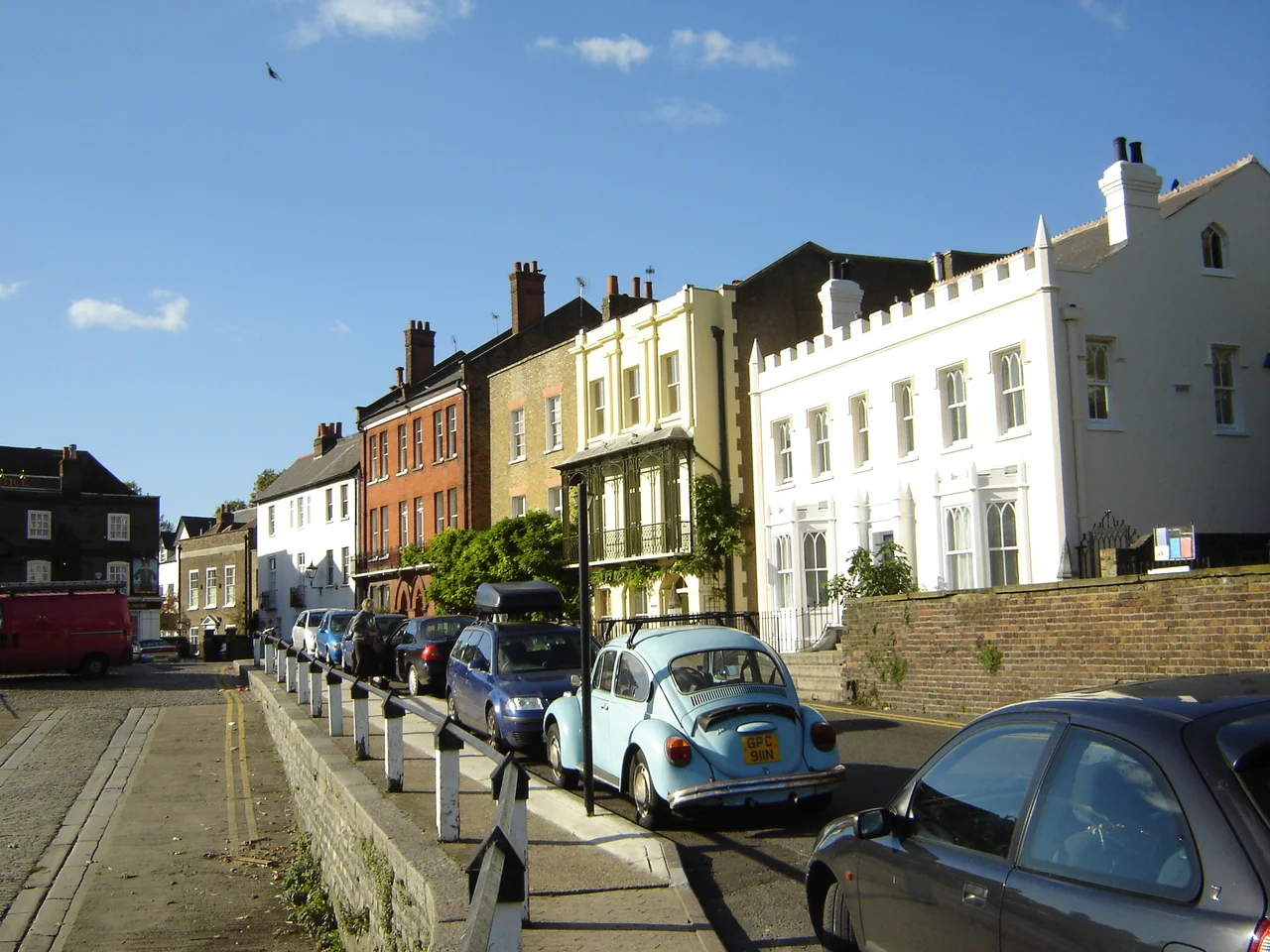

Isleworth
In 695, an Anglo-Saxon charter recorded a permanent settlement called Gislheresuuyrth - the enclosure belonging to a man called Gislhere. By the time the Domesday Book reached it in 1086, the place was Gistelesworde and worth £72 a year to its overlords, with 55 ploughlands, 118 households, and a productive river frontage. Today the name has shrunk to Isleworth, the river is the Thames, and the town belongs to the London Borough of Hounslow. The pub by the church is called the London Apprentice and dates to the sixteenth century. The view of the river from the church tower is still the same view that J. M. W. Turner painted from a boat in the 1820s.
Henry V's Monastery
In 1415, Henry V granted nuns of the Swedish Bridgettine order land on the Thames opposite his new palace at Sheen. Seven years later he transferred the manor of Isleworth from the Duchy of Cornwall to the new community. In 1431 the nuns moved across the river and built their new monastery on Isleworth's bank - Syon Monastery, named for the holy mountain. The order ran an English house in exile for centuries after Henry VIII demolished the buildings in 1539, and the order itself, the most senior English religious community to survive the Reformation through emigration, finally returned to England in 1861. The stone for the Tudor monastery is mostly gone, but the name survives in Syon House, the great mansion built on the same plot in 1548 by Edward Seymour, Duke of Somerset, the boy-king Edward VI's protector.
Lady Jane Grey
From Syon House on a July morning in 1553, a sixteen-year-old girl named Jane Grey was rowed down the Thames to the Tower of London to be made Queen of England. She had not asked to be queen. Her father-in-law had pushed her forward against the Catholic claim of Mary Tudor, and Jane reigned for nine days before Mary's supporters took the throne and Jane's head. The barge from Syon to the Tower is a small detail in a vast tragedy, but it happened from this riverbank. After Seymour's fall, the manor passed in 1594 to Henry Percy, ninth Earl of Northumberland, and his bride Dorothy Devereux. It has remained with the Percys - now the Dukes of Northumberland - for over four hundred years. The current Syon Park was landscaped by Capability Brown and rebuilt by the Adam brothers between 1766 and 1773, and the interiors are still considered Robert Adam's masterpiece.
Van Gogh on the Twickenham Road
In 1876 a struggling Dutch art dealer in his early twenties came to Isleworth to take a job as a teacher and assistant preacher at a small school. He was, at this point in his life, more interested in being a Methodist evangelist than a painter. He preached his first sermon in a chapel in Richmond and walked it back through the night to the school. He left after a few months, returned to Holland, and only began painting seriously several years later. The schoolhouse on the Twickenham Road has a blue plaque now, marking the home of Vincent van Gogh during his English year - the year before he discovered the colour that would consume the rest of his life. He once drew Streatham Common in a letter to his brother Theo, and his self-portrait of 1887, the famous one with the swirling brushwork, was painted ten years after he had walked these streets.
Marina and Prince
Among the residents of Isleworth in 1765 were two people who appear in the historical record only because their enslavers placed advertisements seeking their capture. Marina Dellap was a young woman in her twenties, brought from Jamaica about a year before, who lived in the household of a Mrs Dellap near All Saints Church. She was a skilled seamstress, had a child, and ran away on the 26th of May 1765. Prince was twenty-four, from Guinea, a musician who played the French horn in the household of a merchant named Mr Shea. He ran away on the 13th of August the same year, wearing an old brown livery coat turned up with red. Marina was reportedly later seen with someone matching Prince's description. They were two of the small Black community in Georgian Isleworth, most of whose members were enslaved. We know almost nothing else about them, but the advertisements seeking their return survived, and so their names did too.
Spring Grove and the Pears Family
Sir Joseph Banks, the botanist who sailed with Captain Cook on the Endeavour and helped found Kew Gardens, lived at Spring Grove House in the eighteenth century. In 1886 the house was bought by Andrew Pears, the third-generation head of the family soap business that had been making transparent amber soap in Isleworth since the late 1700s. Pears rebuilt the house in red brick on a grander scale between 1892 and 1894, and most of it still stands - now part of West Thames College. There is a memorial to the family in Isleworth cemetery, including Thomas Pears, who died on the Titanic in 1912. The cake of clear amber soap that sat on the bathroom shelves of half of Britain was made within walking distance of this church.
The Boy Who Watched Animals
On 8 May 1926, in a house in Isleworth, a son was born to Frederick Attenborough, a Cambridge-educated principal of the local university college, and his wife Mary. The boy was named David, and from a young age he collected fossils and small reptiles in the gardens around the family home. By the time he died, his career as the face and voice of British natural history would have spanned nearly seventy years - the Life series, Planet Earth, Blue Planet. His older brother Richard, born in 1923, became the actor and director Richard Attenborough. Both boys grew up in Leicester - their father moved there shortly after David's birth - but the entry on David's birth certificate reads Isleworth, and the town claims him. The London Apprentice pub on Church Street, where Doctor Who actor William Hartnell lived from the 1920s and where the Thames frontage has barely changed in three centuries, looks much as the Attenboroughs would have seen it.
From the Air
Isleworth sits at 51.4666°N, 0.3363°W on the west bank of the Thames, where the river makes its sharp double bend below Richmond. From 1,500-2,500 ft AGL look for Syon House and its great park north of the river, with the Pavilion of Syon and the Thames-side meadows clearly visible. Nearest airports: London Heathrow (EGLL) 4 nm west, RAF Northolt (EGWU) 6 nm north, London City (EGLC) 12 nm east. Heathrow's approach to Runway 27L brings traffic directly over Isleworth at low altitude, making the area familiar to anyone arriving in London from the east.
Nearby Stories
- Battle of Britain, Northfleet 1.1 km away
- Bayham Old Abbey 5.4 km away
- Catharine Macaulay 6.4 km away
- Hatfield rail crash 8.8 km away
- Chequers 8.9 km away
- Chelmsford Cathedral 10 km away
- Queen Victoria Hospital 13 km away
- Fishbourne Roman Palace 36 km away