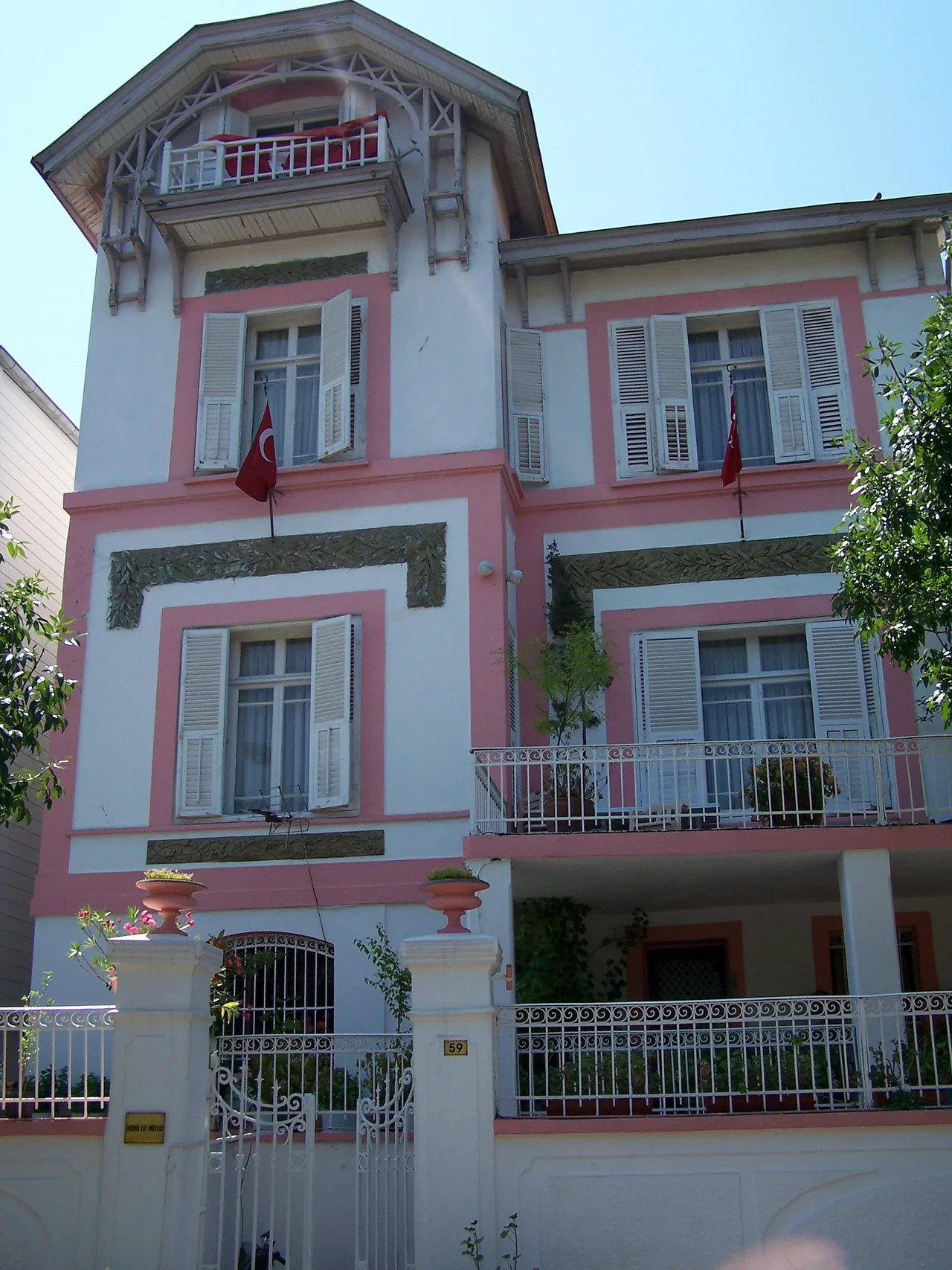

İsmet İnönü House Museum
The furniture was a gift from Atatürk. That detail, almost incidental in the telling, speaks to the closeness of the two men who created the Turkish Republic together: İsmet İnönü, who fought alongside Mustafa Kemal at Gallipoli and then commanded the armies that won the War of Independence, received household furnishings from the founder of the state for the house on Heybeliada where İnönü's family spent their summers. The house had not started life as a Turkish statesman's retreat. It was built in the 19th century by a Greek family named Mavromatis — Mavromatis Mansion, the deed would have said — and it sat in a quiet part of the second largest of the Princes' Islands through the last decades of the Ottoman Empire before İsmet Pasha arrived to rent it in 1924.
A General in a Greek Mansion
In 1924, İsmet Pasha was in the thick of the new republic's politics: he had served as the first Prime Minister under Atatürk, negotiated the Treaty of Lausanne that established Turkey's modern borders, and was deeply embedded in the governance of a state still finding its form. He rented the Mavromatis Mansion during the period when he briefly stepped aside as prime minister to allow Fethi Bey (Fethi Okyar) to serve in that role. By 1925 he was back as prime minister. From 1925 onward, the house served as the İnönü family's summer residence — a place apart from the capital's pressures, on an island where horse-drawn carriages were the only transport and the ferry brought the mainland close enough to reach but far enough to escape.
The President's Island Retreat
In 1934, İsmet Pasha formalized the connection by purchasing the house outright, adopting the surname 'İnönü' — after the Battle of İnönü, one of his great victories in the War of Independence — in line with the Surname Law that Atatürk had enacted that year. Atatürk's gift of furniture made the interior of the mansion feel less like a rented summer house and more like an extension of the new state's domestic life. In 1937, İnönü resigned from the prime ministerial position and began living primarily on Heybeliada. The following year, after Atatürk's death in 1938, İnönü was elected as the second President of Turkey — and the calculus changed. Presidential duties meant vacations in other places, state obligations replaced island mornings, and the Heybeliada house, as the source article notes, "lost its past liveliness."
Defeat, Return, and the Island's Second Chapter
In 1950, İsmet İnönü and his Republican People's Party lost the general election — Turkey's first genuinely competitive multiparty election — to Adnan Menderes's Democrat Party. It was a historic defeat, the first peaceful transfer of power in Turkish republican history. For İnönü, political exile of a kind followed: he returned to opposition, to parliamentary work, and, significantly, to the house on Heybeliada. The source article observes simply that when İnönü lost the 1950 elections, "the house once again returned to its former liveliness." He remained one of Turkey's most important political figures throughout the 1950s and 1960s, serving again as prime minister from 1961 to 1965, but the island house resumed its central role in the family's life during this period.
A House Preserved as It Was
İsmet İnönü died on 25 December 1973. The family kept the house after his death, and eventually the decision was made to open it as a museum while preserving the original furniture — the furniture Atatürk had given, along with everything the family had added across decades of use. The garden of the property is now used by the Museum of the Princes' Islands. The İsmet İnönü House Museum functions not as a monument to political triumph but as a domestic record: rooms and objects that reflect the private life of a man who was simultaneously a war commander, a republic-builder, an opposition leader, and a regular visitor to one of Istanbul's most quietly beautiful islands. That combination of national history and personal habit — the president who kept coming back to the same island house — is what makes the museum worth the ferry ride.
From the Air
The İsmet İnönü House Museum is located at approximately 40.8781°N, 29.0933°E on Heybeliada, the second largest of the Princes' Islands in the Sea of Marmara, about 13 km southeast of central Istanbul. From the air at 2,000–3,000 feet, Heybeliada is the smaller island immediately northwest of Büyükada, with the main settlement visible at its northern end near the ferry landing. The museum sits in the residential interior of the island. The nearest airport is LTFJ (Sabiha Gökçen International, Asian side of Istanbul, approximately 20 km north). The major hub is LTFM (Istanbul Airport, European side). The island cluster is best observed from the southeast approach, where the full chain of Princes' Islands is visible in sequence against the Marmara backdrop.
Nearby Stories
- Second Battle of Çatalca 1.5 km away
- Tarabya 4.1 km away
- Şile 7.9 km away
- Hereke Carpet 12 km away
- Battle of Melantias 19 km away
- Bursa 47 km away
- Bandırma 51 km away
- 2025 Kartalkaya Hotel Fire 192 km away