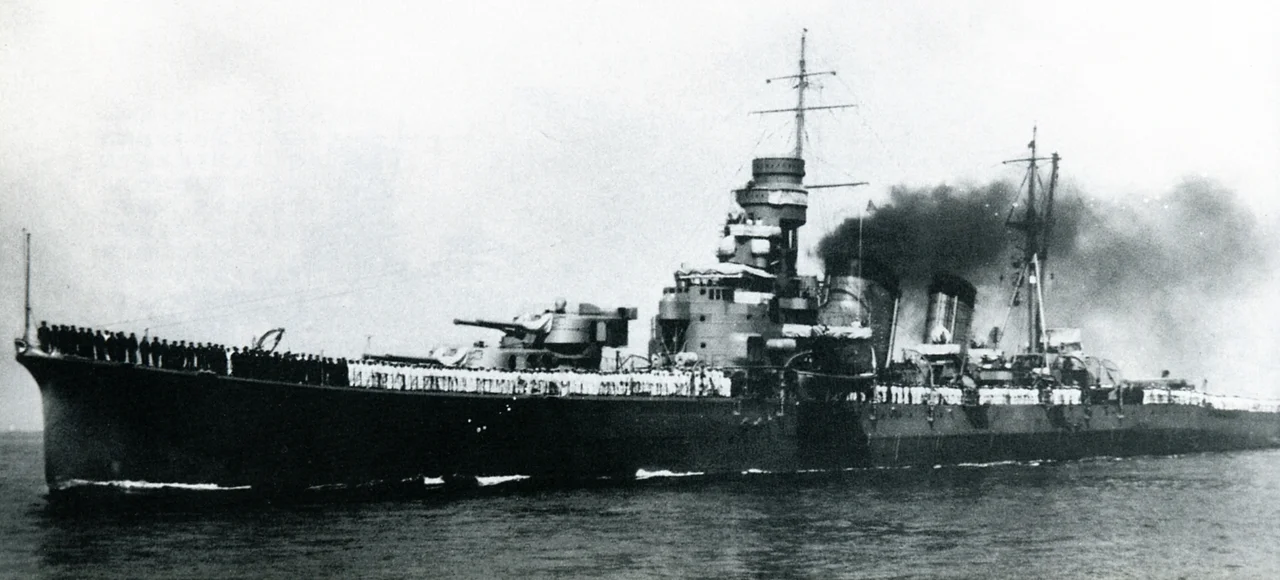

Japanese cruiser Kinugasa
Five hundred and eleven men went down with her. That is the number worth keeping in mind when you pass over these waters southwest of Rendova Island, where the Japanese heavy cruiser Kinugasa rolled onto her side at 11:22 on the morning of 14 November 1942 and disappeared into the Solomon Sea. She was fifteen years old. She had been, briefly, the first Japanese combat ship ever to carry an aircraft catapult. By the time American dive bombers found her on that last morning, she was a burning, listing wreck - her captain dead on the bridge, her executive officer beside him, her gasoline storage afire, and her engines gone. The crew stayed with her until she capsized.
A Ship Built Heavy
Kinugasa was the second of a two-ship class named for Mount Kinugasa near Yokosuka. Kawasaki shipyards in Kobe completed her on 30 September 1927. She was meant to be an elegant compromise - fast, gunned, protected - but the compromises had already gone wrong by the time she slid down the ways. Designers had added twin turrets and that innovative aircraft catapult to an already top-heavy Furutaka-class hull, and the result was a ship with chronic stability problems. Engineers would spend her entire career trying to rebalance her. Sasebo Navy Yard took her apart and rebuilt her between 1937 and 1940. When she emerged for the war everyone could feel coming, she was a veteran of China patrols, of a collision with a submarine that had used her as a target, and of thirteen years of Pacific service. Her sailors knew her quirks.
From Pearl Harbor to the Slot
On the day Pearl Harbor burned, Kinugasa was nowhere near Hawaii. She and Cruiser Division 6 were covering the invasion of Guam, and then the second assault on Wake Island. Through the first half of 1942 she worked the long supply lines out of Truk Lagoon, escorting troop convoys into Rabaul, Kavieng, and Tulagi as Japan pushed south. At the Battle of the Coral Sea in May, she escorted the damaged carrier Shokaku home after American aircraft from Yorktown and Lexington sank her smaller sister Shoho in ten minutes of chaos north of Tagula Island. Kinugasa came through untouched. The word untouched would not apply much longer. After the Eighth Fleet reorganization in July 1942, she fell under Vice Admiral Gunichi Mikawa at Rabaul - and Rabaul meant the Slot, the 500-mile corridor between the twin chains of the Solomons where night battles had already begun to define the Pacific war.
Savo Island, Cape Esperance
The night action off Savo Island on 9 August 1942 was, from the Japanese perspective, almost perfect. Kinugasa and the cruisers of CruDiv 6 came down the Slot under darkness, launched flare-dropping floatplanes, and fell on the Allied screen covering the Guadalcanal landings. Four Allied cruisers went down. Kinugasa took two shell hits - one 8-inch round from Vincennes that failed to explode, killing one of her crew and wounding another in the No. 1 Engine Room. The American transports were naked and Mikawa turned away, fearing a dawn air attack that never came. Captain Sawa of Kinugasa, furious, fired a long-range torpedo spread at the distant transports. Every one missed. Two months later at Cape Esperance, the Americans returned the favor with radar - and CruDiv 6 came apart. Admiral Goto was mortally wounded aboard Aoba. Furutaka went down. Kinugasa straddled Boise and Salt Lake City with her 8-inch guns before taking four hits of her own and limping back to Shortland. She was earning a reputation for bringing her crew home.
The Last Morning
Her luck was finite. After Kinugasa helped pound Henderson Field on the night of 14-15 October - 752 shells into the American airstrip on Guadalcanal - the bills came due. On the morning of 14 November 1942, American pilots found her returning from yet another bombardment run. At 09:36 a 500-pound bomb struck the machine gun mount forward of her bridge and ignited the gasoline storage below. Captain Sawa and his executive officer died in the same blast. Near-misses opened her hull to the sea. A second strike - seventeen more Dauntlesses - took out her engines and rudder. She listed further to port, fires spreading, water rising. At 11:22 she rolled over and went down, taking 511 men with her, southwest of Rendova Island at roughly 8.75 south, 157 east. The Navy List removed her name on 15 December. The men she carried remained where they fell.
Ironbottom Sea
These waters have a name that sailors use when civilians are not listening: Ironbottom Sound, Ironbottom Sea - the stretch of the Solomons where so much steel came to rest in 1942 and 1943 that the seabed here is, in places, a graveyard of ships. Kinugasa is part of that company, together with American cruisers she fought and Japanese cruisers she sailed beside. The survivors of the Pacific war - on both sides - often insisted that the dead below did not care about the flag above. From altitude, the sea looks ordinary. Palm islands, reef shadow, the long wake of a fishing boat. But the geography carries memory. When you pass this water, the water remembers.
From the Air
Kinugasa's wreck lies southwest of Rendova Island at approximately 8.75°S, 157.17°E, in the central Solomon Islands. Recommended viewing altitude: FL200-FL300 gives a sweeping view of the New Georgia group and the long corridor of the Slot stretching northwest toward Bougainville. Nearest airports: Munda (AGGM) on New Georgia and Honiara's Henderson Field (AGGH) on Guadalcanal. Weather in the Solomons is tropical with frequent afternoon cumulus buildups; mornings typically offer the clearest visibility across the chain.
Nearby Stories
- Munda Airport 14 km away
- Vella Lavella 80 km away
- Battle of Vella Lavella (land) 109 km away
- Woodlark Island 442 km away
- Louisiade Archipelago 535 km away
- Païta 1724 km away
- Maré Island 1787 km away
- 1737 Kamchatka Earthquake 6778 km away