
Vella Lavella
The language does not fit. Walk the coast of Vella Lavella and the words you hear - if you hear the old tongue rather than Solomon Islands Pijin - belong to a family called Papuan, a linguistic category stitched together more by what it is not than by what it is. Everywhere else in the Solomons, people speak Austronesian languages, part of the great maritime web of Polynesia, Micronesia, and island Southeast Asia. Here the Bilua language sits stubbornly outside that web, a survivor from an older migration. Archaeologists cannot entirely explain it. The painted potsherds dug from Vella Lavella soil date back 2,000 to 3,000 years, hinting at a people who came by a different route than most of their neighbors, and who have been shaping this volcanic island ever since.
A Volcanic Island with a Thermal Heart
Vella Lavella sits in the Western Province of the Solomon Islands, west of New Georgia, north of the Treasury Islands, with Choiseul on the northern horizon and the Shortlands to the northwest. It is a volcanic island, built up by the same tectonic restlessness that gave the Solomons their whole serrated skyline. Coral reef rings it in places. A thermal spring bubbles somewhere inland. The highest point is Mount Tambisala at 790 meters, and the youngest volcano, Nonda, reaches 750 meters and is still considered active, though it has not erupted in modern memory. Short rivers drop quickly from the mountains to the coast, and the Bilua-speaking people have used them for centuries to irrigate gardens along the shoreline - because the interior is thick lowland rainforest, and everyone lives on the coast. The climate is warm, wet, and relentless, and every few years an earthquake or a cyclone reminds the islanders who is in charge.
Forests That Hold Birds Found Nowhere Else
In the northwest corner of the island, 14,641 hectares of lowland rainforest have been designated an Important Bird Area by BirdLife International. That is not paperwork. The forest holds populations of white-winged fantails, Kolombangara monarchs - and the Vella Lavella white-eye, a small bird that lives here and nowhere else in the world. Endemic species are what remain when an island has been alone long enough for evolution to improvise. The white-eye is one of those improvisations. The primary threat is logging - the same pressure that has thinned forests across the Solomons - and the island's biodiversity depends on how that tension resolves over the coming decades. A Vella Lavella without its white-eyes would be a quieter, poorer place; a forest that survives the saws will keep being a laboratory for something the rest of the world cannot produce.
The People Who Speak Bilua
The Bilua are the linguistic puzzle of the central Solomons. Their language belongs to a small group of Papuan languages spoken on a few Solomon Islands - an outlier in a sea of Austronesian speech. For archaeologists this suggests an earlier migration, people who were not part of the main wave that carried Austronesian languages across the Pacific from Taiwan down through island Southeast Asia and out into Polynesia. The painted potsherds dating back two to three millennia hint at an older story, one whose details have mostly been lost to the tropics. What is not lost is the living culture. Bilua is still spoken. Villages still cluster along the coast where freshwater streams reach the sea. The knowledge of reef and forest and garden passes down in a language that predates the wider Melanesian pattern around it - a kind of cultural thermal spring, still flowing.
The Protectorate and the War
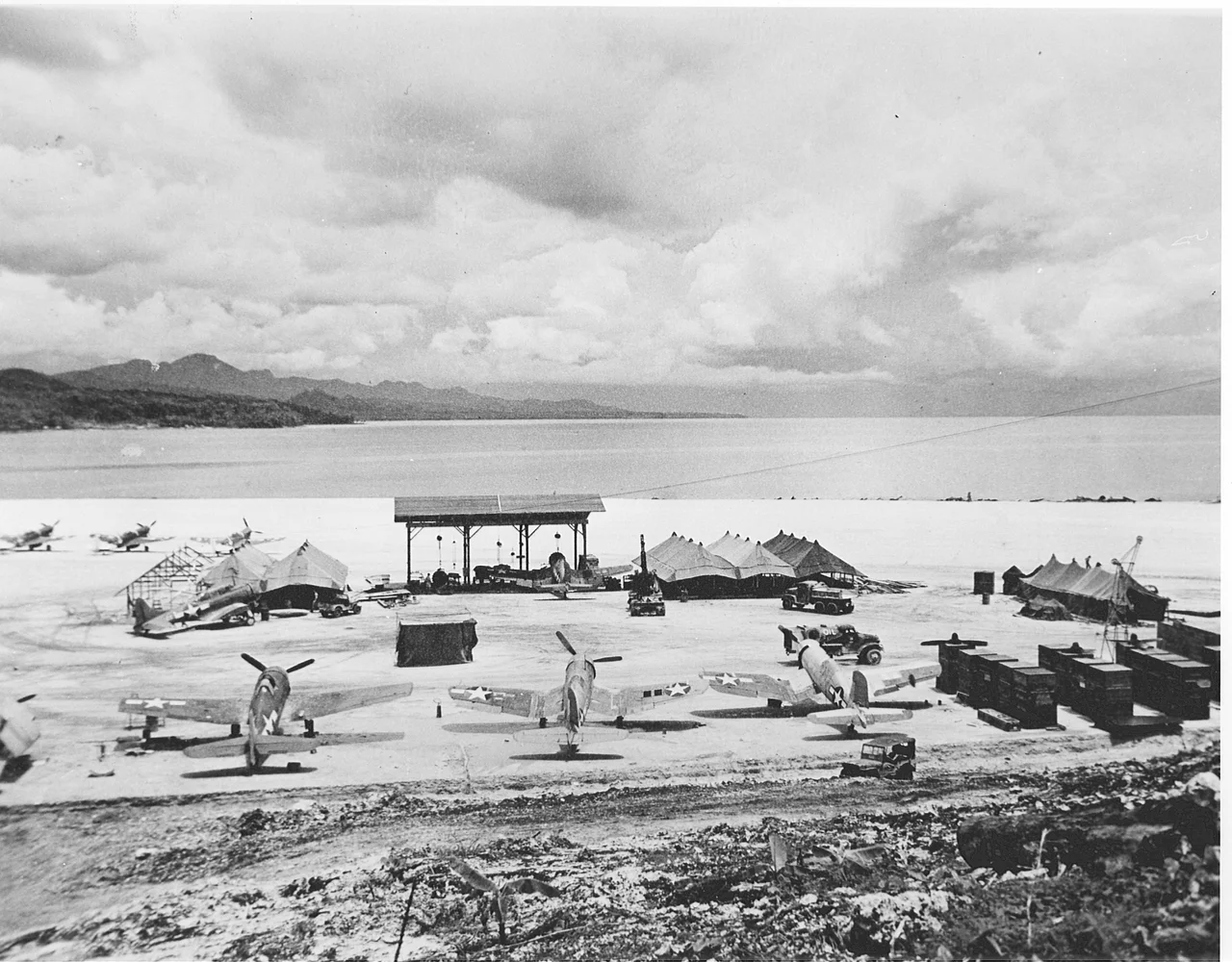
On 15 March 1893, Vella Lavella was declared part of the British Solomon Islands protectorate - a line drawn on a map in London that meant little to the Bilua until it began to mean a great deal. By the early 1940s it meant soldiers. The Empire of Japan occupied the island in the opening moves of the Pacific War, and in August 1943 the war came to Bilua gardens and coastal villages when American troops landed at Barakoma on the southeastern tip. What followed was the Battle of Vella Lavella - American troops, then New Zealanders, pushing the Japanese garrison north through jungle and rain. By the time the Japanese evacuated on the night of 6 October, and the Allies had built an airstrip at Barakoma, the island's inhabitants had lived through nearly two months of an industrial war fought across terrain they knew better than any soldier on either side. From that airstrip - home to VMF-214, the Black Sheep Squadron under Gregory Pappy Boyington - Allied aircraft flew north toward Rabaul and helped end the war. When the war ended, the soldiers left. The Bilua were still there.
The Island Today
Since 1978, Vella Lavella has been part of the independent Solomon Islands, not a protectorate but a province of a sovereign country. The coast is dotted with villages, many in places that would be recognizable to a villager from 1893 or 1943. Milner Tozaka, elected to the National Parliament in 2006 to represent the North Vella Lavella Constituency, has served as Foreign Minister and Minister for Public Service - a reminder that the island produces national figures as well as endemic birds. Google Maps images still show faint rectangular shapes on the southeastern coast where the old airfield was. The reef is still there. Mount Tambisala still stands at 790 meters. And the Bilua language, the linguistic outlier, is still spoken along the coast - a quieter kind of survival than airbases and battles, but one that has outlasted both.
From the Air
Vella Lavella centered at 7.73 degrees south, 156.63 degrees east. Recommended viewing altitude 3,000 to 8,000 feet depending on whether you are tracing the coastline or taking in the whole volcanic silhouette. Mount Tambisala (790 m) and Nonda (750 m) are visual landmarks in the interior. Barakoma (AGOK), a grass strip on the old WWII airfield site on the southeast coast, is the main airstrip. Munda Airport (AGGM) on New Georgia lies about 35 nautical miles southeast. Honiara International (AGGH) on Guadalcanal is approximately 200 nautical miles southeast. Weather is tropical - expect scattered cumulus, afternoon buildups, and occasional heavy rain.
Nearby Stories
- USS Helena (CL-50) 14 km away
- Gizo, Solomon Islands 33 km away
- Munda Airport 48 km away
- Raid on Choiseul 56 km away
- Shortland Islands 57 km away
- Battle of the Treasury Islands 66 km away
- Woodlark Island 390 km away
- 1737 Kamchatka Earthquake 6662 km away