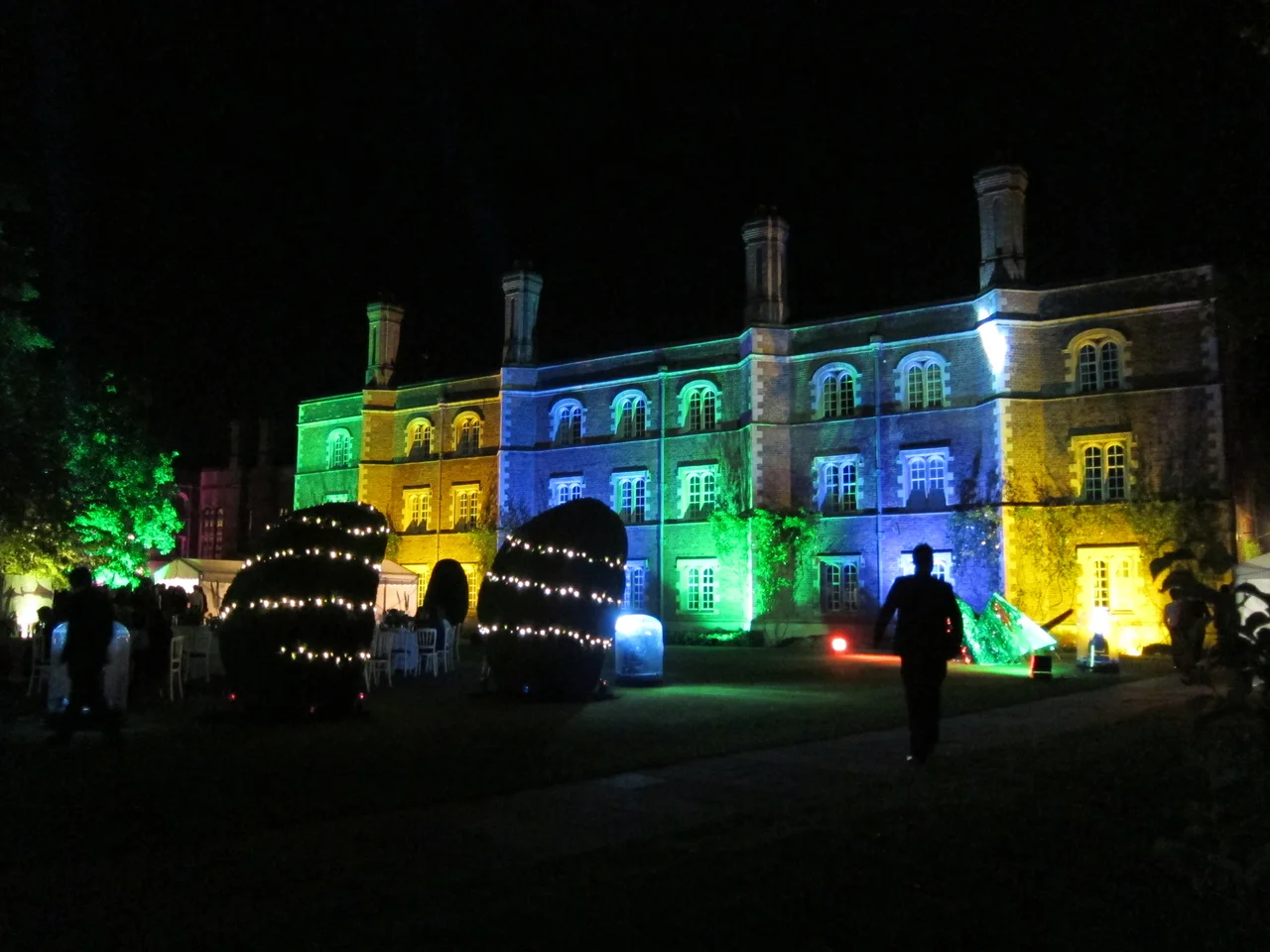

Jesus College, Cambridge
The chapel at Jesus College was already over three hundred years old when the college itself was founded. Built beginning in 1157 as the chapel of the Benedictine Convent of St Mary and St Radegund, it predates the University of Cambridge by half a century. When John Alcock, Bishop of Ely, dissolved the struggling nunnery in 1496 and converted its buildings into a college, he inherited medieval walls, a cloister, a refectory that became the college dining hall, and a chapel that remains the oldest university building in Cambridge still in regular use. You enter Jesus College through a narrow passage called the Chimney — from the Middle French cheminée, meaning "little path" — and emerge into courts that feel monastic because they were, once, exactly that.
What the Nuns Left Behind
The Benedictine Convent of St Mary and St Radegund was founded in the early 12th century. By the late 15th century it had declined; the nuns were few, the buildings dilapidated, the endowment insufficient. Alcock dissolved it and transformed the whole complex into a college for men. The nuns' refectory became the hall. The prioress's lodging became the Master's Lodge. The cloister remained a cloister — and still is today, unusually intact. The churchyard of the old parish of St Radegund still lies within the grounds, and some of the lawns at Jesus College conceal burial sites from the nunnery's era. The college is one of the few in Cambridge that allows visitors to walk on most of its lawns — but not the burial sites, which are marked off. History persists underfoot as much as overhead.
A Chapel Ravaged and Restored
The chapel at Jesus was not preserved gently. It burned twice, in 1313 and 1376. Its belfry and steeple collapsed in 1277. When Alcock converted the convent, the cathedral-sized church — the largest in Cambridge at the time — was radically reduced. Much of the nave was demolished and replaced with college rooms. What remained was carved, restored, and decorated across the centuries: Augustus Pugin worked here between 1849 and 1853, recreating medieval misericords from fragments preserved in the Master's Lodge. George Frederick Bodley carried out further work in the 1860s, commissioning decorative schemes from Morris, Marshall, Faulkner and Co. — the firm founded by William Morris, with work contributed by Edward Burne-Jones, Dante Gabriel Rossetti, and Ford Madox Brown. The firm returned in the 1870s to install stained glass. Standing in the chapel today is to stand inside eight centuries of crisis, repair, and aspiration.
Cranmer, Coleridge, and Clean Bandit
Thomas Cranmer entered Jesus in 1503, at the age of fourteen. He became the first Protestant Archbishop of Canterbury, responsible for the Book of Common Prayer — the liturgical text that shaped the English language as much as any single document. Robert Malthus arrived in 1784, later producing An Essay on the Principle of Population, which influenced Darwin and reshaped economics and sociology. Samuel Taylor Coleridge studied here in the 1790s; the college grounds include a nature trail inspired by his poetry. The pattern holds across the centuries: Alistair Cooke, the British-American journalist who wrote and broadcast Letter from America for 58 years. Nick Hornby, author of About a Boy. Prince Edward, Duke of Edinburgh. And Grace Chatto, cellist and co-founder of Clean Bandit — along with her bandmates, all educated at Jesus. In 2019, Sonita Alleyne was elected master, becoming both the first woman and the first Black leader of an Oxbridge college.
Two Nobel Prizes and an International Court
Three members of Jesus College have received Nobel Prizes. Philip W. Anderson won the Physics prize in 1977; he was a fellow from 1969 to 1975 while holding a visiting professorship at the Cavendish Laboratory. Peter D. Mitchell, an undergraduate and later research student, won the Chemistry prize in 1978. Eric Maskin won the Economics prize in 2007. Two fellows of the college have been appointed to the International Court of Justice: Robert Yewdall Jennings served as a Judge from 1982 to 1991 and as President from 1991 to 1995; James Crawford was appointed in November 2014. Stormzy was elected an honorary fellow in 2025. The range itself — from medieval theologians to Nobel physicists to grime artists — reflects something about what a 500-year-old institution accumulates when it keeps its doors open to genuine talent.
Grounds and the Boathouse Across the Common
Jesus College occupies some of the most spacious grounds in central Cambridge. Within the walls: football, rugby, cricket, tennis, squash, basketball, and hockey pitches. Four hundred yards away, across Midsummer Common, the college boathouse sits on the River Cam. The Jesus College Boat Club has rarely dropped below 12th place in the May Bumps. The college hosts a highly regarded May Ball each year, an annual arts festival, and formal hall five nights a week. In 2017, West Court opened — the college's largest modern addition, including a 180-seat lecture theatre, medical teaching suite, and student social areas. The development incorporated part of the site of nearby Wesley House, whose freehold had belonged to Jesus since 2014. Growth at a Cambridge college always carries this quality: methodical accumulation, one court at a time, over five centuries.
From the Air
Jesus College sits in central Cambridge at approximately 52.209°N, 0.123°E, northeast of the city center near the River Cam and Midsummer Common. Cambridge City Airport (EGSC) is about 2.5 miles to the east-northeast. The monastic-style courts and open grounds, distinctly different from the compact arrangement of colleges along the river, are identifiable from the air. Approach from the east at 1,500–2,000 feet for a clear view of the college grounds and the Common beyond.
Nearby Stories
- Walden Abbey 4.6 km away
- Bury St Edmunds 5.5 km away
- RAF North Pickenham 8.1 km away
- Ampthill 9.5 km away
- RAF Wittering 10 km away
- Murder of Una Crown 12 km away
- Colchester Community Stadium 18 km away
- John Bunyan Museum 19 km away