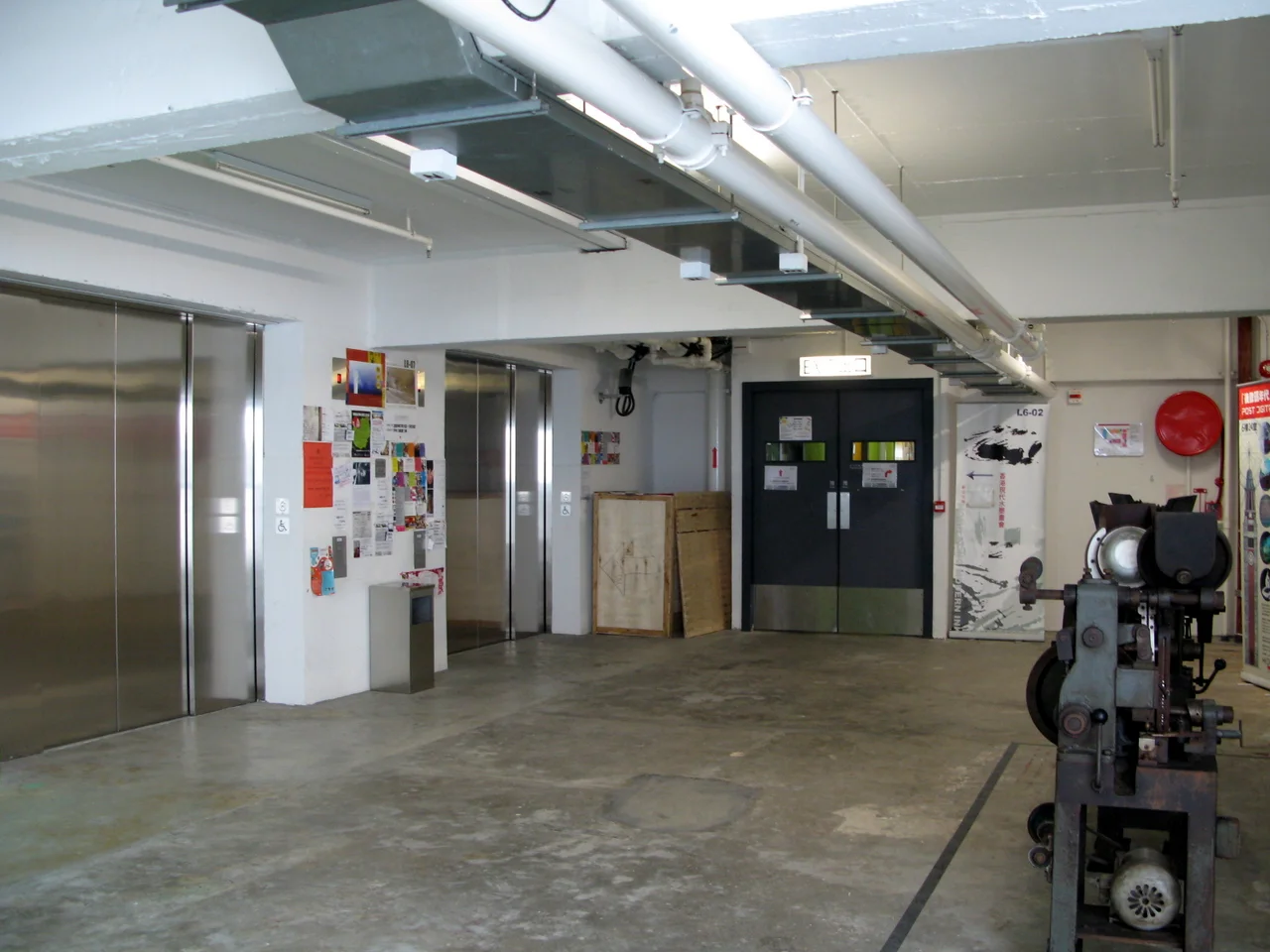

Jockey Club Creative Arts Centre
In January 2007, when applications for studio space at a new arts centre in Shek Kip Mei were opened, demand outstripped supply five to one. The building hadn't even been converted yet — the former Shek Kip Mei Flatted Factory was still being stripped and retrofitted. But 112 artists, arts groups, and recent graduates would eventually take up residence, claiming studios in a nine-storey block that had sat empty since 2001, in a neighbourhood long associated with public housing and light industry. Hong Kong had been looking for a place to put its artists. It found one in a factory.
What the Factory Was
The Shek Kip Mei Factory Estate was built in 1977 by the Hong Kong Housing Authority. It contained 390 factory units across nine floors, designed for cottage industries and light manufacturing — the kind of small-scale, labour-intensive production that defined Hong Kong's economic miracle in the 1970s and 1980s. Garment-making was central to that economy, and the factory estate was built to serve it. By the 1990s, the logic had reversed. Manufacturing moved to cheaper labour markets in mainland China, the garment industry contracted sharply in Hong Kong, and the building found itself without tenants. It stood vacant from May 2001. The question was what to do with a nine-storey industrial block in a dense urban neighbourhood where most sites are immediately absorbed by residential or commercial development.
The First Adaptive Reuse
The Jockey Club Creative Arts Centre was the first attempt in Hong Kong to convert a decommissioned factory building into a creative arts centre. Funding came from the Hong Kong Jockey Club Charities Trust, which took naming rights. The conversion project began in October 2005 and was completed by February 2008, with the first tenants moving in the following month. The official opening took place on 26 September 2008. JCCAC is managed as a self-financed subsidiary of Hong Kong Baptist University, in partnership with the Hong Kong Arts Development Council and the Hong Kong Arts Centre, and is registered as a charity. The conversion preserved the building's industrial character while adapting it for creative use: exposed concrete, freight lift lobbies, and open corridors that were once used to move manufactured goods now connect painting studios, ceramics workshops, and performance spaces. The Hong Kong Institute of Architects gave the project its Medal of the Year in the HKIA Annual Awards 2008.
One Hundred and Forty Studios
JCCAC provides 140 studio units, most measuring around 300 square feet, at rents substantially below market rate. The range of practice is broad: painting, sculpture, ceramics, photography, illustration, art technology, music, dance, community art, and art education all have a presence in the building. In addition to individual studios, the centre includes a Black Box Theatre, two exhibition galleries, and a central courtyard on the ground floor — Level 1 — where cafés and a Chinese tea house face the open interior. When applications were first accepted in November 2006, demand ran five times the available places; 112 applicants were eventually selected from among the pool, including six arts organisations and 88 individual artists or arts groups. The centre is architecturally compared to London's Tate Modern in its industrial origins and adaptive character, though it operates at a neighbourhood rather than international scale.
The Tension Beneath the Creativity
A pioneer project learns by friction. In the first years after its opening, artists at JCCAC complained about bureaucratic management, poor facilities, and public spaces that were difficult to use. Visitors sometimes found studios closed, as some tenants had taken affordable studios without prioritizing public engagement. The centre adapted: closer collaboration with tenants, regular social gatherings, and guided public tours helped shift the balance. A separate friction emerged around rent. In 2012, tenants faced back-to-back rent increases that pushed rates to HK$7.80 per square foot — up from HK$6.50. One artist, Mac Mak Keung-wai, captured the feeling precisely: 'I am not against increasing the rent if it's necessary. I just feel that this is a commercially driven decision and that it strays from the original vision of the centre.' What kept the centre viable despite the tension was the math: even at HK$7.80 per square foot, JCCAC was more than 30% below the private market average of HK$11.30 per square foot in January 2012. The artists stayed because, even with its contradictions, there was nowhere cheaper to make work in Kowloon.
From the Air
The Jockey Club Creative Arts Centre sits at 22.33°N, 114.17°E in Shek Kip Mei, southern Kowloon, immediately east of the Sham Shui Po district. The nine-storey industrial building is identifiable from the air by its massed floor-plates, distinct from the surrounding residential towers. Approach from the south over Victoria Harbour at 1,500–2,500 feet; the neighbouring Shek Kip Mei Estate public housing blocks are prominent nearby landmarks. The nearest major airport is Hong Kong International (VHHH), approximately 20 km to the west on Lantau Island. Kai Tak Airport's former runway site in Kowloon Bay is visible to the southeast. The centre is served by the MTR Shek Kip Mei station on the Kwun Tong Line.
Nearby Stories
- Chapel of St. Francis Xavier 3.5 km away
- Cuiheng 4.1 km away
- 2015 Shenzhen Landslide 16 km away
- Shunde 31 km away
- Wanshan Archipelago 37 km away
- Nanxiong Formation 96 km away
- Heyuan 149 km away
- Checheng Fu'an Temple 629 km away