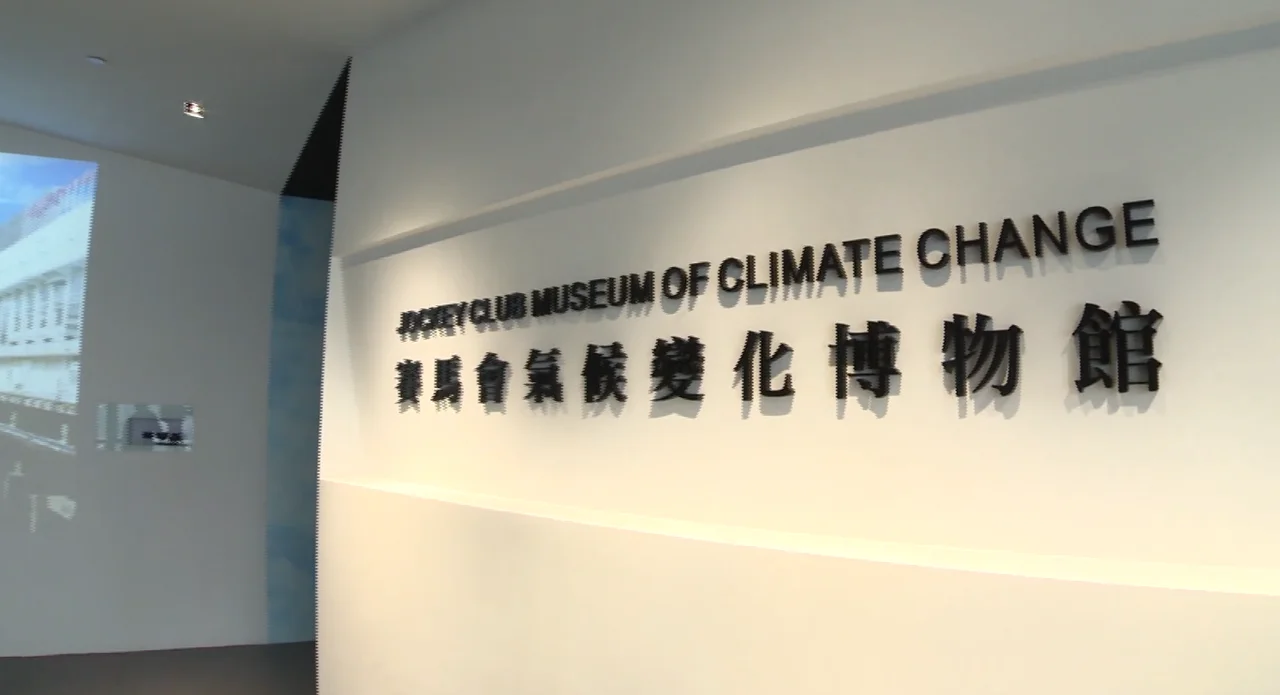

Jockey Club Museum of Climate Change
In 1987, Rebecca Lee stood at the South Pole as part of a Chinese scientific expedition, and the idea arrived: Hong Kong needed a polar museum. It was not obvious why Hong Kong — a subtropical commercial city, far from any ice sheet — should be the place. But Lee's logic was the logic of distance: precisely because Hong Kong felt so removed from what was happening at the poles, it needed a place where that distance could be closed. She spent the next twenty-six years trying to make the museum happen. Funding fell through, institutions said no, and she considered abandoning the plan more than once. The museum opened on 16 December 2013.
Rebecca Lee's Twenty-Six Years
Rebecca Lee began focusing on climate issues in the 1980s — early, relative to the broader public conversation. Her 1987 South Pole expedition, with the State Oceanic Administration of the People's Republic of China, was the inflection point. She returned convinced that what she had witnessed at the poles — the scale, the fragility, the speed of change — needed to be communicated to people who would never travel there. In 1997, she founded the Polar Museum Fund and began approaching universities and schools for support. All attempts failed. The museum's eventual home came through the Jockey Club's Initiative Gaia program at the Chinese University of Hong Kong, a collaboration that officially launched on 1 June 2012. Eighteen months later, the museum opened in the Yasumoto International Academic Park building at CUHK, on the eighth floor, with Ma Liu Shui and Tolo Harbour visible through the campus windows below.
The World's First
The Jockey Club Museum of Climate Change carries a specific distinction: it was the world's first museum dedicated to climate change as its central subject. The Hong Kong Jockey Club Charities Trust funded its construction; the naming reflects that sponsorship. The museum's permanent collection draws heavily on Lee's own archive — over 40,000 photographs and videos gathered during expeditions that, by her account, involved life-threatening conditions and significant personal cost. These images form the backbone of the permanent exhibitions on polar climates, environmental protection technologies, and the intersection of science and advocacy. The Polar Corridor, the museum's signature space, is designed to resemble the interior of an icebreaker, with a model of the Xue Long — China's polar research vessel — displayed inside. The Chinese Antarctic Research Expedition donated a genuine artefact: a giant Antarctic stone, eroded by wind into a shape resembling a wind chime, which stands in the museum as a physical fragment of the south polar landscape.
A Museum That Leaves the Building
The MoCC is unusual among small specialized museums in that a significant portion of its programming happens outside its walls. Eco-tours run on the CUHK campus, each lasting two to three hours, guiding visitors to environmental facilities and natural sites: the tree study path around Lake Ad Excellentiam, a solar garden near the University Mall, a regeneration garden. The campus at Ma Liu Shui — reached by MTR at University station — provides an ecological setting that most urban museums cannot offer. Schools, youth organisations including the Hong Kong Scout Association, and government agencies including the Hong Kong Observatory have all taken part in these tours. The museum also maintains an internship programme through which CUHK students serve as guides and participate in event planning, keeping the institution embedded in the university community rather than operating as a standalone exhibit space.
A Local Mirror for a Global Problem
The museum's influence reached beyond Hong Kong in ways its founders had not necessarily anticipated. A New York City delegation visited and saw parallels with a climate museum they were planning — inviting a representative from MoCC to join their advisory committee. But project director Cecilia Yeung was candid about the museum's scope: it primarily targets Hong Kong residents and nearby visitors. That candour is useful. MoCC is not trying to be the definitive global institution on climate change. It is trying to be Hong Kong's entry point into a subject that affects everywhere but feels far away. Rebecca Lee's 1987 intuition — that distance is the problem, and that proximity to evidence could close it — is the museum's operating principle. Special exhibitions like 'About Climate Change, What I Want to Say' (featuring statements from 22 Australian climate scientists) and 'Melting Ice and Disintegration' extend that principle into different registers, combining scientific data with the kind of visual and emotional weight that climate data alone rarely carries.
From the Air
The Jockey Club Museum of Climate Change is located at 22.42°N, 114.21°E on the campus of the Chinese University of Hong Kong in Ma Liu Shui, Sha Tin, on the southern shore of Tolo Harbour. The CUHK campus is a distinctive landmark from the air — a dense cluster of mid-rise academic buildings on sloped terrain above the Tolo Channel. Approach from the south via Sha Tin at 1,500–3,000 feet; the University MTR station and the adjacent Tolo Harbour shoreline provide clear orientation. The nearest major airport is Hong Kong International (VHHH), approximately 30 km to the southwest. Tai Po Market and the broader Sha Tin Valley are visible to the west.
Nearby Stories
- Chapel of St. Francis Xavier 3.5 km away
- Cuiheng 4.1 km away
- 2015 Shenzhen Landslide 16 km away
- Shunde 31 km away
- Wanshan Archipelago 37 km away
- Nanxiong Formation 96 km away
- Heyuan 149 km away
- Checheng Fu'an Temple 629 km away