
Jorvik Viking Centre
Forty thousand objects. That is what the York Archaeological Trust pulled out of the ground at Coppergate between 1976 and 1981, in one of the most productive urban excavations ever conducted in Britain. The site - a former confectionery works in the heart of York - turned out to sit on top of the Viking city of Jorvik, with timber buildings, leather shoes, wooden combs, textiles and even plant remains preserved in oxygen-deprived wet clay for a thousand years. The Jorvik Viking Centre, which opened on the same spot in April 1984, did something nobody had quite tried before: it put the dig back, peopled it with figures, and added the smells. It has been arguing with archaeologists ever since.
From Craven's Chocolates to Coppergate
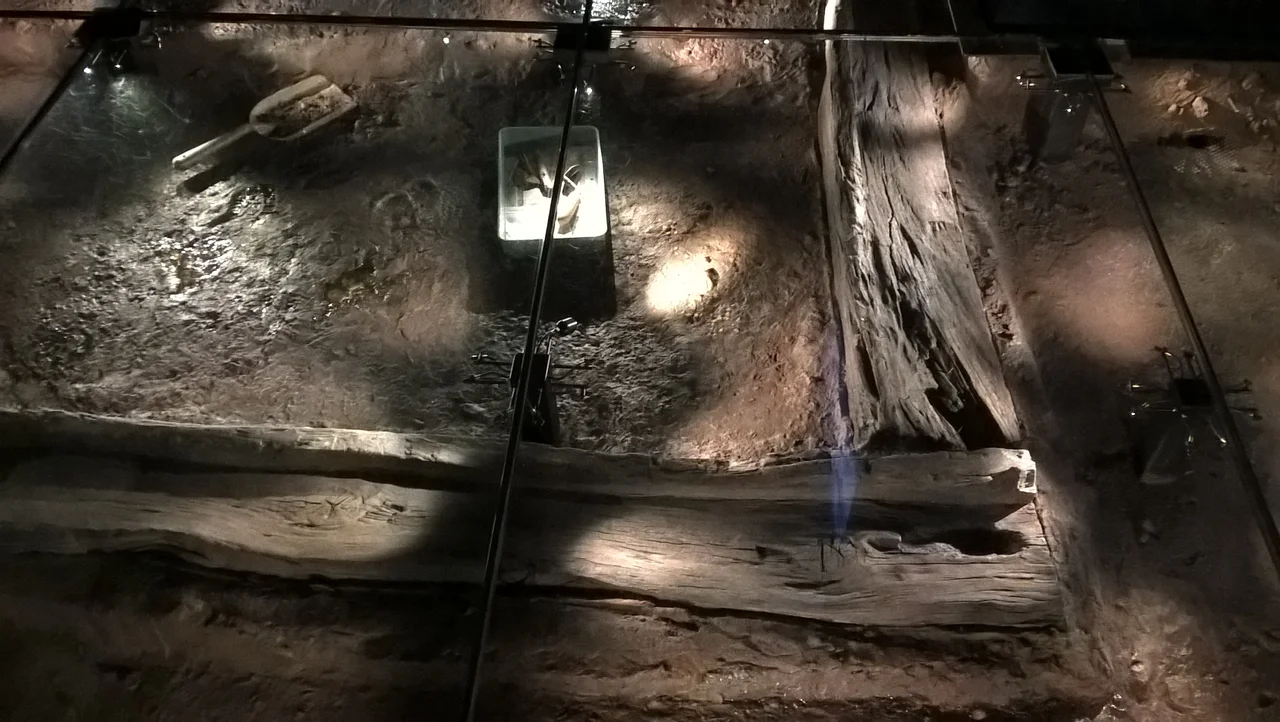
Thomas Craven, a York confectioner, acquired land on Coppergate in the 1850s. His widow Mary Ann continued the chocolate business after his death in 1862 and it grew into one of the city's industries. In 1966 Cravens moved out to a new factory on the outskirts and the old works were demolished. Before the shopping centre that now occupies the site could be built, archaeologists got a window - five years of digging, from 1976 to 1981, on a piece of ground that had been continuously occupied since the Romans. The York Archaeological Trust, founded in 1972 by Peter Addyman, ran the excavation. What emerged was not the usual archaeological menu of pottery and bone. Coppergate was wet, anaerobic and astonishingly well-preserved. The buried Viking street came up almost complete: timber walls still standing to waist height, leather still pliable, textile fibres still spinnable. The Trust began to think about what such a site might look like reopened to the public.
Reconstruction Over the Hole
John Sunderland designed the original Jorvik Viking Centre, which opened in April 1984. The concept was a "time-capsule": visitors climbed into small carriages on a track, which carried them slowly through full-scale reconstructions of the excavated Viking street and houses. The buildings were peopled with mannequins - traders, families, children, a fishmonger gutting his catch, men at a workbench. There were sounds, recreated voices, and - notoriously - smells. Wet leather, woodsmoke, fish, livestock, the unmistakable suggestion of a tenth-century latrine. It was an early example of what would later be called immersive heritage; Anthony Gaynor, one of the original creators, defended the approach against academic critics by saying: "We're making history accessible and enjoyable to the general public. You can't do that if you wrap it in a lot of academic foliage."
Three Generations of Vikings
The centre has been rebuilt three times. The first refurbishment in 2001 cost five million pounds; another million followed in February 2010. The ride got longer, twelve minutes then sixteen, and the technology more sophisticated. By the 2010 rebuild the animatronic figures had been modelled using laser-scanned skeletons from the original Coppergate dig - faces and bodies built from the bones of the actual people who had lived on the street. Then in December 2015 the floods that swamped northern England caught Jorvik too. Water poured into the lower levels of the centre and damaged exhibits across the building. The most valuable artefacts were evacuated. The museum closed for over a year. When it reopened in April 2017 the timeline had shifted - visitors now travel back to a September day in 975 AD - and University of York researchers had recorded some of the animatronic characters speaking actual reconstructed Old Norse.
The Critics and the Coprolite
Not everyone has loved Jorvik. Critics have called it a "pop-up book view of history" and labelled the presentation "Disney-like." The BBC, more generously, described the Time Warp experience as "a new art form." Both views miss the point a little: Jorvik is a serious archaeological institution that has wrapped itself in an entertainment package because the entertainment pays for the archaeology. Twenty million visitors had passed through by October 2022. Among the objects displayed in the museum proper is the Lloyds Bank coprolite - a 20-centimetre piece of fossilised human excrement excavated nearby in 1972, considered the largest such specimen ever found, and one of the most studied. It tells researchers exactly what one Viking ate (meat and grain, with parasites). It is also probably the only piece of preserved Viking faeces with its own insurance valuation.
Jolablot in February
Every February, in the long dark middle of the English winter, Jorvik runs the JORVIK Viking Festival. The festival takes its name and rough timing from Jolablot, an ancient Viking mid-winter celebration, and pulls thousands of re-enactors from across Europe to York. Combat displays on the Eye of York, long-ship parades down the Ouse, longhouse cooking demonstrations, and Old Norse storytelling fill out the week. The festival is one of the city's biggest annual events and a reminder that the Coppergate dig didn't just preserve objects - it preserved a sense of place strong enough that, every year, several thousand modern people put on woollen tunics and try to live in it for a little while.
From the Air
Jorvik Viking Centre at 53.96N, 1.08W, on Coppergate in York's medieval centre - 0.2 nm south-east of York Minster, 0.1 nm west of Clifford's Tower. Best viewed at 2,000-3,000 ft AGL. York Minster's central tower remains the unmistakable visual anchor for the whole historic centre. Leeds Bradford (EGNM) is 20 nm to the south-west, Doncaster Sheffield (EGCN) 28 nm to the south. The River Ouse winds through the city centre; the medieval walls trace a clear oval enclosing the old town. The Coppergate Shopping Centre - built on top of the excavation - is one of the larger modern roof structures visible inside the walls.
Nearby Stories
- Scampston Hall 3.5 km away
- Salts Mill 4.7 km away
- Newburgh Priory 6 km away
- Brodsworth Hall 6.2 km away
- Coverham Abbey 16 km away
- RAF Leconfield 17 km away
- Macclesfield Canal 27 km away
- RAF Scampton 35 km away