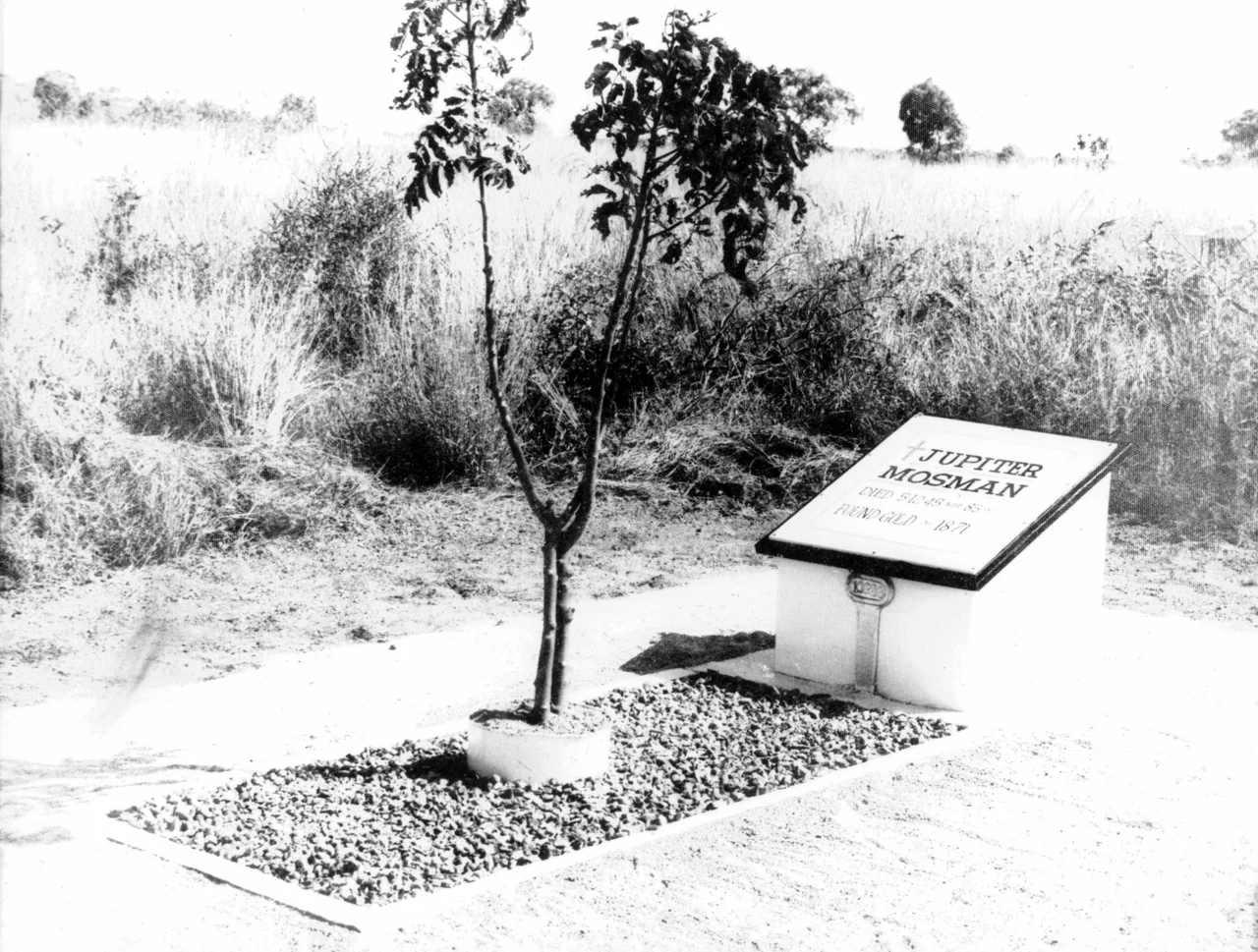

Jupiter Mosman
He was perhaps twelve years old, and he was looking for horses, not gold. The packhorses had bolted into the bush during a savage North Queensland thunderstorm, and the next morning the boy went out after them. Tracking the animals into a gully near the base of a granite hill, he knelt at a waterhole for a drink - and in the wet rock around him saw stone shot through with gold. It was just before Christmas, 1871. The boy's name was Jupiter, and the find he made that morning would summon thirty thousand people, build banks and theatres and a stock exchange wired to London, and pour out more than twenty million pounds of gold. The men he traveled with would be honored with claims, streets, and a river. Jupiter was Aboriginal, and a servant, and for a long time history gave him far less than he was owed.
The Boy With Luminous Eyes
His birth name is not recorded. He was born around 1861, a child of the Gudjal country that white settlers were rapidly claiming for cattle — his specific clan affiliation was never recorded by the colonists who named and employed him. By the late 1860s he was in the household of Hugh Mosman, a prospector and pastoralist, who employed him as a horse boy - the youngster who minded and tracked the animals on which an expedition's survival depended. Mosman gave the child the name Jupiter, reportedly because his eyes were large, luminous, and clear as a planet. It was the era's habit to rename and possess Aboriginal people, and the boy carried Mosman's surname too, as enslaved and indentured people across the British world carried the names of the men who claimed them. Yet within that constrained life, Jupiter was good at what he did. Reading ground, finding water, following a trail of hoofprints across hard country - these were the skills that put him in that gully on that particular morning.
Christmas Eve at Towers Hill
The prospecting party was small: Hugh Mosman, George Clarke, John Fraser, and Jupiter, camped behind a prominent granite rise that would soon be called Towers Hill. When a thunderclap sent the horses galloping into the scrub, it was Jupiter who tracked them. Sources differ on whether the morning was 23 or 24 December, but the moment itself is consistent across every telling: bending to drink, he saw rich gold-bearing stone in the gully. He carried specimens back to camp. On 2 January 1872 the men registered their claims on the North Australia line of reef, and the rush was on. The field was proclaimed a goldfield weeks later, named for the mining warden W. S. E. M. Charters. Within a generation the diggings the boy had found became the colony's second city, a place so complete in itself that its people simply called it 'The World.'
A Life After the Find
When Hugh Mosman lost an arm in a blasting accident and retired to Sydney, he took Jupiter with him. The boy was sent to school in Newtown and then to Lyndhurst College, where he was baptised a Roman Catholic and christened John Joseph. He took to sport - a medium-fast bowler at cricket, a footballer, a runner clocked at a hundred yards in eleven seconds. After his schooling he came back to North Queensland. When Hugh Mosman left Charters Towers in 1891, Jupiter signed on as a drover, taking a mob of cattle from near Kynuna down to Wodonga in Victoria - six months and five days on the road, and not a single beast lost. He spent his later years among the Aboriginal community of Charters Towers, of which he became a patriarch. Much of his adult life is thinly documented, the fate of so many Aboriginal lives recorded only at their edges. What survives shows a capable, respected man who outlived almost everyone who had been present at the beginning.
What the Town Owes Him
By his final years, Jupiter Mosman was one of only two people left alive who had been at Charters Towers at its birth. When he needed care, the Eventide Home did not normally admit Aboriginal people - so the townsfolk petitioned the Queensland Government to make an exception, on the grounds of his place in their history. He died there on 5 December 1945, aged about eighty-four, and was buried the next day in the Charters Towers cemetery. The honors arrived slowly and unevenly. Hugh Mosman's name went onto the main street and onto the Mossman River; Jupiter's went onto a far-off casino on the Gold Coast. Only in 1997 was a large boomerang-shaped monument raised in his memory in Lissner Park, and his name given to a cooperative that houses Indigenous people in the town. The arithmetic is hard to miss: a man could find the gold that made a city, and wait more than a century to be honored as its founder. Stand at the foot of Towers Hill today and the debt is plain. The World began with a thirsty boy, a waterhole, and an eye sharp enough to know what it was seeing.
From the Air
Charters Towers sits at 20.07 degrees south, 146.26 degrees east, on the dry inland plains roughly 130 km southwest of Townsville. The key landmark is Towers Hill, the granite rise (421 m / 1,381 ft) immediately south of the town where Jupiter's gold was found; its flat top and lookout are visible for miles across otherwise level country. Lissner Park, with the boomerang monument, lies in the town grid to the north. Charters Towers Airport (ICAO YCHT) is just southwest of town; Townsville (YBTL) is the nearest major field. Best viewed at 2,000-4,000 ft AGL in the clear, dry winter air; summer afternoons bring the kind of buildup that scattered the horses in 1871.
Nearby Stories
- Bindal People 44 km away
- Herveys Range Heritage Tea Rooms 57 km away
- Bowen River Hotel 65 km away
- Radar Station, Charlie's Hill 71 km away
- Strathmore Homestead 126 km away
- Porcupine Gorge 153 km away
- Undara Volcanic National Park 230 km away
- Lake Dunn 276 km away