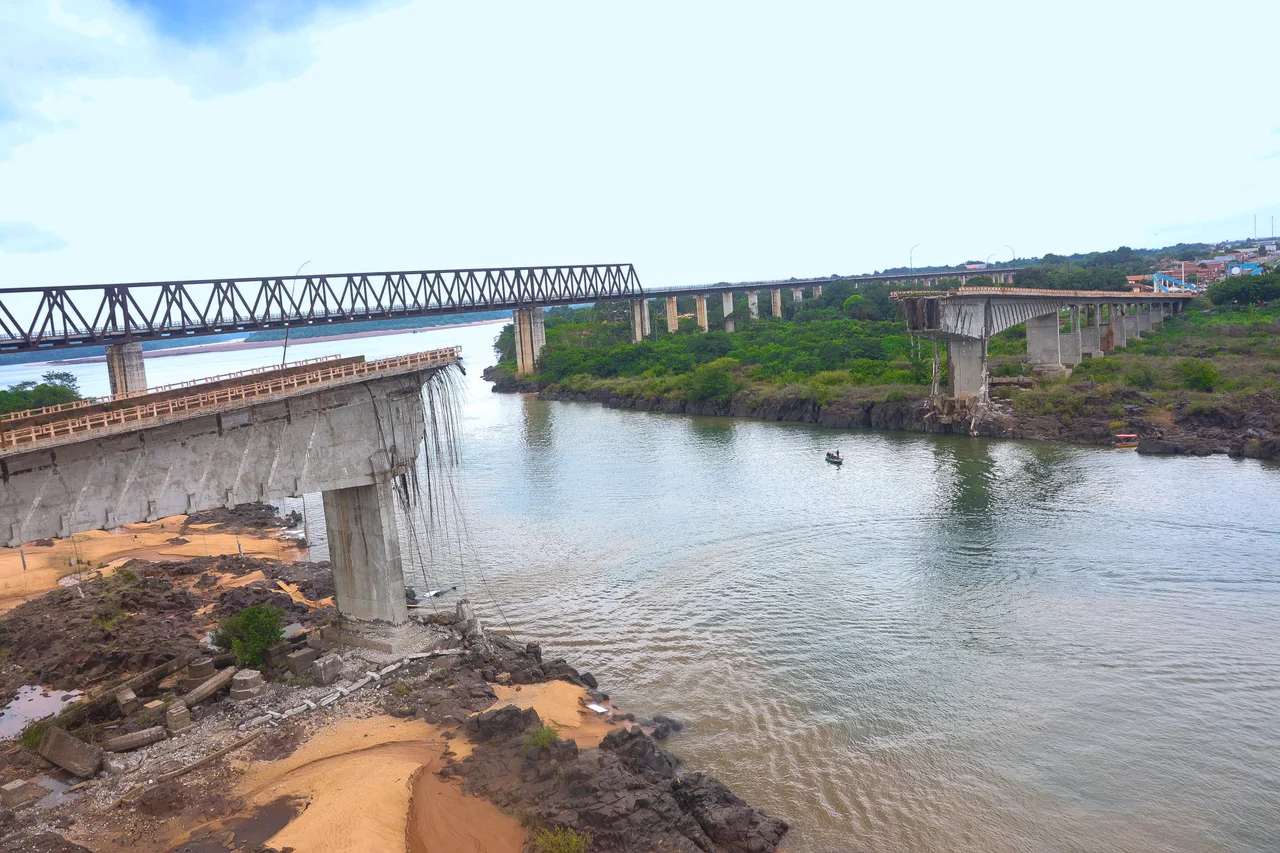

Juscelino Kubitschek de Oliveira Bridge
There is footage. A local councillor had gone to the Juscelino Kubitschek de Oliveira Bridge to film what he said were obvious structural problems. Cracks. Sagging in places where a bridge should not sag. The camera was pointed at the central span when, at 2:50 p.m. local time on 22 December 2024, the deck buckled and the whole section pitched into the Tocantins River. Ten vehicles fell with it - cars, motorcycles, trucks - including one tanker carrying about 76 tonnes of sulfuric acid and another 22,000 to 25,000 liters of pesticide. At least thirteen people died. At least four others were reported missing and never conclusively found. The bridge, built when Brazil was young and ambitious, was 63 years old.
A President's Bridge
The bridge had opened in January 1961, named after the Brazilian president who had commissioned the Belém-Brasília Highway project that required it. Juscelino Kubitschek - JK to every Brazilian then and since - was the architect of the nation's mid-century modernization. His slogan, "fifty years in five," gave the country a new capital at Brasília, a new interior highway system, and a new sense that the modern world might be accessible by road. The JK Bridge was an emblematic product of that era. At 533 meters long, with a free span of 140 meters, it held a record for its type at the time. It carried the BR-226 and BR-010 highways between the municipalities of Estreito, Maranhão, and Aguiarnópolis, Tocantins, across the broad Tocantins River - a critical link for cargo moving between the northeast and the interior.
Before the Fall
Signs of decay had been observed for years. Engineers had flagged structural concerns. Local officials had requested repairs. Trucks carrying heavy loads - the cargo traffic the bridge was originally built to serve - continued rolling across without apparent restriction. The councillor who filmed the collapse was recording evidence precisely because he believed the bridge was dangerous. His video, shared across Brazilian news within hours, became one of the most widely viewed records of an infrastructure failure in recent memory. It showed a moment of terrifying ordinariness: a span that looked entirely normal until, in the space of perhaps two seconds, it was not there anymore.
The Chemical Problem
The fall itself was one disaster. The possibility of a second loomed immediately afterward, when it became clear that one of the trucks on the span had been carrying sulfuric acid and another pesticide. Both tankers had gone into the river along with their cargo. The Tocantins is a major regional waterway - a tributary of the Amazon system, and the primary drinking water source for a chain of municipalities downstream. The state governments of Tocantins and Maranhão ordered water providers to halt intake from the river. Only some followed through. Imperatriz, a large city on the Maranhão side, did shut down its supply as a precaution. Others relied on groundwater and kept operating. Authorities warned the public not to touch the river. Two days later, Maranhão's environmental supervisor Caco Graça announced that the truck's tank had been found intact. The acid had not spilled. The water intakes reopened.
Recovery in Dark Water
The Tocantins is deep and silt-dark at the bridge site, and the currents are strong. Divers and underwater search units from the Brazilian Navy worked through the days after Christmas, recovering bodies from the river. By 3 January 2025, thirteen victims had been found. At least four more were listed as missing - presumed lost to the current, the depth, or the wreckage trapped beneath the river. Grieving families held vigils on the riverbank. Identifications came slowly. The names were ordinary: a truck driver heading home for the holidays, a family crossing to visit relatives, a motorcyclist whose bike was found crushed in the tangle of rebar and concrete that had sunk to the bottom.
After the Fall
President Lula da Silva expressed condolences within hours. Transport Minister Renan Filho traveled to the site, and together with Tocantins governor Wanderlei Barbosa announced an immediate reconstruction commitment of more than 100 million reais. Maranhão governor Carlos Brandão held press conferences reassuring the public about water safety. The Federal Police opened investigations into responsibility for the failure - questions about inspections, maintenance contracts, and warnings that may have been ignored. The ferry services that had once been alternative crossings before the bridge was built returned overnight. A temporary floating bridge was planned. A new permanent span was promised. For the towns on either side, the JK Bridge had been the only quick way across the Tocantins for six decades. In an instant, it was gone.
From the Air
Located at 6.56°S, 47.46°W where the Tocantins River forms the boundary between the states of Maranhão and Tocantins. The collapsed bridge site is between Estreito (Maranhão side) and Aguiarnópolis (Tocantins side). Best viewed at lower altitudes (3,000-6,000 feet AGL) to appreciate the river crossing. Carolina Airport (SWKO) is the nearest small airport, approximately 80 km south. A temporary crossing and reconstruction works may be visible in the area. The Tocantins River is broad and slow at this point.
Nearby Stories
- Chapada das Mesas National Park 23 km away
- São Geraldo do Araguaia Environmental Protection Area 73 km away
- Serra dos Martírios/Andorinhas State Park 94 km away
- Maranhão 129 km away
- Parnaíba Basin 131 km away
- Tocantins 287 km away
- Nascentes do Rio Parnaíba National Park 368 km away