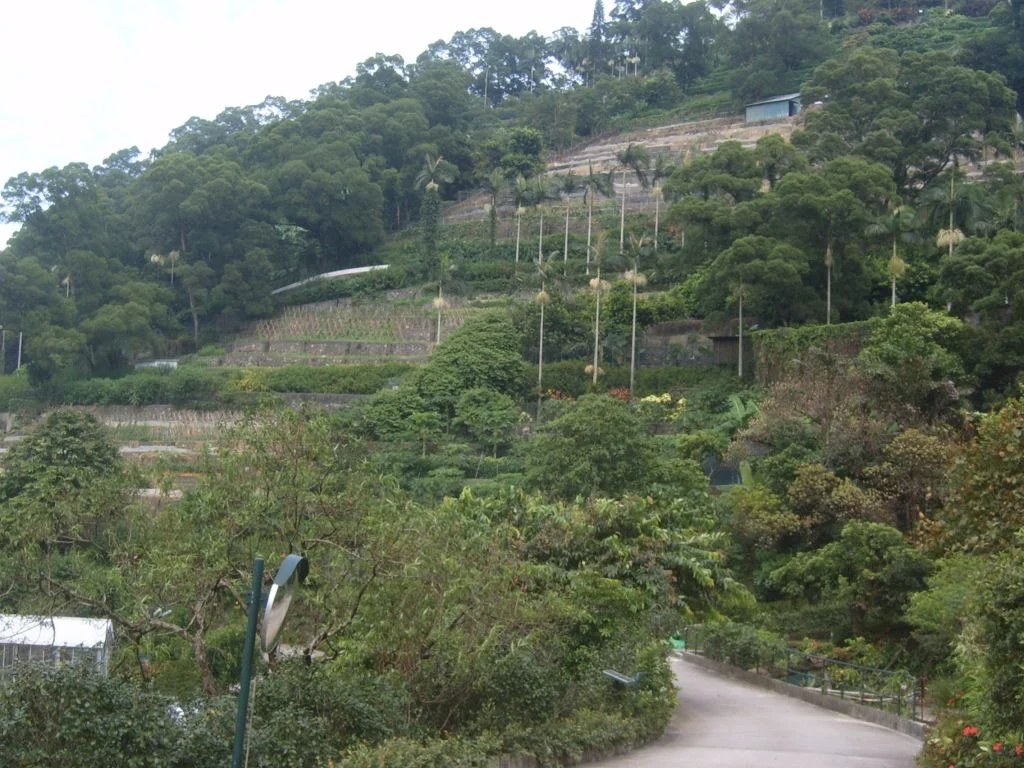

Kadoorie Farm and Botanic Garden
In 1951, two brothers looked at Hong Kong and decided the most useful thing they could do was teach people to farm better. Lord Lawrence Kadoorie and Sir Horace Kadoorie had made their fortunes in utilities and real estate, but what they founded that year was an agricultural aid association — an organization whose stated aim was "helping people to help themselves" through training, interest-free loans, and practical support. Five years later, on the slopes of Kwun Yam Shan in the central New Territories, their vision took physical form: a farm built in a valley of streams, woodlands, and terraces, designed to demonstrate what careful cultivation could produce. That farm is still there. It covers 150 hectares and receives between 3,000 and 5,000 visitors per week. But its purpose has changed almost completely.
Farming as a Post-War Act of Faith
Hong Kong in the early 1950s was crowded, raw, and uncertain. The population had surged with refugees from the mainland following the Communist victory in the Civil War, and the New Territories — agricultural land leased from China — was full of farmers who lacked capital, technical knowledge, and much hope. The Kadoorie Agricultural Aid Association went to work in this environment. It supplied agricultural inputs, offered training, and extended interest-free loans to people who had no credit. At the experimental farm established at Pak Ngau Shek in 1956, researchers developed special breeds of pigs and chickens adapted to local conditions — practical genetics in the service of practical need. The farm also trained local farmers alongside Hong Kong–based Gurkha soldiers, a detail that speaks to the range of people the Kadoories were trying to reach. Crop production, animal husbandry, soil management: the work was unglamorous and essential. It was also, in retrospect, a foundation for something that would outlast its original purpose by decades.
The Turn Toward Conservation
By 1995, Hong Kong had changed beyond recognition. The New Territories were dotted with new towns. The farming economy the Kadoories had supported had largely been replaced by an urban one. On 20 January 1995, the Legislative Council passed an ordinance establishing the Kadoorie Farm and Botanic Garden Corporation, giving the institution a new legal identity and a new mission. The language shifted from agricultural aid to biodiversity conservation, from helping farmers to harmonizing humanity's relationship with the environment. The raptor sanctuary opened — named after Jim Ades — along with the Piers Jacobs Wildlife Sanctuary, an Amphibian and Reptile House, and a Wildlife Walkthrough. The farm still has its pigsties, now part of the Sun Garden Animal Exhibit rather than a production facility. The terraces still exist. But where crops once grew, native species are now rehabilitated for release, and where farm staff once advised on livestock breeding, ecologists now advise government bodies and private developers on conservation policy.
Reaching into China
The conservation work did not stay within Hong Kong's borders. From 1997 onward, the KFBG China Programme conducted rapid biodiversity assessments in the nature reserves of Hainan, Guangdong, and Guangxi, producing reports on the distribution and status of vertebrates, plants, dragonflies, and ants. The programme communicated through a magazine called Living Forests and eventually shifted its focus toward helping protected-area authorities manage key sites. One particular site drew sustained attention: Yinggeling, a great tropical forest in central Hainan, now designated a national nature reserve. Since 2003, the organization has been involved in conserving the Hainan gibbon — Nomascus hainanus — at the Hainan Bawangling National Nature Reserve. The Hainan gibbon is thought to be the rarest ape in the world. In 2011, the China work was formalized as Kadoorie Conservation China. The arc from teaching a farmer in the New Territories to protect the last refuge of an endangered ape is not a straight line, but it is a coherent one.
The 150-Hectare Classroom
Today, Kadoorie Farm and Botanic Garden is a working institution with multiple and sometimes competing objectives — biodiversity, education, sustainable agriculture, ecological advisory work — all conducted on the same 150-hectare estate. The Education Department runs tree-planting sessions, art workshops, and mindfulness programs. The Sustainable Living and Agriculture Department works on food systems and supports community transitions toward more sustainable practices. The Ecological Advisory Programme, launched in 1998, counsels government agencies, NGOs, and developers. Somewhere in the valley below Kwun Yam Shan, a crested goshawk might be recovering from an injury in one of the wildlife facilities, while a group of schoolchildren learns to identify native plants thirty meters away. The Kadoorie brothers' original principle — helping people to help themselves — has expanded its scope enormously. Its subject is no longer farming. Its subject is the living world.
From the Air
Kadoorie Farm and Botanic Garden sits at 22.4335°N, 114.118°E on the slopes of Kwun Yam Shan in the central New Territories, roughly 35 km north-northeast of Hong Kong International Airport (VHHH). From 2,000–3,000 feet, the terraced green hillsides of the farm are visible against the broader landscape of the New Territories, with the Kowloon peaks visible to the south and Tai Mo Shan — Hong Kong's highest peak — to the southeast. The farm's valley setting is distinctive: a pocket of green surrounded by the increasingly urbanized New Territories.
Nearby Stories
- Chapel of St. Francis Xavier 3.5 km away
- Cuiheng 4.1 km away
- 2015 Shenzhen Landslide 16 km away
- Shunde 31 km away
- Wanshan Archipelago 37 km away
- Nanxiong Formation 96 km away
- Heyuan 149 km away
- Checheng Fu'an Temple 629 km away