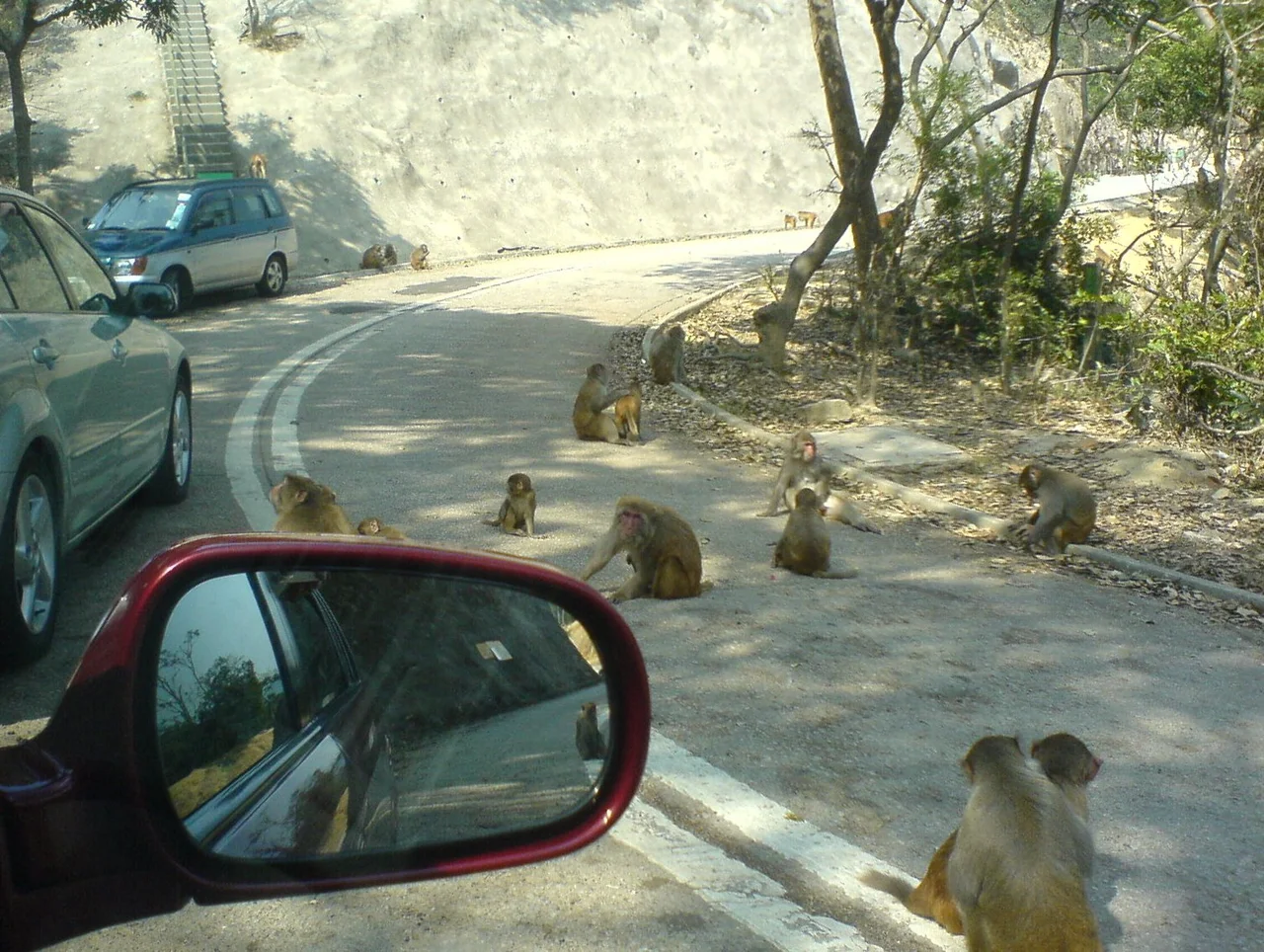

Kam Shan Country Park
Nobody calls it Golden Hill. The official name — Kam Shan Country Park, named for the 369-meter peak at its center — appears on maps and government documents, but the locals have always called it Monkey Hill. The monkeys in question arrived by a circuitous route. In the 1920s, pet owners released macaques into the area, perhaps as acts of Buddhist merit-making, perhaps simply because the animals had become inconvenient. The wild macaque populations native to Hong Kong were meanwhile being destroyed by habitat loss and hunting. What survived — and what visitors encounter today in the forested hills just north of Kowloon — are almost certainly descendants of those released pets, a colony that has been here for a century and has no intention of leaving.
A Pocket of Green Above the City
Established on 24 June 1977, Kam Shan Country Park covers 3.37 square kilometers in the ranges that separate urban Kowloon from the New Territories to the north. Most of the park's land surrounds the Kowloon Group of Reservoirs — water infrastructure that shaped this landscape long before it became a country park — and the trails and barbecue areas are accessible from Tai Po Road via waterworks access roads. The park is small enough to walk across in an afternoon and large enough to feel, in its interior, genuinely remote from the city below. The peak, Kam Shan, rises to 369 meters. From the slopes and the western ridge, the views are extraordinary: Smuggler's Ridge, Tai Mo Shan (Hong Kong's highest peak), Needle Hill, Sha Tin, Lion Rock, Beacon Hill, the northern reaches of Kowloon, Stonecutters Island, the Kwai Chung container port, Tsing Yi Island, and Tsuen Wan. A small hill above a large city, but in clear weather it shows you nearly all of it.
The Macaques of Monkey Hill
Two species of macaque live in Kam Shan: the rhesus macaque (Macaca mulatta) and the long-tailed macaque (Macaca fascicularis). They are the largest group of mammals in the park, which also supports squirrels and a wide range of bird species. The monkeys move through the forest and along the roads with the assurance of animals that know exactly where they are — because they have been here for a century. They are habituated to humans, which makes them both easy to observe and occasionally bold with food. The park's management asks visitors not to feed them, a request that is approximately as effective as such requests usually are. What the macaques represent is something genuinely unusual: an introduced population that has become, through long residence, the defining character of a place. They are not native, strictly speaking, but they are permanent, and the hill would feel emptied without them.
Stone 130 Million Years Old
Beneath the macaques and the forest is granite laid down in the Upper Jurassic period, formed between 130 million and 160 million years ago. Road cuttings inside the park expose the rock face directly, making Kam Shan an incidental geology lesson for anyone paying attention. The same igneous rock underlies much of Hong Kong, pushed up from the earth's interior during a period of volcanic activity that preceded the dinosaurs' extinction by tens of millions of years. Walking a trail here, you move across ground whose deep history stretches beyond anything the city above or below it can claim. The macaques do not know this. The crested goshawks — a protected species found in the park — do not know it either. But the rock is patient.
The Birds, the Threats, and the Protection
Kam Shan shelters species that find little refuge elsewhere in the densely urbanized Hong Kong landscape. The crested goshawk (Accipiter trivirgatus) is a protected species present here. Other birds recorded in the park include the black-eared kite (Milvus migrans lineatus), house swift, greater coucal, common kingfisher, rufous-backed shrike, and common tailorbird. The monkeys face periodic threats. In May 2009, a rights group reported that 300 monkeys had been killed, and a separate incident involved someone shooting at the animals with a BB gun and wounding a volunteer. The Secretary for Food and Health responded by increasing patrols. Under Hong Kong's Wild Animals Protection Ordinance, anyone who hunts or willingly disturbs wild animals faces a fine and up to one year in jail. The macaques have survived a century of city expansion pressing in from all sides. They appear, so far, to be surviving human carelessness too.
From the Air
Kam Shan Country Park sits at 22.352°N, 114.154°E in the ranges immediately north of Kowloon. From 2,000–3,000 feet, the park appears as a compact green wedge between the dense urban fabric of north Kowloon to the south and the broader greenery of the New Territories to the north. The Kowloon reservoirs are visible within the park boundary. Lion Rock, to the east, is a prominent landmark. Hong Kong International Airport (VHHH) is approximately 30 km to the west. The peak of Kam Shan at 369 meters is the highest point in the immediate area.
Nearby Stories
- Chapel of St. Francis Xavier 3.5 km away
- Cuiheng 4.1 km away
- 2015 Shenzhen Landslide 16 km away
- Shunde 31 km away
- Wanshan Archipelago 37 km away
- Nanxiong Formation 96 km away
- Heyuan 149 km away
- Checheng Fu'an Temple 629 km away