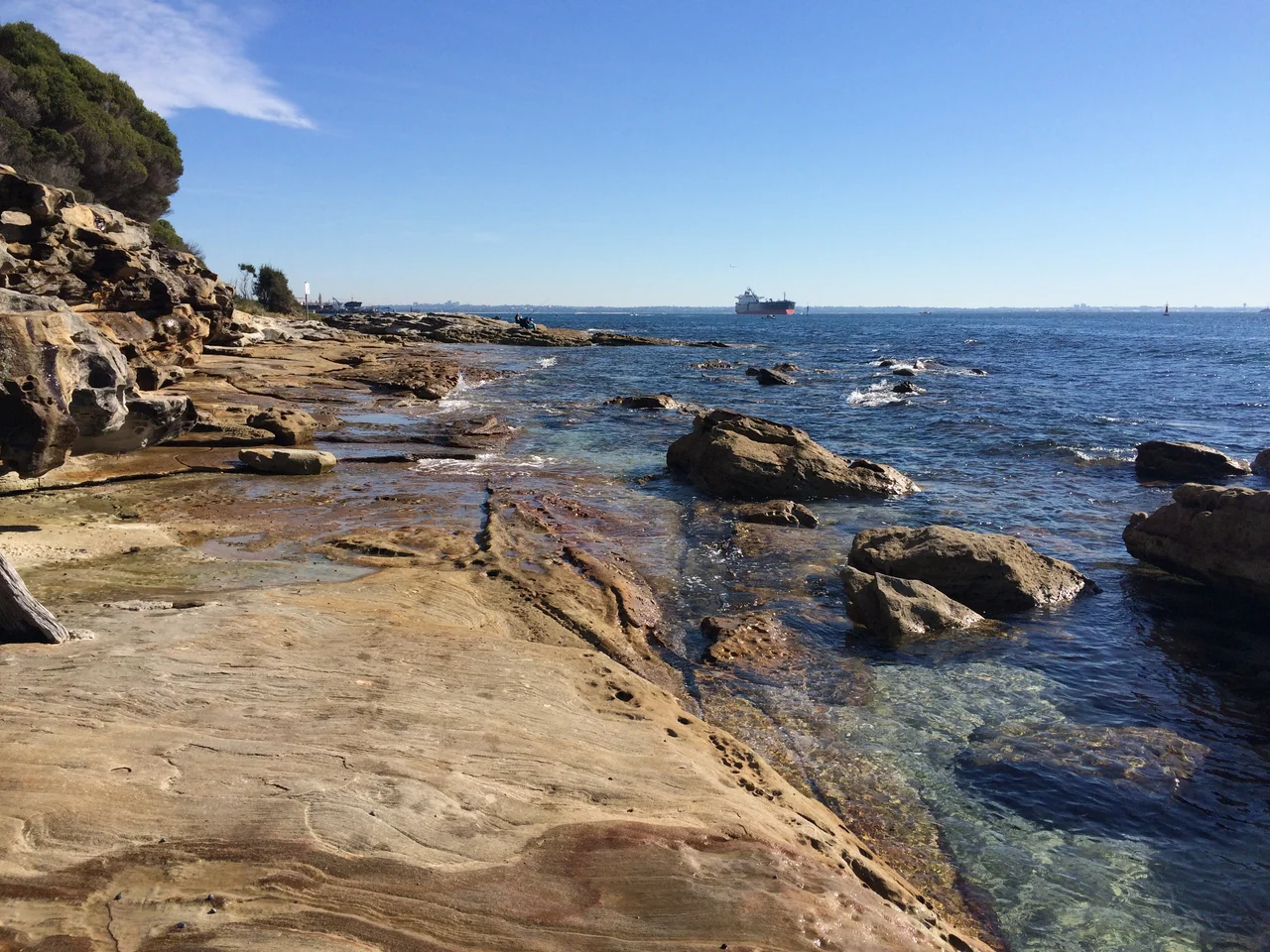

Kamay Botany Bay National Park
From the shore at Kurnell, the Gweagal saw something that did not belong to the world they knew. The oral memory passed down speaks of a great white bird, or a floating island, moving along the coast in the days before the 29th of April, 1770. Further south, the Yuin people understood it as Gurung-gubba, the pelican of their Dreaming. It was none of these. It was Lieutenant James Cook's Endeavour, and it was about to drop anchor in the bay the Gweagal called Kamay. What happened on that beach over the next eight days would be retold for centuries, claimed and contested, because it was here that two entirely separate human histories — one tens of thousands of years deep, one arriving on the tide — first looked each other in the eye.
Eight Days at Kamay
Cook's arrival broke every rule of the country he was entering. In Aboriginal law a visitor waits to be invited; instead the Endeavour anchored off a small village and Cook prepared to land uninvited on Gweagal ground. Two warriors met the boats, painted in ceremonial ochre, and made the strangers' welcome plain — they called out 'Warra warra wai,' you are all dead, and raised their spears. Cook ordered muskets fired. One shot struck a warrior, who ran for a shield and turned back to keep defending his country rather than flee. As the British landed, the men threw a final spear, then withdrew and pointedly ignored the intruders for the rest of their stay — the customary response of country-owners refusing visitors who would not meet them on the proper terms. Before leaving, the British gathered up forty Gweagal spears from the shore. Their absence is still felt; the question of their return has never gone quiet.
The First Harvest of Specimens
While the encounter unfolded, two other men aboard were filling boxes with a different kind of cargo. The botanist Joseph Banks and the naturalist Daniel Solander walked the landing place and the wetlands now called Towra Point, collecting plants no European science had ever recorded — at least 132 species at this bay alone, many of them becoming the type specimens against which the species would forever be defined. Among them was the genus later named Banksia, in Banks's honour. The collection mattered enough that Cook's first name for the place, Stingray Bay, gave way to Botany Bay. There is a hard irony folded into this triumph of natural history: the same Joseph Banks who catalogued the living country here would, decades later, receive in England the severed head of the resistance leader Pemulwuy, sent for his collection. The science and the dispossession were never separate things.
The French at La Perouse
Eighteen years after Cook, the bay drew another set of sails. In January 1788 the French expedition of Jean-François de Lapérouse arrived on the northern shore — on the very day, the 26th, that the First Fleet was abandoning Botany Bay for the better harbour at Port Jackson. The two old rivals met cordially on the beach. The French camped six weeks, set up an observatory that made some of the first astronomical observations in Australia, buried a priest, Père Receveur, who died there, and sailed away on the 10th of March. They were never seen again. Their fate stayed a mystery until 1828, when wreckage was found on the reefs of Vanikoro. That northern headland still carries the name La Perouse, and to this day French visitors gather there for memorial ceremonies, a quiet thread of one nation's grief woven into an Australian shoreline.
Where Resistance Endures
The story did not stop with the ships. White settlement spared this land at first but not its people; smallpox and other diseases tore through the area, and there are caves nearby where remains from those outbreaks are believed to have been found. Through the nineteenth and twentieth centuries an Aboriginal community persisted at La Perouse — working as fishermen and gardeners, crafting shell ornaments and boomerangs for the tourists who poured in once the tram line arrived. Today the headlands form a national park of 456 hectares on the dramatic sandstone gates of Botany Bay, recognised on the National Heritage List as the place where the shared history of Indigenous and non-Indigenous Australia began. The Gweagal warriors who stood on that beach in 1770 are remembered now as enduring symbols of resilience. And in recent years the park has hosted repatriation burials, as elders welcome home the remains of ancestors once studied as curiosities — Country, at last, receiving its own.
From the Air
Kamay Botany Bay National Park occupies both headlands at the entrance to Botany Bay at approximately 34.02 degrees south, 151.22 degrees east, about 16 kilometres southeast of central Sydney. From the air the two sandstone headlands frame the dramatic mouth of the bay — Kurnell to the south (Cook's landing place, beside the prominent Caltex/Kurnell oil refinery), La Perouse to the north. The green wetland wedge of Towra Point Nature Reserve sits inside the bay to the west. Sydney Airport (ICAO YSSY) lies directly on the northwestern shore of Botany Bay, so this is busy controlled airspace under the approach and departure paths; expect heavy traffic and observe airspace restrictions. Clear coastal conditions reveal the cliffs and the bay's full geometry; the Yena Track lookout on the southern headland is a noted whale-watching point during the winter migration.
Nearby Stories
- Wollongong 46 km away
- Jervis Bay 87 km away
- Hive shipwreck 130 km away
- Apsley Falls 303 km away
- Smoky Cape Lighthouse 334 km away
- South West Rocks Pilot Station Complex 365 km away
- Roxy Theatre and Peters Greek Cafe Complex 432 km away
- 2003 Fiordland Earthquake 1760 km away