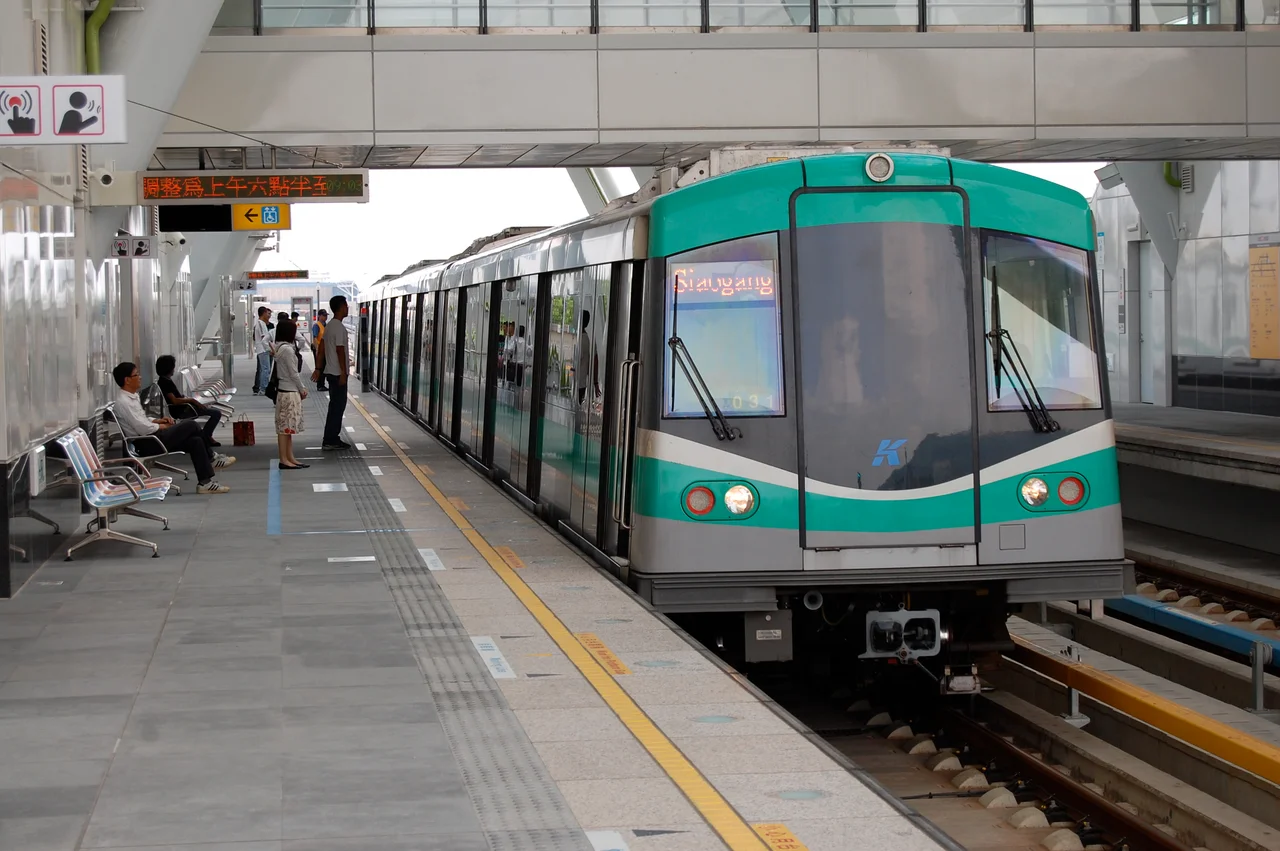

Kaohsiung Metro
In 2005, the city of Kaohsiung was building the second metro system in Taiwan's history when two scandals hit almost simultaneously. First, investigations revealed that Thai migrant workers constructing the tunnels had been subjected to inhumane conditions, with kickbacks flowing to politicians from the contractor. The Thai Prime Minister intervened, asking the workers to return home, and the chairperson of Taiwan's Council of Labor Affairs resigned. Then, in December, a section of the Orange Line tunnel in eastern Kaohsiung collapsed during construction, taking a road tunnel above it down as well. The metro that was supposed to modernize southern Taiwan had instead become a national embarrassment. It opened anyway, three years later, and what emerged from the wreckage was something nobody expected: a transit system that treated public art as seriously as it treated public transportation.
Twenty Years in the Making
Kaohsiung's city government commissioned a feasibility study for rapid transit in 1987, when the city was still primarily an industrial port. Favorable results led to years of lobbying the central government for approval and funding. The first phase, covering the Red and Orange lines, was approved in 1991, but disputes over cost-sharing between the city and county governments stalled progress. The Mass Rapid Transit Bureau was officially established in 1994. By 1996, the central government had pushed the project toward a Build-Operate-Transfer model, and in 2000, the Kaohsiung Rapid Transit Corporation won the contract. Construction costs were split among the central government at seventy-nine percent, the city at nineteen percent, and the county at two percent. Tunneling began in October 2001. The original target was December 2006, but between the scandals, the collapse, and the general difficulties of boring through a subtropical city's clay and coral substrate, that date slipped repeatedly.
The System Takes Shape
The Red Line opened for service on March 9, 2008, after four days of free test rides in February. The Orange Line followed on September 14. Together, the two lines comprise thirty-eight stations spanning 42.7 kilometers, with twenty-seven stations underground, nine elevated, and two at grade. A Circular light rail line opened in 2015, adding another thirty-eight stations and completing a loop around the city center. The trains, based on the Siemens Modular Metro design, run in three-car sets along third-rail-powered tracks, though platforms are built to accommodate six cars when demand warrants expansion. Automated announcements play in Mandarin, Taiwanese, Hakka, and English, with Japanese added at major stations. Average daily ridership on the MRT stands at about 178,800, with a total annual ridership of 65.44 million trips. The light rail adds another 12.58 million annually. The system's single-day record was set on New Year's Eve 2012, when 472,378 passengers rode the metro.
Art Underground
What distinguishes Kaohsiung Metro from most transit systems is its commitment to integrating art into infrastructure. Three stations feature major commissioned works by international artists. Formosa Boulevard Station houses the Dome of Light, a thirty-meter glass installation by Italian artist Narcissus Quagliata, assembled from 4,500 glass panels and recognized as the world's largest glass artwork. Kaohsiung Arena Station and Kaohsiung International Airport Station also feature large-scale installations. The artistic ambition extends beyond showcase stations. Platform screen doors supplied by ST Electronics double as display surfaces, with LCD screens broadcasting train information and content. The stations are designed not merely as transit infrastructure but as civic spaces, wheelchair accessible throughout, with public art woven into the experience of moving through the city. The system's mascots reflect a playful side: the K.R.T. Girls are four anime-styled characters, while Mikan, a cat appointed station master at Ciaotou Sugar Refinery station in 2020, has become a local celebrity.
A City Reinvented
Kaohsiung Metro has always been a bet on transformation. The city built the system not because it already had the ridership to justify it but because it believed the metro would help shift Kaohsiung's identity from industrial port to modern metropolis. That bet has been uneven. Ridership has grown but remains well below original projections, and the system has struggled financially. Nine additional main lines and six extensions are planned but not yet funded. Still, the metro has become indispensable to the city's self-image. It connects the harbor district to the night markets, the airport to the cultural quarter, the old Japanese-era sugar refinery at Ciaotou to the southern suburbs. For a city that spent most of the twentieth century known for steel mills and shipyards, the metro is proof that Kaohsiung can be something else entirely. The tunnels that collapsed during construction were eventually rebuilt. The workers who were mistreated eventually received settlements. The system that was supposed to open in 2006 opened in 2008 and has been running ever since.
From the Air
Coordinates: 22.625N, 120.301E, central Kaohsiung. The metro system spans the city from Siaogang in the south to Ciaotou in the north (Red Line) and from Sizihwan in the west to Daliao in the east (Orange Line). The Circular light rail traces a loop around the harbor area. Nearest major airport: RCKH (Kaohsiung International Airport), served by its own metro station. Viewing altitude: 5,000-10,000 ft for the full extent of the metro corridor.
Nearby Stories
- Taimali 7.2 km away
- Meinong East Gate Tower 15 km away
- Kunci Temple 20 km away
- Checheng Fu'an Temple 42 km away
- Dongji Island 49 km away
- Orchid Island 69 km away
- South Penghu Marine National Park 77 km away
- Hong Kong 12 549 km away