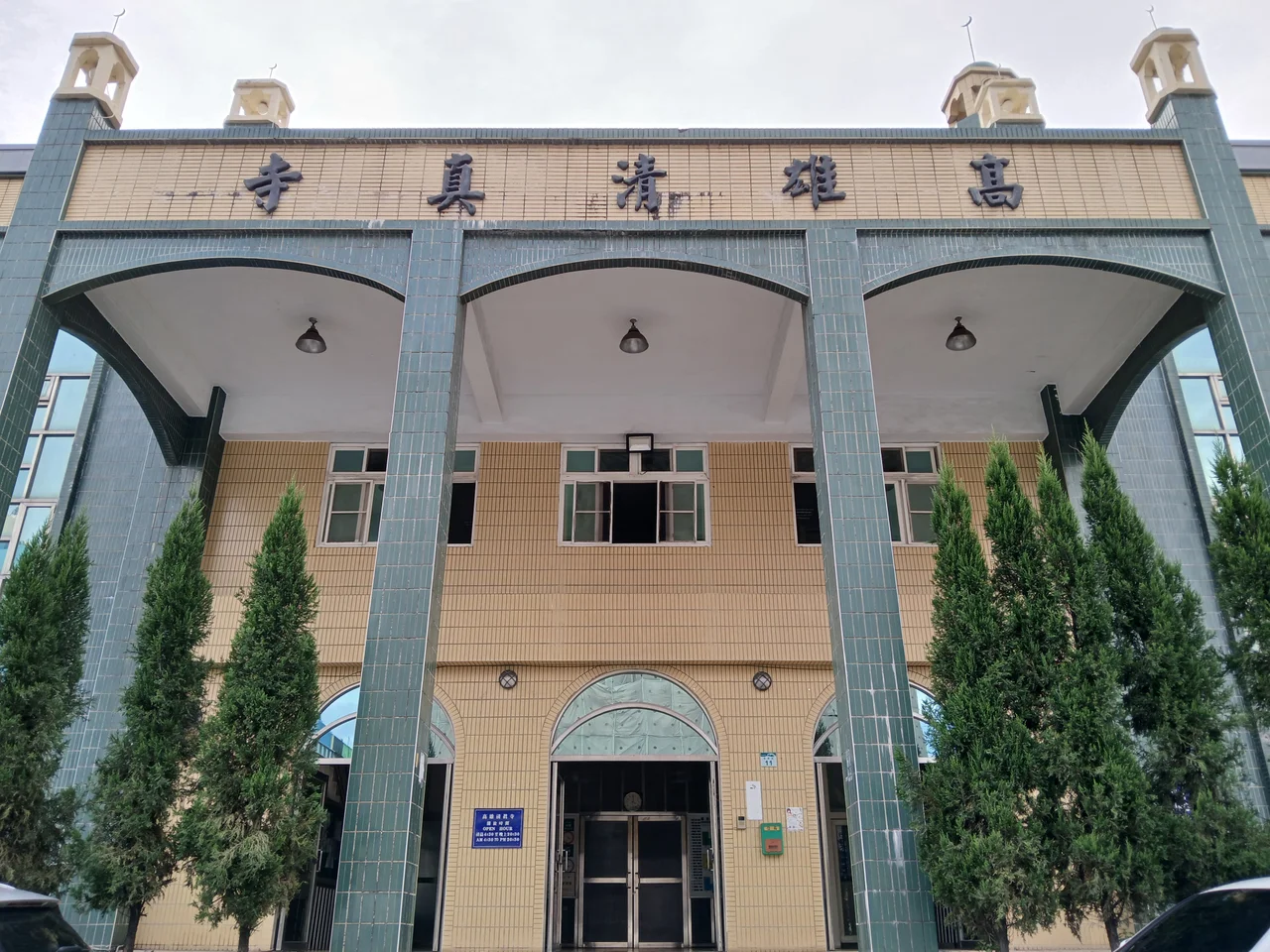

Kaohsiung Mosque
The Chinese Civil War ended for many Muslims the same way it ended for everyone who crossed to Taiwan with the Nationalist forces in 1949: a sea crossing, a new island, and the work of building a life somewhere unfamiliar. Among those who arrived that year were Muslim officers and public officials from mainland China, members of a faith community that had existed in China for more than a thousand years. Within months of reaching Taiwan, they were raising funds to build a mosque. The Kaohsiung Mosque was completed that same year, the second mosque built on the island after the Taipei Grand Mosque, and its presence in a city with no prior Muslim tradition was itself an act of cultural persistence.
1949: Arrival and First Prayer
The fundraising began in January 1949, even as the Nationalist military situation on the mainland continued to collapse. By the time the People's Liberation Army completed its victory and the Nationalist government retreated to Taiwan, the Muslim community in Kaohsiung had already secured a temporary location: a rented space of 270 square meters at 117 Wufu 4th Road in Yancheng District. It was a beginning — not a permanent home, but a place to pray and to maintain the ties of community that the crossing had stressed. That first space was practical more than symbolic, rented from necessity rather than chosen for significance. But it meant that Kaohsiung's Muslim community did not allow the disruptions of war and migration to sever their religious practice.
Three Buildings, Four Decades
The story of the Kaohsiung Mosque is really the story of a growing community outgrowing its spaces. From Wufu 4th Road, the congregation moved in 1951 to a larger Japanese wooden-style building at 196 Linsen 1st Road in Sinsing District — 460 square meters, with a main prayer hall of 135 square meters. That building served for nearly four decades as the community continued to expand. By the late 1980s, the congregation needed something larger and more permanent. In October 1988, the old mosque land was sold and the proceeds directed toward construction of a new facility. Planning for the current building began in February 1990; construction started in December of that year and was completed in late December 1991 at a cost of US$1,900,000. The mosque opened to worshippers in April 1992.
Architecture: A Middle Eastern Voice in a Taiwanese City
The current mosque at 11 Jianjun Road in Lingya District is a three-story building whose design draws directly from Middle Eastern mosque architecture. The large vault over the prayer hall, the geometric patterning of the nooks and corners, the overall massing of the building — these elements follow the traditional forms of mosques in the Muslim world rather than any local architectural idiom. The choice was deliberate: a statement of identity, a visual marker that said, in the middle of a Taiwanese city, that this is a Muslim space. The building covers 2,657 square meters. Adjacent to it, halal restaurants serve the community and welcome visitors. The mosque sits in Lingya District, a busy residential and commercial area of central Kaohsiung.
A Community in Continuous Practice
What the Kaohsiung Mosque represents, above the architectural details, is continuity. The Muslim community that established it in 1949 arrived with almost nothing except their faith and their determination to maintain it. They rented, then bought, then built — each stage representing a deepening commitment to permanence on an island they had not originally planned to call home. Friday prayers still gather the faithful in the large prayer hall on Jianjun Road. The mosque is open to curious visitors and has become, over the decades, a point of cross-cultural contact in a city not otherwise known for a Muslim presence. Taiwan's Muslim population, while small as a proportion of the total, has deep roots — and in Kaohsiung, those roots run back to a rented room on Wufu 4th Road in the desperate, uncertain year of 1949.
From the Air
Located at 22.628°N, 120.342°E in Lingya District, near the center of Kaohsiung. From the air, the mosque's dome and Middle Eastern architectural profile can be identified in the dense urban grid of central Kaohsiung, roughly 3 nautical miles east-northeast of the harbor waterfront. Kaohsiung International Airport (RCKH) lies approximately 5 nautical miles to the southeast. The surrounding neighborhood is flat, residential-commercial Taiwanese streetscape, making the mosque's architectural distinctiveness more visible from altitude. Recommended viewing altitude: 1,500–2,500 feet provides good urban context while allowing the building's profile to register against the surrounding cityscape.
Nearby Stories
- Taimali 7.2 km away
- Meinong East Gate Tower 15 km away
- Kunci Temple 20 km away
- Checheng Fu'an Temple 42 km away
- Dongji Island 49 km away
- Orchid Island 69 km away
- South Penghu Marine National Park 77 km away
- Hong Kong 12 549 km away