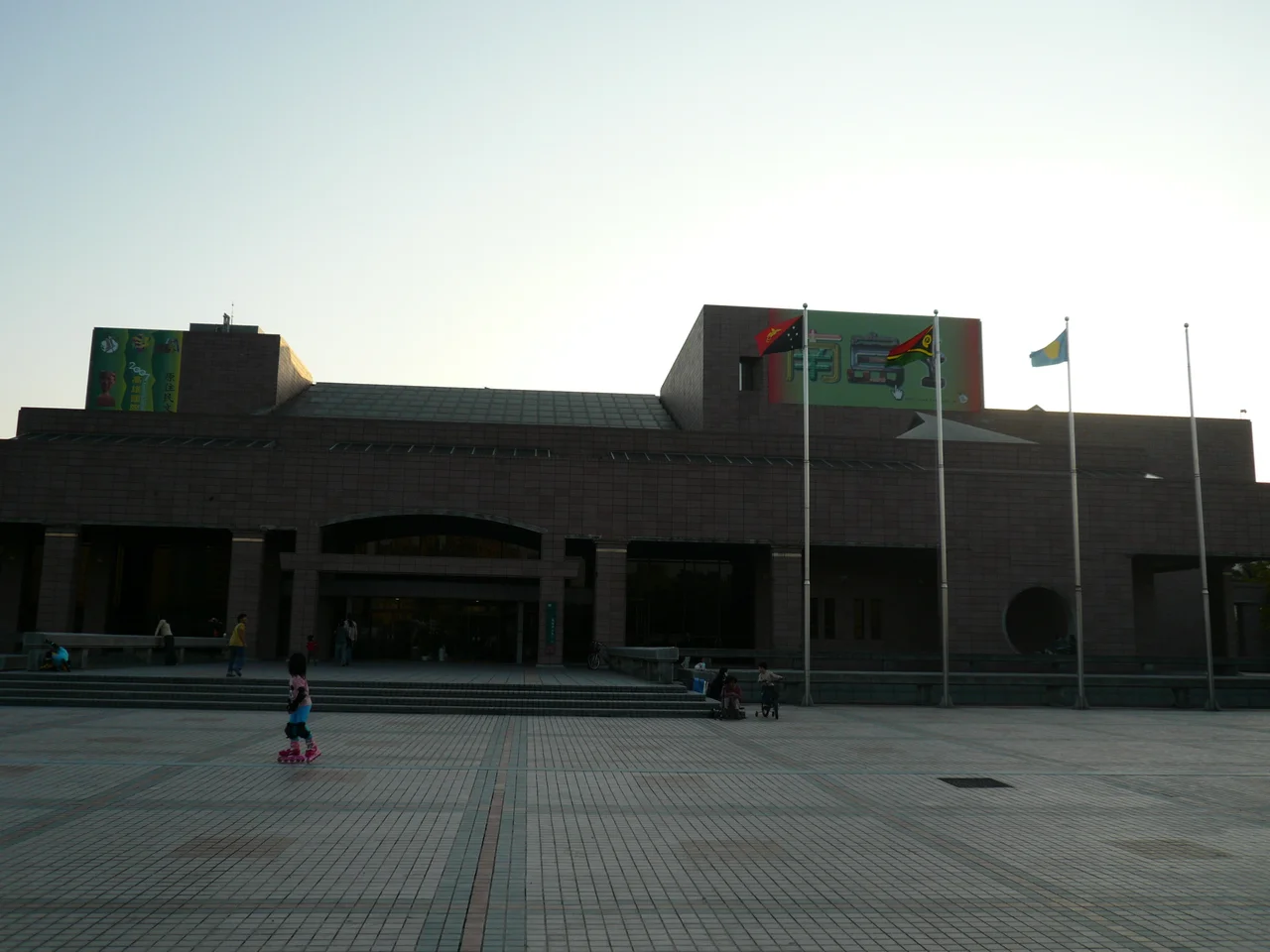

Kaohsiung Museum of Fine Arts
Sunlight falls through the skylight of the Sculpture Hall and makes the stone figures glow. The hall rises four stories from the ground floor of the Kaohsiung Museum of Fine Arts, and it functions as the building's spine: every gallery, every exhibition space, every corridor leads back to this central column of light and stone. When the museum opened in 1994, it became only the third public art museum in all of Taiwan, after the National Taiwan Museum of Fine Arts in Taichung and the Taipei Fine Arts Museum. Southern Taiwan had been waiting decades for a cultural institution of this scale, and the city of Kaohsiung built one that was as much about landscape as it was about art.
A Park First, Then a Museum
The museum occupies 8.15 acres within the much larger Neiweipi Cultural Park, a forty-hectare expanse in Gushan District that took shape in stages beginning in 1989. The first phase of construction, completed in 1994, included the museum building itself. Later phases added an entrance plaza, a sculpture park, and an ecology park. The design philosophy treats the museum as one element within a broader landscape rather than a standalone monument. Walk through the entrance and the path leads past sculptures arranged on lawns and in groves, through covered walkways that connect outdoor spaces to indoor classrooms and auditoriums, and eventually to the ecology park with its marsh, lake, small island, forest area, and observation platform. The ecology park was designed with restoration principles in mind, creating habitat that does not prevent creatures from inhabiting or breeding. The result is a museum that a visitor can spend a full day in without ever feeling enclosed.
Four Floors of Galleries
Inside, the museum is organized vertically by function. The ground floor houses the lobby, the Sculpture Hall, and five galleries. Galleries 101 through 103, on one side of the hall, host general and international exhibitions. Galleries 104 and 105 sit opposite, with double-height ceilings that allow visitors to look down at artworks from above, a perspective particularly suited to large-scale sculpture. The second floor is dedicated to oversized works that need room to breathe. The third floor handles the most sensitive material: calligraphy and other works that require strict climate control to maintain stable temperature and humidity. The fourth floor offers flexibility, with mobile gallery walls that can be reconfigured to create spaces of varying size. It is a practical building designed by people who understood that art comes in every dimension, and that the architecture should adapt to the work rather than the other way around.
Where Art Meets Ecology
The sculpture park wraps around the southwestern and rear portions of the administrative area, its lawns and groves providing varied settings for outdoor installations. Some sculptures stand in the open on manicured grass. Others emerge from tree cover, half-hidden, rewarding the attentive walker. The ecology park pushes the boundaries of what a museum campus can be. Marshland, open water, forested paths, and an observation platform create an environment where herons and egrets share the grounds with gallery visitors. The designers intended the ecology park as a demonstration of ecological restoration: proof that a cultural institution can coexist with a functioning wetland ecosystem. The semi-circular outdoor plaza and its covered walkway bridge the transition, connecting the educational spaces inside the museum to the living landscape outside. On weekends, families picnic on the lawns, children chase each other along the footpaths, and the distinction between visiting a museum and visiting a park dissolves entirely.
Southern Taiwan's Cultural Anchor
The Kaohsiung Museum of Fine Arts is administered by the Kaohsiung Bureau of Cultural Affairs, which took over from the city government in 2003. Its art library holds approximately 3,000 videotapes and nearly 20,000 books of art-related materials, all accessible to the public. Tours are available in English, Japanese, Mandarin, and Taiwanese, though group tours require two weeks' advance booking. The museum is accessible via the Museum of Fine Arts railway station on the Taiwan Railway line, anchoring it to the broader transit network. For a city that spent most of the twentieth century known for heavy industry and port logistics, the museum represents a deliberate pivot. Kaohsiung bet that southern Taiwan deserved a world-class cultural institution, built it at the center of a park that doubled as an ecological preserve, and has spent three decades proving the gamble right. More than a building that houses art, it is a landscape that argues art and nature are not separate endeavors.
From the Air
Coordinates: 22.657N, 120.286E, in Gushan District, northern Kaohsiung. The forty-hectare Neiweipi Cultural Park is visible as a large green area in the urban fabric. Nearest major airport: RCKH (Kaohsiung International Airport), approximately 12 km south. The Museum of Fine Arts railway station provides access. Viewing altitude: 3,000-5,000 ft to see the park in its urban context.
Nearby Stories
- Taimali 7.2 km away
- Meinong East Gate Tower 15 km away
- Kunci Temple 20 km away
- Checheng Fu'an Temple 42 km away
- Dongji Island 49 km away
- Orchid Island 69 km away
- South Penghu Marine National Park 77 km away
- Hong Kong 12 549 km away