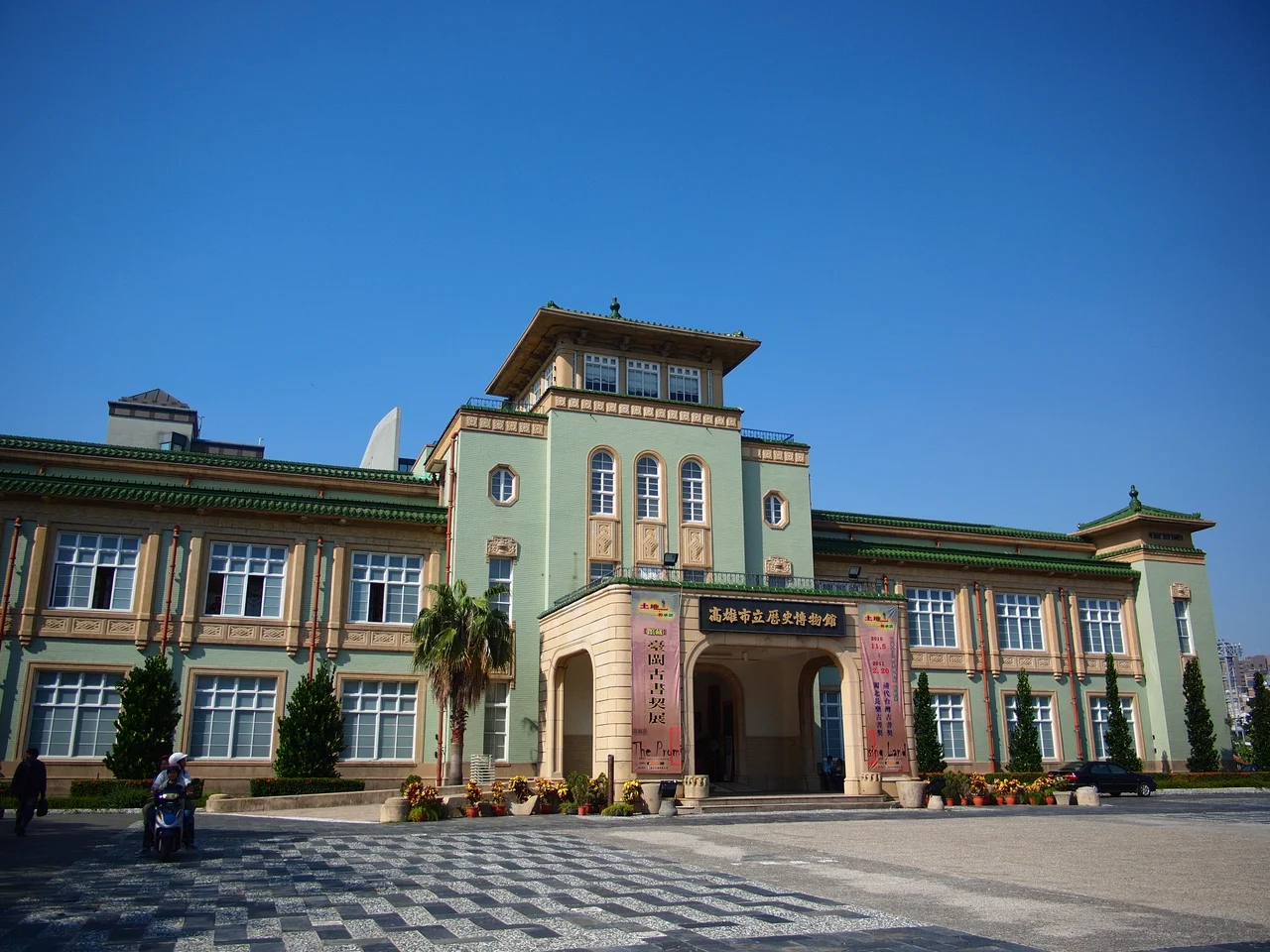

Kaohsiung Museum of History
The chrysanthemum patterns are still there. Look closely at the ribbons carved into the facade of the Kaohsiung Museum of History and you will find them -- delicate imperial motifs pressed into reinforced concrete, designed to survive the earthquakes that regularly shake this island. Completed in 1939 as Kaohsiung's city hall under Japanese colonial rule, the building served its original purpose for over five decades before reinventing itself as a repository of the city's tangled, multilayered past. The architect Oono Yonezirou, working with the Shimizu Corporation, created something that was meant to project authority. Today it projects something more interesting: the complicated story of a city that has been governed by the Dutch, the Qing, the Japanese, and the Republic of China, each leaving traces in its streets and structures.
Authority in Concrete and Tile
The building is a textbook example of the Japanese Imperial Crown style, an architectural movement that grafted traditional Japanese rooflines onto Western structural forms. A main tower rises from the fourth floor, flanked by bilaterally symmetrical sub-towers, each crowned with a traditional four-cornered top and glazed tile roof. The exterior wears a military-base shade of light green. Aquarius-style spires and plum blossom rain-drop patterns decorate the towers alongside those chrysanthemum ribbons. Inside, a Y-shaped staircase sweeps through a lobby designed to impress, with arched corridors running along the sides and grand columns that blend Eastern and Western decorative traditions. The building was constructed with reinforced concrete specifically for seismic resistance -- a practical acknowledgment that Taiwan sits on the Pacific Ring of Fire, where architectural ambition must always negotiate with tectonic reality.
From Seat of Power to House of Memory
After Japan's surrender in 1945, the building was renamed the Kaohsiung Municipal Government and continued to serve as the city's administrative center. For nearly half a century, bureaucrats walked the same corridors that Japanese colonial officials had paced. Then, on January 18, 1992, the municipal government relocated to the Union Office Building, and the old hall stood empty -- a grand shell searching for a new purpose. Six years later, on October 25, 1998, it reopened as the Kaohsiung Museum of History. The transformation was deliberate: rather than demolishing or repurposing the colonial-era structure beyond recognition, the city chose to make the building itself part of the exhibit. Its architecture tells one story; the collections inside tell many others.
Curating a Port City's Identity
The museum's collection is organized around a deceptively simple theme: Kaohsiung city development. But Kaohsiung is not a simple city. It is Taiwan's largest port, a place where indigenous Makatao and Pingpu peoples, Dutch traders, Qing administrators, Japanese colonizers, and waves of Chinese migrants have all left their mark. The museum systematically collects artifacts, oral histories, and cultural relics that trace this multiculturalism, from the days when the harbor was a natural lagoon called Takao to its current status as one of Asia's busiest container ports. Contemporary social events and issues are documented alongside historical materials, ensuring the museum remains a living archive rather than a static monument. Visitors can reach it on foot from Yanchengpu Station on the Kaohsiung MRT, arriving in the Yancheng District neighborhood that was once the commercial heart of Japanese-era Kaohsiung.
Layers Visible from Above
From the air, the museum's distinctive silhouette -- that central tower with its paired sub-towers -- is recognizable amid the dense urban grid of downtown Kaohsiung. It sits near the Love River, close to the harbor entrance, in a district where Japanese-era street patterns still underlie the modern city. The building is one of several colonial-era structures scattered across Kaohsiung that have been preserved and repurposed, forming an informal architectural trail through the city's history. Nearby, the old British Consulate at Takao on Shoushan and the warehouses along the harbor tell overlapping chapters of the same story. Together, they form a physical record of the forces -- trade, colonialism, war, modernization -- that shaped this subtropical port into the metropolis of nearly three million people visible below.
From the Air
Located at 22.627N, 120.288E in Yancheng District, downtown Kaohsiung, near the Love River. The museum's distinctive tower is visible amid the urban grid. Nearby airports: RCKH (Kaohsiung International Airport, 8 km south). Best viewed at 2,000-3,000 ft AGL. The harbor entrance and Cijin Island barrier beach are prominent visual references to the west.
Nearby Stories
- Taimali 7.2 km away
- Meinong East Gate Tower 15 km away
- Kunci Temple 20 km away
- Checheng Fu'an Temple 42 km away
- Dongji Island 49 km away
- Orchid Island 69 km away
- South Penghu Marine National Park 77 km away
- Hong Kong 12 549 km away