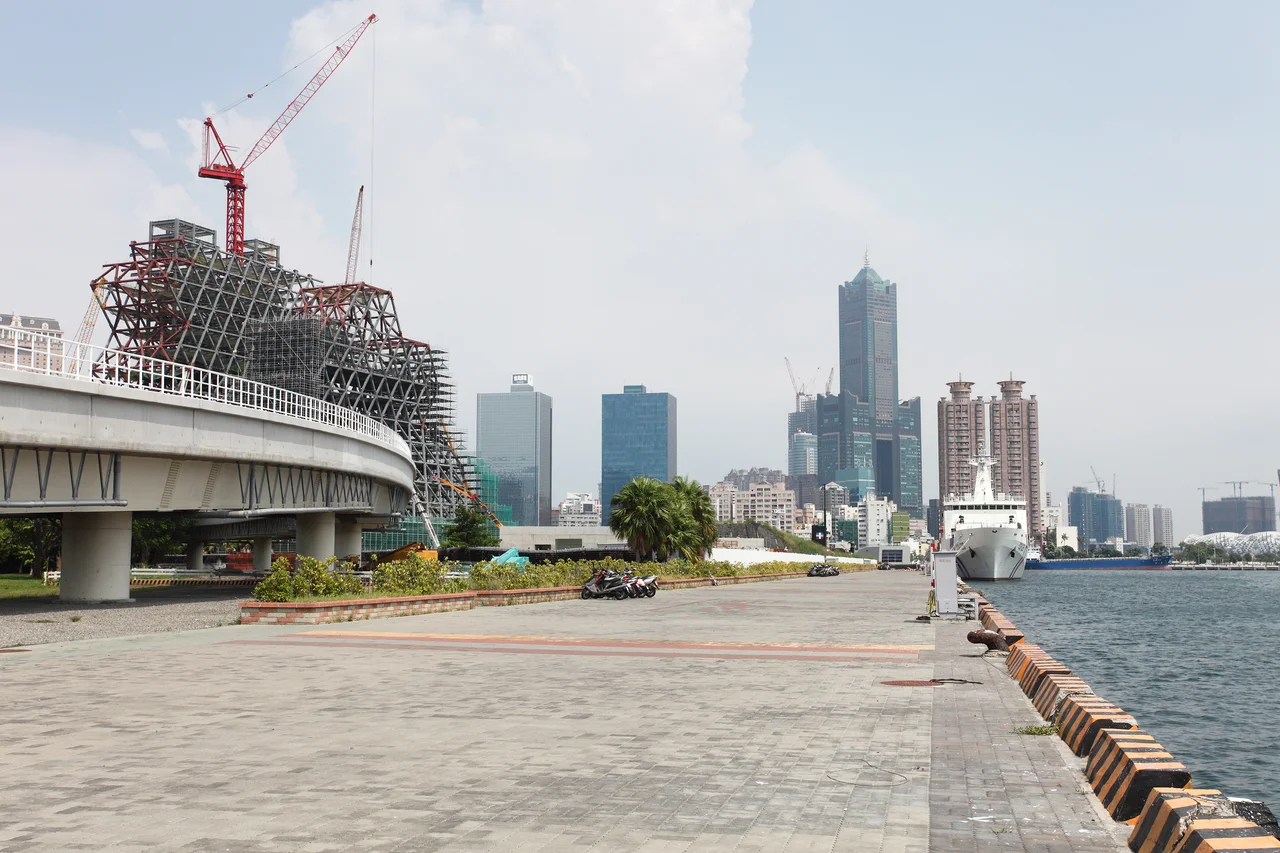

Kaohsiung Music Center
The citizens of Kaohsiung named the buildings themselves. When the Spanish architecture team MADE IN Architects won the design competition in 2011 and assigned internal working names to the project's structures, they called the six live-music venues the 'Whales' and the curved main hall the 'Dolphin.' Those names were provisional — meant for the design process, not the finished city. But the people of Kaohsiung adopted them without being asked, and they stuck. By the time President Tsai Ing-wen opened the Kaohsiung Music Center on October 31, 2021, everyone already knew what to call the buildings. That ease of ownership says something about a complex designed, from the beginning, to belong to the city rather than to architecture.
The Case for a Pop Music Capital
The Executive Yuan's 2009 recognition of the need for a major music center in Kaohsiung was as much an economic argument as a cultural one. Pop music — Mandopop, K-pop, Taiwanese pop — commands enormous influence across East and Southeast Asia, and the infrastructure to host major touring acts and recorded media had historically been concentrated in Taipei. Kaohsiung, Taiwan's second city and a major industrial port, had long sought to reposition itself as a cultural destination. The music center project was one of several large cultural investments, including the National Kaohsiung Center for the Arts, that aimed to give the city new weight as a creative hub. The Council for Cultural Affairs commissioned the city government to execute the project, and the international design competition attracted teams from around the world.
The Architecture of Whales and Dolphins
MADE IN Architects, assembled specifically for this competition and led by Manuel Monteserin, proposed something more complex than a single landmark building. The Kaohsiung Music Center is a campus: six live-music houses (the Whales), an open-air auditorium seating 10,000 people, a concert hall for 6,000, two towers housing offices, museum spaces, and rehearsal rooms, an exhibition center, and five restaurants connected by an elevated walkway. The Whale buildings are distinctive from the air and from the water — organic, hull-like forms whose accessible green roofs form gentle hills above the harbor. The design principle was that each structure should respond to its specific program and context, producing a varied skyline rather than a monolithic statement. The result is a district rather than a building.
A Park at the River's Mouth
One of the project's explicit goals was the creation of public spaces that function independently of ticketed performances. The site sits at the mouth of the Love River, where it empties into Kaohsiung Harbor, and the design weaves parks and promenades through the complex. More than a thousand trees were planted across the site; in Kaohsiung's tropical humid climate, that planting was expected to grow quickly into genuine urban forest. The exhibition center's main gathering space, a large shaded platform under hexagonal structures, was designed to host markets, dance events, and theater as well as exhibitions. The green roofs of the Whale buildings are accessible to the public, offering views of the harbor and the sea. Even on days with no performances scheduled, the complex is meant to be occupied.
Opening Night and What It Meant
The opening ceremony on October 31, 2021, with President Tsai Ing-wen and Culture Minister Lee Yung-te in attendance, marked the completion of a project that had been more than a decade from competition to ribbon-cutting. Construction proceeded through the years — you can trace the center's emergence in aerial photographs from 2017 and 2018, its whale-shaped rooflines rising against the harbor backdrop. Within days of opening, it was announced that the Kaohsiung Music Center would host the 2022 Golden Melody Awards, Taiwan's most prestigious music industry recognition — though the ceremony ultimately took place at Kaohsiung Arena. The complex has since become a regular venue for international touring acts alongside domestic Taiwanese and Korean pop concerts, making good on the original argument that Kaohsiung could anchor the region's music industry as effectively as the capital.
Waterfront Reimagined
Viewed from Glory Pier or from the water, the Kaohsiung Music Center has changed the city's visual identity from the harbor side. Where the Love River meets the port, what was once industrial waterfront is now a layered skyline of organic forms, elevated walkways, and planted hillsides. At sunset — a light that photographers have chased from Glory Pier for years — the complex catches the warm gold of the sky and mirrors it in the harbor water below. The Lingyaliao Railroad Bridge nearby provided a ready-made backdrop that the city has learned to use, lighting both structures together for festivals and events. Kaohsiung's harbor was always the city's economic foundation; the music center suggests it can also be its living room.
From the Air
Located at 22.618°N, 120.289°E at the mouth of the Love River on Kaohsiung's inner harbor waterfront, spanning parts of Yancheng and Lingya Districts. From the air, the complex is unmistakable: six organic Whale-shaped live-house buildings with green roofs, a large curved concert hall, and the elevated walkways connecting the restaurant pavilions. The site sits immediately on the harbor, with the Love River entering from the northeast. Glory Pier and Pier 2 Art District are close neighbors to the north. Kaohsiung International Airport (RCKH) lies approximately 5 nautical miles to the southeast. Recommended viewing altitude: 2,000–4,000 feet from the west or southwest provides the best overview of the complex layout and its relationship to the harbor.
Nearby Stories
- Taimali 7.2 km away
- Meinong East Gate Tower 15 km away
- Kunci Temple 20 km away
- Checheng Fu'an Temple 42 km away
- Dongji Island 49 km away
- Orchid Island 69 km away
- South Penghu Marine National Park 77 km away
- Hong Kong 12 549 km away