.JPG)
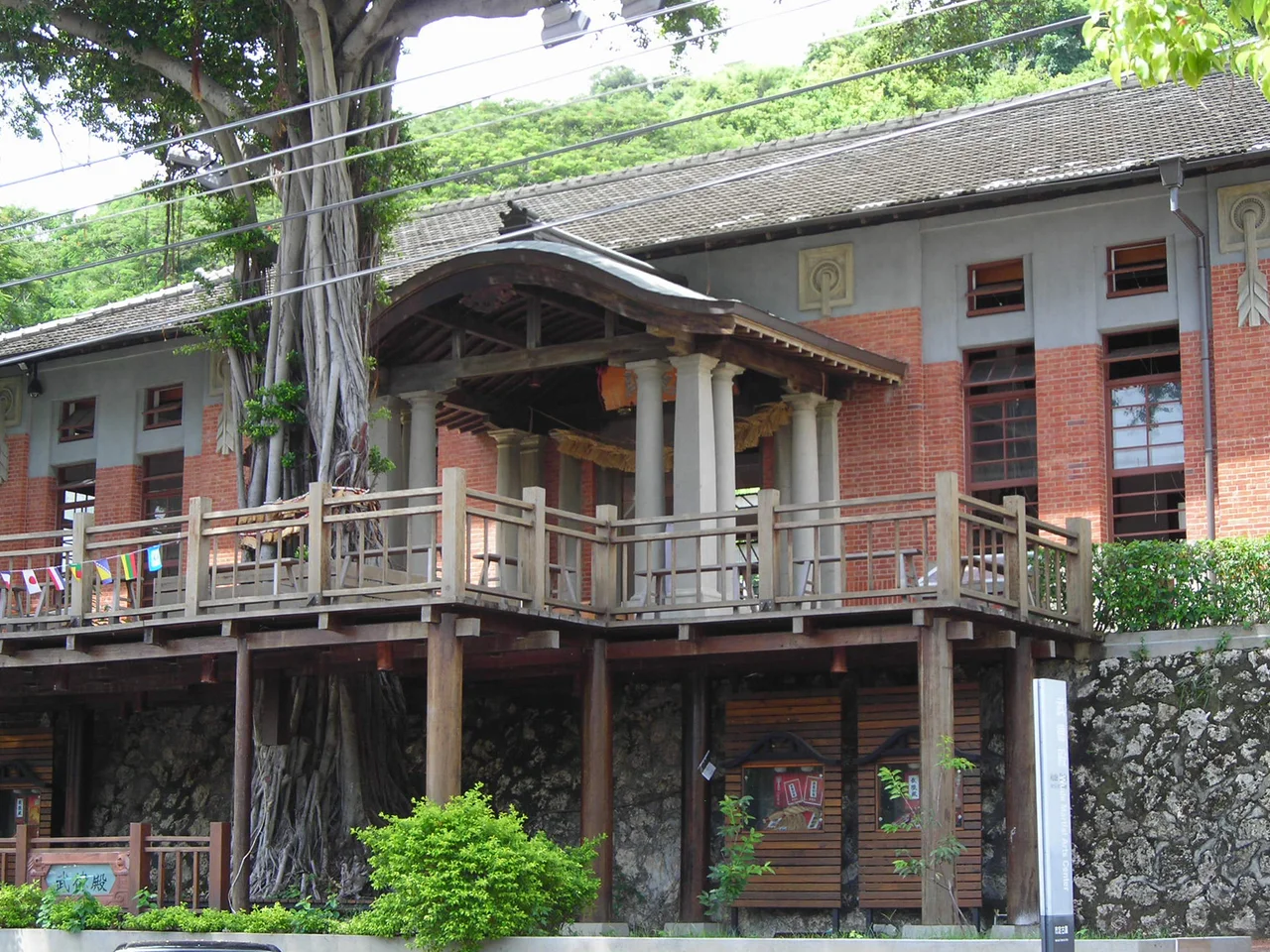
Kaohsiung Wude Hall
Somewhere in the Kaohsiung Wude Hall there is a display featuring Miyamoto Musashi — the legendary seventeenth-century swordsman whose life story has been told and retold so many times that separating the man from the myth is nearly impossible. His inclusion in a permanent exhibition at a 1924 Japanese-era martial-arts hall in a Taiwanese city feels both improbable and completely logical. Improbable because Musashi died more than 250 years before this building was constructed, and nothing about his life connects him to Taiwan. Logical because the Dai Nippon Butoku Kai — the organization that built halls like this one across Japan and its colonial territories — saw figures like Musashi as the living spirit of what they were transmitting. This building was never just a gymnasium. It was a statement about what martial practice meant.
The Organization Behind the Hall
The Dai Nippon Butoku Kai — the Greater Japan Martial Virtue Society — was founded in Kyoto in 1895, the same year the Treaty of Shimonoseki ceded Taiwan to Japan. The organization's membership was drawn heavily from the police, which mattered enormously for Taiwan: the Japanese colonial administration used the police as its primary instrument of social control on the island, and Wude martial arts culture traveled with the police system. Butoku-kai halls were built across Taiwan as training facilities and as expressions of Japanese institutional identity. The Kaohsiung hall, completed in 1924, was part of that network — a place where officers trained in kendo and judo, and where the values the organization associated with those disciplines were practiced and reinforced.
A Brick Building Through Two Administrations
The hall was completed in 1924 and survived Japan's defeat in 1945 intact. When Taiwan was handed over to the Republic of China, the building was turned over to the Kaohsiung Police Department — a handover that preserved the structure by giving it a new institutional purpose even as its original cultural context was severed. The police used it for decades. By 1999, the Civil Affairs Bureau of Kaohsiung City Government recognized the building's significance and designated it an ancient monument. A restoration project followed, completed in December 2004. The restoration was unusually swift: done within a year of the bureau's establishment. In April 2005, the Kaohsiung City Kendo Culture Advocacy Society took over management. The building became, that year, the first ancient monument in Taiwan to be revitalized for the same purpose for which it was originally designed.
The Architecture of Practice
The hall is a red-brick Japanese-designed building with a capacity of around 100 people — not large by contemporary standards, but built for the specific spatial requirements of martial practice rather than spectator crowds. The interior divides into two main areas: the kendo practice space to the east and the judo area to the west. These were not arbitrary divisions; kendo and judo were the two pillars of the Butoku-kai curriculum, associated with different qualities of body and mind. The brick construction, now more than a century old, gives the building a solidity appropriate to its purpose. Brick was a colonial architectural choice in Taiwan — more durable than wood in the subtropical humidity, and more visually authoritative than the lighter materials of traditional Taiwanese construction.
Exhibition and Living Practice
The permanent exhibition inside Wude Hall mixes the historical and the material in ways that reward close attention. A calligraphic board inscribed by Huang Hua-shan establishes the hall's scholarly dimension alongside its athletic one. Cases display authentic handmade Japanese swords — objects that carry extraordinary cultural weight — alongside wooden bokken and bokuto practice swords used in training. Taiko drums, a kamidana household shrine, and pieces of historic Japanese armor complete an environment that is as much cultural immersion as museum. Outside the exhibition, the hall continues to function: kendo, judo, sumo, and archery all take place here. The living practice and the historical display exist side by side, neither subordinated to the other, which gives the place an aliveness that purely museum-mode heritage sites sometimes lack.
Gushan District Setting
Wude Hall sits in Gushan District, one of Kaohsiung's older neighborhoods, within walking distance of Sizihwan Bay and the Kaohsiung MRT's Sizihwan Station. The district is also home to the Former British Consulate at Takao and Cijin Island's ferry landing — a cluster of nineteenth- and early twentieth-century history concentrated along the harbor's western edge. The Wude Hall fits naturally into that context: another layer of colonial-era building, another institution whose physical form outlasted the political order that created it. Coming to the hall from Sizihwan Station, walking through the narrow streets of the district, it is easy to feel the depth of time compressed into this part of Kaohsiung — how many different authorities have governed these same streets, and how differently the same buildings have been understood by each of them.
From the Air
Located at 22.62466°N, 120.2724°E in Gushan District, near the western harbor edge of Kaohsiung. From the air, the building is set in the dense older urban fabric of Gushan, close to the harbor channel and Cijin Island's ferry crossing. Sizihwan Bay is visible to the northwest, and the hilltop of Shoushan (Monkey Mountain) rises immediately to the northwest. The Former British Consulate at Takao is a nearby landmark. Kaohsiung International Airport (RCKH) lies approximately 7 nautical miles to the southeast. Recommended viewing altitude: 1,500–2,500 feet over the Gushan waterfront captures the building's neighborhood context and its proximity to the harbor and Shoushan hillside.
Nearby Stories
- Taimali 7.2 km away
- Meinong East Gate Tower 15 km away
- Kunci Temple 20 km away
- Checheng Fu'an Temple 42 km away
- Dongji Island 49 km away
- Orchid Island 69 km away
- South Penghu Marine National Park 77 km away
- Hong Kong 12 549 km away