.jpg)
Kents Cavern
In 1927, an excavator working through the upper sediment of a Devon limestone cave lifted out a fragment of an upper jawbone. It was clearly human. It was not clearly anything else. Catalogued as Kents Cavern 4, it sat at the Torquay Museum for decades as a curious old find. Then, in 2011, a team radiocarbon-dated the layers around it and concluded that the jaw was between 41,500 and 44,200 years old. If correct, the fragment was the oldest anatomically modern human fossil yet discovered in Britain and northwestern Europe. A small piece of bone, picked up from a poorly-recorded nineteenth-century dig, suddenly held the deepest English claim to the moment when our species first walked into this corner of the continent. Above it in the same cave, layer upon layer, were the bones of cave bears, the teeth of an extinct sabertooth, the tools of Neanderthals, and a slow accumulation of human visits that has not really stopped for half a million years.
How a Cave Becomes a Library
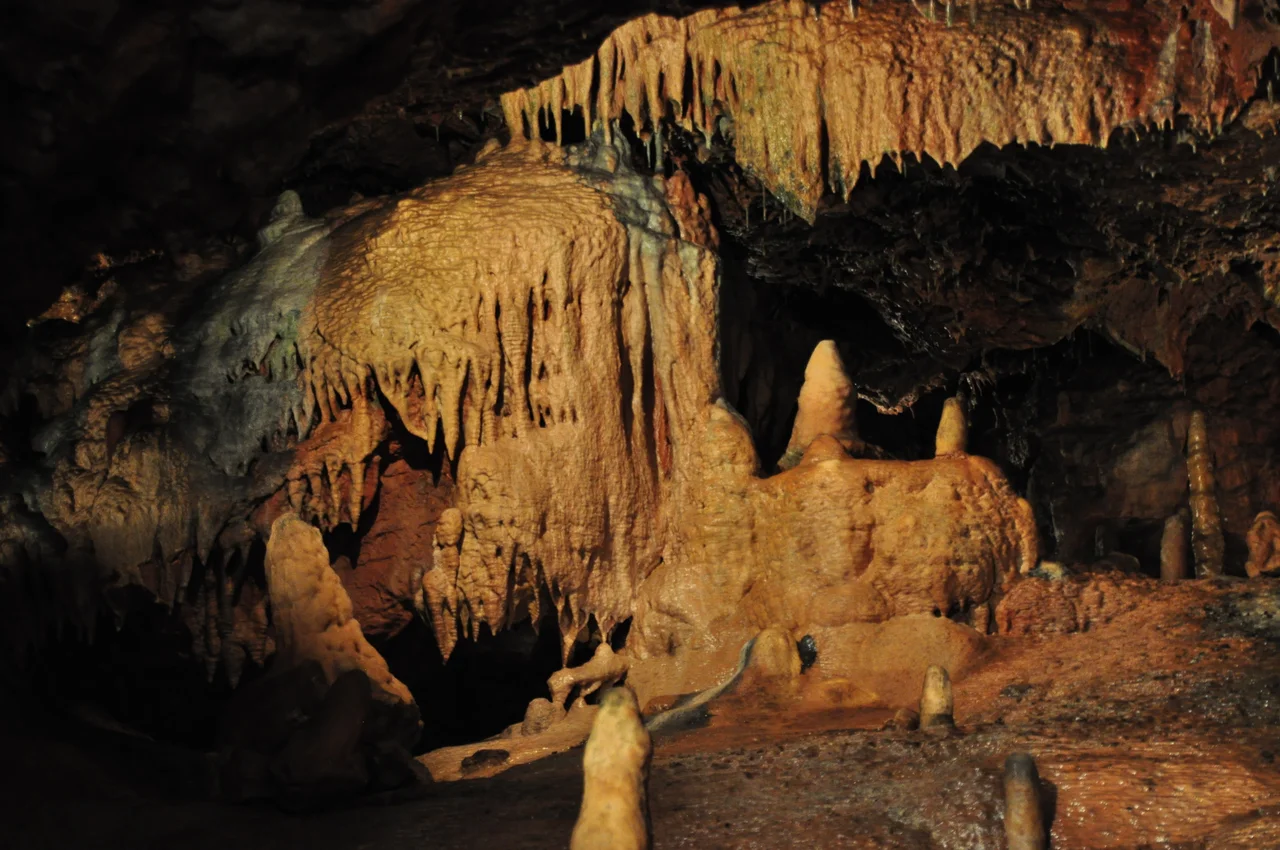
Kents Cavern formed in Devonian limestone, eroded by water rising through the rock during the Early Pleistocene, and then slowly filling, over the next two million years, with everything that fell or wandered in. The lowest layer, the Red Sands, was probably laid down by an ancient river around 800,000 years ago. Above it sits the Breccia, a chaotic mix of red mud, slate, and broken cave fragments that piled up during the Anglian Glaciation roughly 478,000 to 424,000 years ago. Above that are sheets of flowstone, the slow-built calcite skin that drips down through millennia. The earliest flowstone formed during MIS 11, about 400,000 years ago. A major pulse of calcite came down during MIS 9, 300,000 years ago. Above the flowstone is the Cave Earth, a mixture of mud, sand, and rock fragments, and within it the Black Band, a thin lens dark with charcoal and full of human artifacts. The cave is not a single moment. It is a layered manuscript, and the calcite is still being written today.
Cave Bears and a Sabertooth's Tooth
During MIS 11, around 400,000 years ago, cave bears used Kents Cavern as a hibernation den. They died in their sleep, or in fights, or of age, and their bones accumulated in the Breccia. Excavations found remains of the transitional bear species between archaic Ursus deningeri and the later Ursus spelaeus, alongside bones of the massive extinct lion Panthera fossilis, ancient water voles, tundra voles, and wolves. Some of the vole fossils may date back to MIS 13, 500,000 years ago, which means the cave's mammalian record stretches deeper than most British sites. In 1826 the local geologist John MacEnery collected something stranger: a pair of canine teeth from the sabertooth cat Homotherium latidens. Richard Owen formally described them in 1846. Modern isotopic analysis suggests the teeth were not native to the cave. They were probably carried in by Palaeolithic humans from somewhere on the European mainland, perhaps as trade goods or curiosities. Forty thousand years before us, someone was already keeping a sabertooth's tooth as a treasure.
Neanderthals, Modern Humans, and Pengelly's Notes
The cave was occupied, on and off, by Neanderthals during the late Middle Palaeolithic, around 60,000 to 40,000 years ago. Their Mousterian tools, mostly lost in the nineteenth-century digs, included bifaces, scrapers, and two Levallois flakes. The traces are not a record of long settlement but of brief visits, with most artifacts probably carried in already finished. The jawbone fragment, Kents Cavern 4, sits at the very transition between Neanderthal and modern human Europe. The earliest known human inscriptions on the stalagmites date much later, to William Petre in 1571 and Robert Hedges in 1688. The first systematic excavator was Father John MacEnery, the Roman Catholic chaplain at Torre Abbey, who worked the cave between 1824 and 1829. Between 1846 and 1858, Edward Vivian and the geologist William Pengelly took over. Pengelly was the rarest kind of nineteenth-century excavator: he plotted the exact position of every bone, every flint, every fragment. In the autumn of 1859 his work, alongside finds at Brixham Cavern and in France, helped persuade the Royal Society and the Society of Antiquaries that humanity was very much older than the few thousand years biblical chronology had allowed. Pengelly kept digging at Kents Cavern until his death in 1894, in a house less than two kilometres away.
The Carpenter Who Bought a Cave
In 1903 the cave passed out of Lord Haldon's estate and into the hands of Francis Powe, a Torquay carpenter who needed somewhere to build beach huts. He used the cavern as a workshop. The Powe family still owns it. On 23 August 2003 they celebrated a century of ownership with an archaeology dig for children and a display by a cave rescue team, and the following year they opened a new visitor centre with a restaurant and gift shop, built at a cost of around half a million pounds. The cave became a Site of Special Scientific Interest in 1952 and a Scheduled Ancient Monument in 1957. Visitors today walk paths that pass directly over the layers that contained the cave bears and the jawbone and the sabertooth's tooth. Agatha Christie, who grew up in nearby Torquay, based the Hampsley Cavern in her 1924 novel The Man in the Brown Suit on this place. She knew what every visitor learns. Some caves are simply holes in rock. Kents Cavern is a slow library, and the reading has been going on for two hundred years.
From the Air
Kents Cavern is at 50.4682N, 3.503W on the eastern edge of Torquay, just inland from Anstey's Cove. From 2,000 to 4,000 feet the wooded ridge of Lincomb Hill above the cave is visible, with Torquay harbour to the south and the curving coast of Babbacombe Bay to the north. Exeter Airport (EGTE) lies about 18 nautical miles to the north, the natural arrival point. Look for the cluster of hotels along the Torquay seafront, Anstey's Cove and Hope's Nose just east of the cave, and Berry Head lighthouse across Tor Bay to the south.
Nearby Stories
- Childe's Tomb 5.7 km away
- Coldharbour Mill Working Wool Museum 11 km away
- Montacute Castle 18 km away
- Action of 18 June 1793 18 km away
- Portland Bill 25 km away
- Eddystone Lighthouse 30 km away
- Manor of Orleigh 33 km away
- German Submarine U-672 33 km away