
Candi Kidal: The Temple That Inspired a Nation's Emblem
Three stone panels on a temple wall tell the story of a son who would do anything to free his mother. Carved into the base of Candi Kidal, a slender Hindu shrine rising from rice paddies southeast of Malang, the reliefs depict the mythical bird-deity Garuda battling serpents, carrying the sacred water of eternal life, and finally lifting his mother from bondage. Seven centuries after an anonymous artisan chiseled those scenes, President Soekarno studied them and decided that this Garuda -- fierce, devoted, unyielding -- should represent the entire Indonesian nation. The temple that King Anusapati's court built as a funerary monument in 1248 had, without intending it, given a country its symbol.
A Son's Debt in Stone
The Garudeya reliefs wrap around Candi Kidal's base in three panels, each advancing a single narrative. In the first, Garuda carries three giant serpents on his back -- the children of Kadru, whose treachery had condemned Garuda's mother Winata to slavery. The myth turns on a wager: Kadru bet Winata that the divine horse Uraiswara was black, not white. When Kadru's serpent children poisoned the horse with venom to darken its coat, Winata lost the bet and her freedom. The second panel shows Garuda balancing a jar of tirta amerta -- the water of immortality -- on his head, the ransom Kadru demanded. The final panel depicts the liberation itself: Garuda lifting a woman skyward, his mother free at last. Experts regard these three carvings as one of the most complete mythological narratives on any Hindu-Shaiva temple in Indonesia.
The King Who Built It
Anusapati, the second king of the Singhasari dynasty, ruled for roughly two decades before his death around 1248. His story is inseparable from the bloody founding of the kingdom itself. His stepfather Ken Arok had seized power by assassinating Tunggul Ametung with a cursed keris forged by the smith Mpu Gandring, then married Anusapati's mother, the legendary Ken Dedes. That keris carried a dying curse: it would kill Ken Arok and seven generations of his descendants. When Anusapati eventually used the same dagger to avenge his biological father, the curse continued its work through the dynasty. Candi Kidal was built as Anusapati's mortuary shrine -- a place where his spirit could be venerated through an image of Shiva bearing the king's likeness. The choice to decorate it with Garuda's rescue of his enslaved mother reads as a pointed tribute: Anusapati honoring Ken Dedes, the woman whose contested beauty had set the kingdom's violent history in motion.
East Javanese Architecture in Miniature
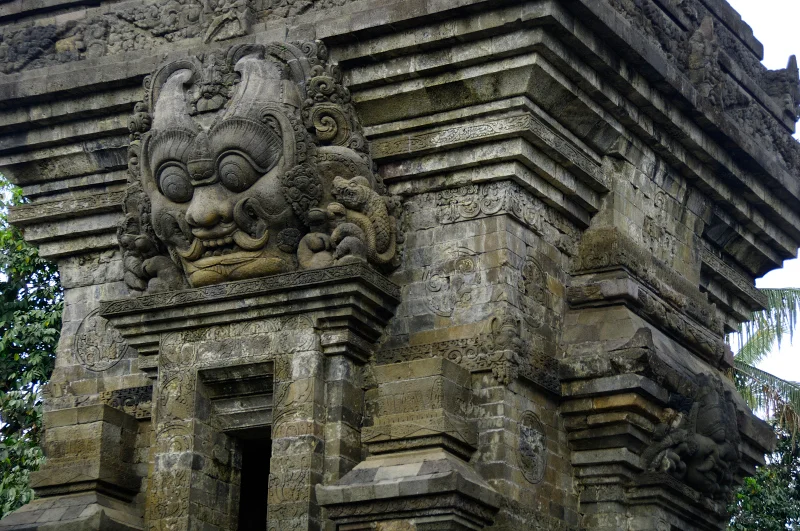
Standing roughly 12 meters tall on a square base measuring 8.36 meters per side, Candi Kidal is modest by the standards of Javanese temple building. It originally reached 17 meters before its upper tiers crumbled. But what it lacks in scale it compensates in detail. The temple marks the emergence of a distinct East Javanese architectural style: a large, high base supporting a body that leans slightly backward, giving the structure an impression of alert tension rather than passive mass. The entrance is guarded by a full-faced Kala -- a fanged time deity -- flanked by two hands with index and middle fingers raised in a gesture that is half benediction, half warning. Makaras, mythical sea creatures, frame the lintel below. The temple sits in Rejokidal village in the Tumpang district, surrounded by wet-rice fields with the slopes of Mount Arjuno visible to the north. It was restored in the 1990s, though its stone has weathered to a dark volcanic gray that makes the relief carvings harder to read with each passing decade.
From Sacred Ruin to National Symbol
When Indonesia's founders debated the design of a national emblem in the late 1940s, they turned to Candi Kidal. President Soekarno saw in the Garudeya reliefs a philosophy that matched his vision for the new republic: sacrifice, devotion, and the willingness to fight for freedom. The Garuda Pancasila -- the eagle-like figure clutching a shield and a banner reading "Bhinneka Tunggal Ika" (Unity in Diversity) -- draws its conceptual lineage from these 13th-century carvings. Today the temple receives far fewer visitors than the grander Singhasari monuments nearby. The village of Rejokidal is quiet, the approach road narrow. But for those who make the detour, the connection between a medieval funerary shrine and the emblem stamped on every Indonesian passport is startling in its directness. A son freed his mother. A nation adopted the story as its own.
From the Air
Candi Kidal (8.03S, 112.71E) sits in the Tumpang district roughly 20 km east of Malang. The nearest airport is Abdul Rachman Saleh Airport (WARA/MLG), approximately 15 km to the northwest. The temple is in a low-lying agricultural area surrounded by rice paddies, with Mount Arjuno visible to the north. Recommended viewing altitude: 3,000-5,000 feet for context of the temple's position relative to the surrounding volcanic landscape and the Malang basin.
Nearby Stories
- Jawi Temple 8.1 km away
- The Kedopok War: When Probolinggo Rose Against Its Buyer 24 km away
- Shaken Foundations: The 2021 East Java Earthquake 38 km away
- The Train Builders of Madiun 70 km away
- Meru Betiri: The Last Forest on Java's Southern Edge 70 km away
- The School That Gave Itself Away 72 km away
- Madura: Salt, Bulls, and the Island That Emptied Itself 78 km away
- The Ghost Boat That Built an Empire 361 km away