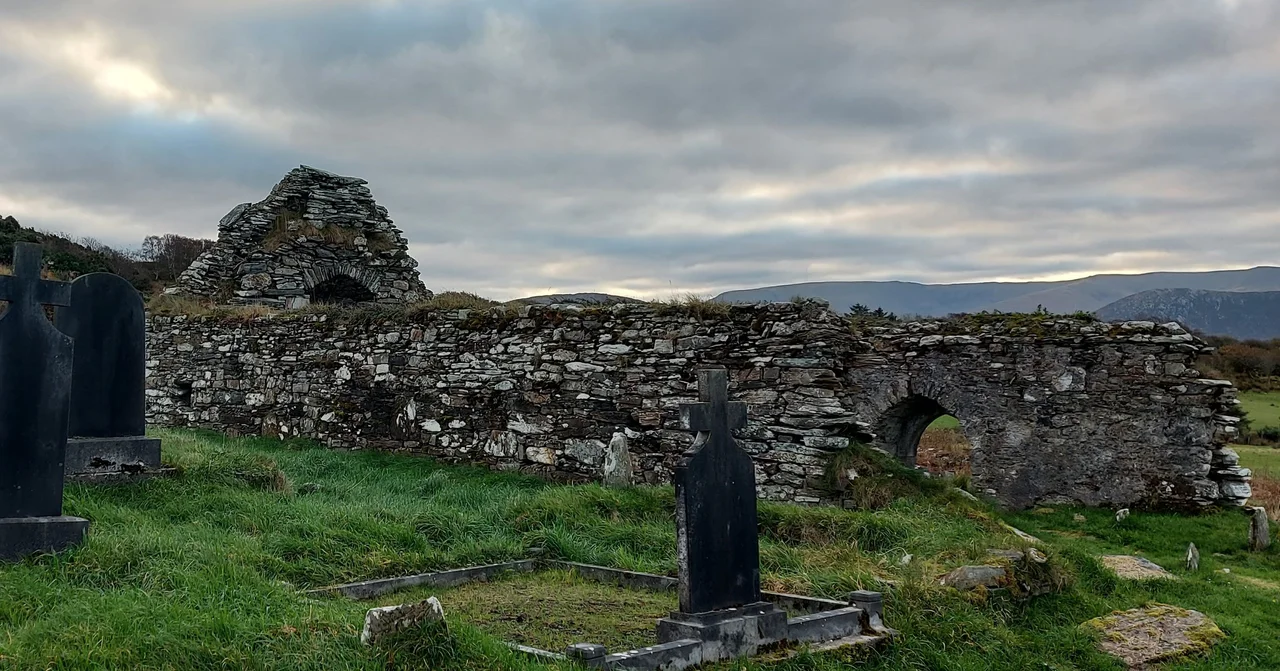

Kilgeever Abbey
Pilgrims arriving at Kilgeever still do something their predecessors did centuries ago: they cut a cross into rock. The marks accumulate on a stone beside the holy well, layer upon layer of small incisions, each one made by a hand reaching down with whatever sharp implement was available. The ritual is not symbolic in any abstract sense. It is the act itself. The well sits beside a ruined medieval church a short walk outside Louisburgh, on the southwest corner of Clew Bay, and the pattern, an annual gathering of pilgrims, has been held here on 15 August for as long as local memory reaches.
The Church of Many Centuries
The church at Kilgeever is what archaeologists call a multi-period building, meaning successive generations modified and added to it without ever quite finishing or replacing it. It was constructed on the site of an earlier church associated with the followers of Saint Patrick. The surviving east wall holds a round-headed window typical of twelfth-century Irish Romanesque architecture. A later medieval doorway, added in the fifteenth century, has a pock-dressed Gothic arch and a drawbar slot for locking. The structure measures 16.6 metres east-to-west by 5.1 metres north-to-south, modest in scale but rich in chronological layers. Only the foundations of the western gable now remain. Inside, in a niche called an aumbry at the east end, votive offerings have been found, evidence that the building's sacred function continued long after its roof failed.
The Holy Well and the Pattern
The holy well at Kilgeever bears the name Toberrendoney, an anglicised form of the Irish Tober Ri an Dhomhnaig. Every year on 15 August, the feast of the Assumption, pilgrims gather here to perform the pattern, the local devotional ritual. Historically the Kilgeever pattern was not a standalone event but part of a larger circuit that took pilgrims onward to Croagh Patrick and across to Caher Island, linking three of west Mayo's most important sacred sites. The site is also visited on Reek Sunday, the last Sunday in July, when as many as 40,000 climb the holy mountain. Pilgrims at Kilgeever incise crosses into a designated rock as part of the devotional sequence. A cross is also incised on the nineteenth-century headstone of the MacEvilly family grave, and before leaving the site, tradition calls for prayers for one Henry Murphy, who had a cross erected over the well.
Patrick and the Windy Church
The Irish name of the site is Cill Chaobhair, and local scholars have offered several translations: the Near Church, the Windy Church, or St. Iomhair's Church. The third option is complicated by the fact that no St. Iomhair appears in O Riain's authoritative Dictionary of Irish Saints. Local legend tells a different origin story. Saint Patrick, having completed his forty-day fast on Croagh Patrick, visited Kilgeever and decided a church should be built there. He assigned the work to one of his followers, the elusive Iomhair. Whether Iomhair was a real person, a half-remembered name, or pure folklore, the site preserves the connection to Patrick that gives it its standing in the regional pilgrimage network.
Stones That Remember
The graveyard at Kilgeever may be even older than the church beside it. Burials are believed to date back to Early Christian times, and the ground continues to receive new graves today. Within the graveyard stands a pillar stone incised with a cross terminating in dovetail forms, a Medieval Pillar Stone now recognised as nationally significant. A free-standing stone and a portable stone cross with incised crosses were also recorded here, though those have passed into private ownership. In 2021, Kilgeever Abbey received more than 10,000 euros from the Irish Community Monument Fund, money directed at protection, conservation, and maintenance of monuments and historic sites. The structures are now recorded by the National Monument Service and scheduled to be included in the next revision of the Records of Monuments and Places, formal recognition of what the pilgrims have known all along.
From the Air
Coordinates: 53.7612 N, 9.7672 W. Kilgeever Abbey sits in farmland about 1 km east of Louisburgh on the southwest corner of Clew Bay, with Croagh Patrick clearly visible to the east. From the air, the ruined church is small but identifiable by its rectangular footprint and the surrounding graveyard. Nearest airports: Ireland West Knock (EIKN) about 55 km east, Galway (EICM, GA only) about 85 km southeast. Recommended viewing altitude 2,500 to 4,000 ft. Clew Bay's irregular shoreline and Croagh Patrick's pyramid make this an unmistakable visual context.
Nearby Stories
- Annaghdown 6.9 km away
- Claremorris 9.4 km away
- Inishbofin Island 9.9 km away
- Attymass 10 km away
- Ballycroy 11 km away
- Toombeola 13 km away
- Blackrock Island, County Mayo 14 km away
- RMS Carinthia (1925) 40 km away