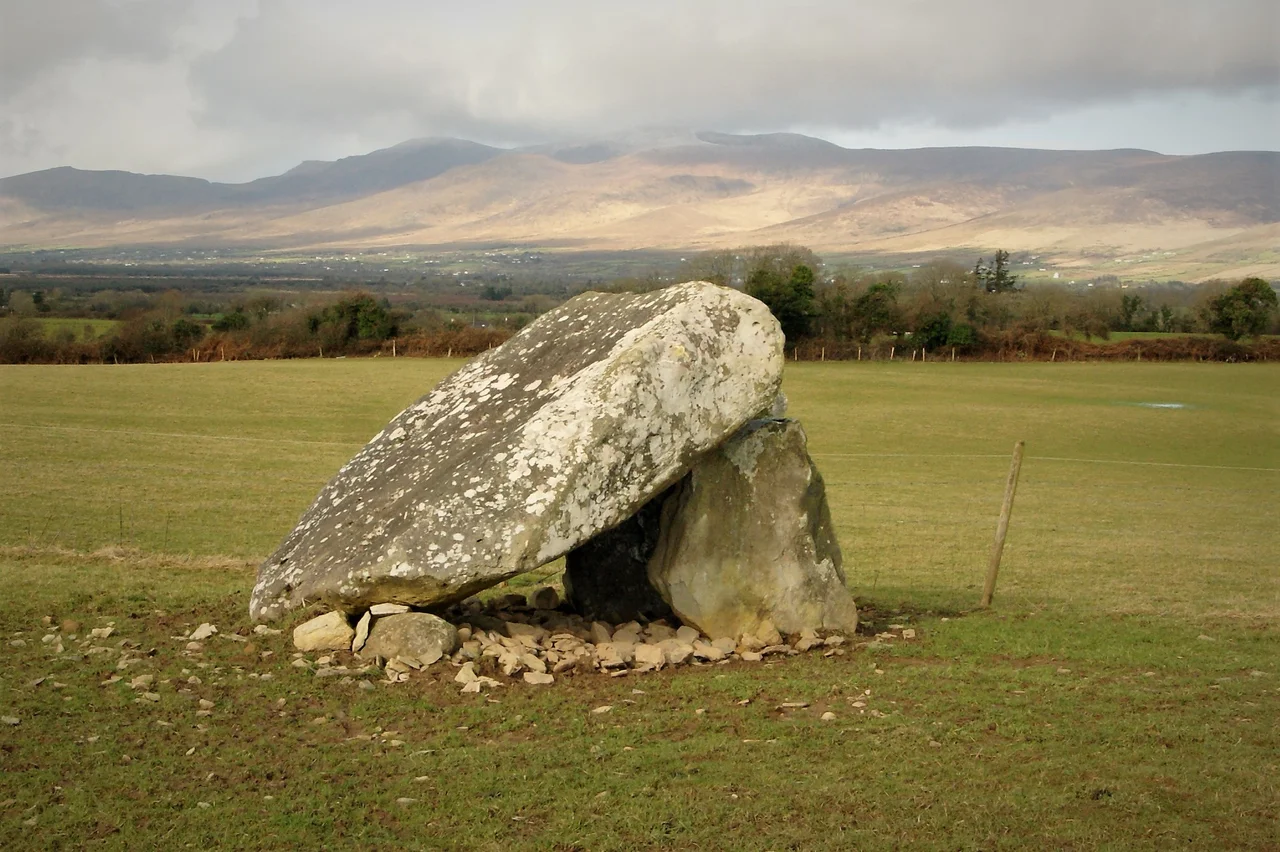

Killaclohane Portal Tomb
The capstone weighs 13.5 tonnes. Two portal stones at the front, all three of them green sandstone, all three of them glacial erratics - boulders carried into Kerry by ice sheets, dropped here when the ice melted, then chosen by Neolithic builders to mark a place of burial. The tomb was raised around 3800 BC. By 2015 it was on the verge of collapse, its supports failing under the slow weight of nearly six thousand years. A team led by Kerry County Archaeologist Dr Michael Connolly excavated, stabilised, and restored it. What they found in the burial chamber rewrote what was known about the start of agriculture in Kerry.
The Oldest Thing People Built in Kerry
Killaclohane Portal Tomb is the oldest known man-made structure in County Kerry and the earliest identified burial monument in the county. It dates to around 3800 BC - that is, before the construction of the Egyptian pyramids, before the invention of writing in any culture, before most of the things people associate with deep antiquity. The dolmen sits in the townland of Killaclohane, about two kilometres east of Milltown. The name itself is an anglicisation of Cill an Chlochain - cill meaning either 'wood' or 'church', clochain meaning stepping-stones, causeway, or old stone structure. The Irish original is uncertain enough that another translation is possible: 'Church of the strong ford'. Two readings of the place name, each older than the village that carries it.
Engineering With Glacial Boulders
The portal tomb's design is at once simple and remarkable. Two tall portal stones at the front face north, framing the entrance to the burial chamber. The single massive capstone rests on top, held in place by the portal stones and the angle of the chamber walls. All three principal stones are green sandstone, all three are glacial erratics, meaning they were carried into Kerry by the last ice age and abandoned by the retreating ice. The Neolithic builders did not quarry these stones from a hillside. They found them where the ice had left them, scattered across the landscape, and selected the ones whose shape and size would serve the design. The burial chamber faces north - oriented toward the entrance to Scotia's Glen at the Slieve Mish Mountains. The orientation is not random. Neolithic builders aligned their tombs to mountains, sunrises, or other features in their landscape. Whatever Scotia's Glen meant to the people who built Killaclohane, the tomb still points at it.
Three Burial Phases
The 2015 excavation produced evidence of three distinct burial phases inside the tomb. The earliest material was early Neolithic carinated bowl pottery - the oldest pottery type known in Ireland - dating to around 3700 BC. This first phase came almost immediately after the tomb was built, with cremated remains accompanying the pottery. A second phase, around 3500 BC, contained flint artefacts including a knife, three arrowheads, and a hollow scraper. The third phase, around 3400 BC, is marked by pottery sherds. Then a long pause. Around 2400 BC, in the early Bronze Age, the tomb was reopened and two more cremation burials were added. That gap matters. The community using the tomb in 3700 BC was not the same community using it in 2400 BC - thirteen centuries separate them. And yet the tomb retained its meaning across that span. People kept finding it. People kept choosing to be buried in it.
What the Tomb Tells Us
Before the 2015 excavation, very little was known about Neolithic settlement in Kerry or the beginning of agriculture in the county. The early Neolithic in Ireland is when farming arrives - when communities stop relying entirely on hunting and gathering and begin clearing land, planting crops, herding animals. The pottery, the flint tools, the careful engineering of the tomb itself: each tells part of the story of how that transition happened in southwest Ireland. The cremated bone fragments, dated by radiocarbon, push the timeline back. The arrowheads of the second phase show a community still hunting, still working stone with sophisticated technique. The fact of cremation - not earth burial, but the deliberate burning of the dead - is itself revealing. It required time, fuel, and ritual knowledge. The people of Killaclohane took those things seriously. They built something with a 13.5-tonne capstone to hold what was left.
From the Air
Located at 52.15 N, 9.69 W, in the townland of Killaclohane about 2 km east of Milltown, County Kerry. The tomb sits in low rolling country between the Slieve Mish Mountains to the north and the Kerry interior to the south. Nearest airport: Kerry (EIKY) at Farranfore, about 8 km north. The tomb is a small target from the air but can be identified by its three large green-sandstone stones and the modest enclosure surrounding it. Best viewed at low altitude in clear conditions.
Nearby Stories
- Emlagh East Ogham Stone 2 km away
- Carrignacurra Castle 2.6 km away
- Uragh Stone Circle 5.2 km away
- Ballinskelligs 6.2 km away
- Eurovision Song Contest 1993 8.2 km away
- Newcastle West 9.6 km away
- Ballyheigue Castle 11 km away
- RMS Carinthia (1925) 98 km away